


Effects of Flibanserin on Subdomain Scores of the Female Sexual Function Index in Women With Hypoactive Sexual Desire Disorder
- PMID: 36400683
- PMCID: PMC9780775
- DOI: 10.1016/j.esxm.2022.100570
Effects of Flibanserin on Subdomain Scores of the Female Sexual Function Index in Women With Hypoactive Sexual Desire Disorder
Abstract
Introduction: Flibanserin treatment increases sexual desire and satisfying sexual events while decreasing distress in certain women diagnosed with acquired, generalized hypoactive sexual desire disorder (HSDD). Additional aspects of sexual function and the time course of response have not been fully characterized.
Aim: To evaluate changes in sexual function assessed by the subdomains of the Female Sexual Function Index (FSFI) in women with HSDD treated with flibanserin.
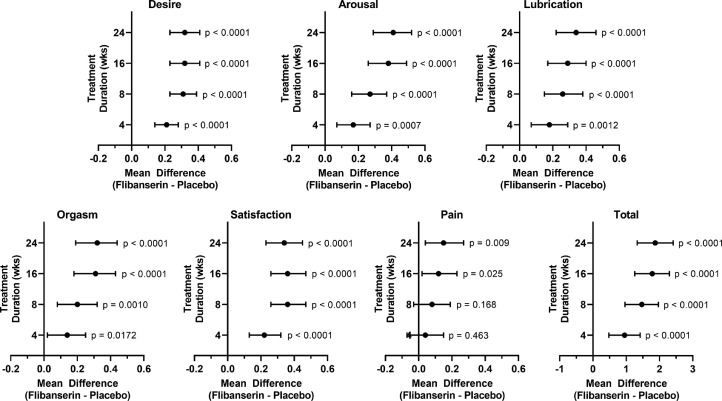
Methods: FSFI data pooled from 3 pivotal flibanserin trials in premenopausal women (flibanserin = 1,165; placebo = 1,203) and FSFI data from one complete flibanserin trial in postmenopausal women (flibanserin = 432; placebo = 463) were subjected to post-hoc analyses. For each FSFI subdomain, least squares mean change from baseline was calculated at each assessment visit (treatment weeks 4, 8, 16, 24) and treatment groups were compared using analysis of covariance. Standardized effect size (Cohen's d) was also determined for each FSFI subdomain.
Main outcome measure: Changes from baseline in FSFI subdomains.
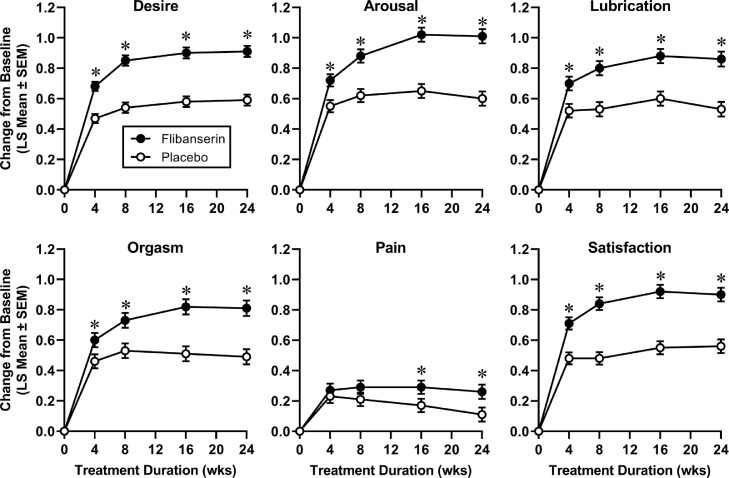
Results: Compared to placebo, both premenopausal (P < .02) and postmenopausal (P < .045) patients in the flibanserin group reported significantly greater increases over baseline in the FSFI subdomain scores of desire, arousal, lubrication, orgasm, and satisfaction. In premenopausal patients, significant improvements were observed at the first assessment of response (week 4) and were maintained through week 24. In postmenopausal patients, significant improvements were observed at week 4 for desire and arousal, while significant improvements in lubrication, orgasm, and satisfaction were observed at week 8. At week 24, excluding the pain subdomain, standardized effect sizes ranged from 0.18 to 0.28 in the premenopausal cohort and 0.12 to 0.29 in the postmenopausal cohort. In both pre- and postmenopausal patients, improvements in pain were smaller and largely undifferentiated between treatment groups.
Clinical implications: While variations in time to response should be taken into consideration, on average, the beneficial impact of flibanserin on overall sexual function occurs within the first month of treatment. The data also suggest that the response to flibanserin is sustained for the duration of treatment.
Strengths and limitations: Sexual function assessments were performed in a large cohort of 2,368 premenopausal women and 895 postmenopausal women. However, the FSFI assesses changes over a 1-month period and time points earlier than 4 weeks could not be assessed.
Conclusion: These analyses suggest that assessment of benefit of flibanserin in HSDD should include improvements across all domains of sexual function, not only desire. Simon JA, Clayton AH, Goldstein I, et al. Effects of Flibanserin on Subdomain Scores of the Female Sexual Function Index in Women With Hypoactive Sexual Desire Disorder. Sex Med 2022;10:100570.
Keywords: Effect Size; Female Sexual Function Index Scores; Flibanserin; Hypoactive Sexual Desire Disorder.
Copyright © 2022 International Society for Sexual Medicine. Published by Elsevier Inc. All rights reserved.
Figures


References
-
- Graziottin A. Prevalence and evaluation of sexual health problems–HSDD in Europe. J Sex Med. 2007;4(Suppl 3):211–219. - PubMed
-
- Hayes RD, Dennerstein L, Bennett CM, et al. Relationship between hypoactive sexual desire disorder and aging. Fertil Steril. 2007;87:107–112. - PubMed
-
- Kingsberg SA. Attitudinal survey of women living with low sexual desire. J Womens Health (Larchmt) 2014;23:817–823. - PubMed
-
- Foley K, Foley D, Johnson BH. Healthcare resource utilization and expenditures of women diagnosed with hypoactive sexual desire disorder. J Med Econ. 2010;13:583–590. - PubMed
-
- Biddle AK, West SL, D'Aloisio AA, et al. Hypoactive sexual desire disorder in postmenopausal women: quality of life and health burden. Value Health. 2009;12:763–772. - PubMed
LinkOut - more resources
Full Text Sources
Other Literature Sources
