


Use of antibiotics and risk of type 2 diabetes, overweight and obesity: the Cardiovascular Risk in Young Finns Study and the national FINRISK study
- PMID: 36401251
- PMCID: PMC9673285
- DOI: 10.1186/s12902-022-01197-y
Use of antibiotics and risk of type 2 diabetes, overweight and obesity: the Cardiovascular Risk in Young Finns Study and the national FINRISK study
Abstract
Purpose: To investigate whether exposure to systemic antibiotics influences the risk of developing type 2 diabetes and overweight/obesity.
Methods: The study sample comprised 2209 (110 with incident diabetes) participants from the population-based Cardiovascular Risk in Young Finns Study (YFS) aged 24-39 years in 2001. The exposure was national linked register data on purchased antibiotic courses between 1993 and 2001. Clinical examinations including BMI were conducted in 2001, 2007 and 2011. Participants with prevalent diabetes in 2001 were excluded. Data on type 2 diabetes was also obtained from two national registers until 2017. Data from four population-based National FINRISK studies were used for replication (N = 24,674, 1866 with incident diabetes).
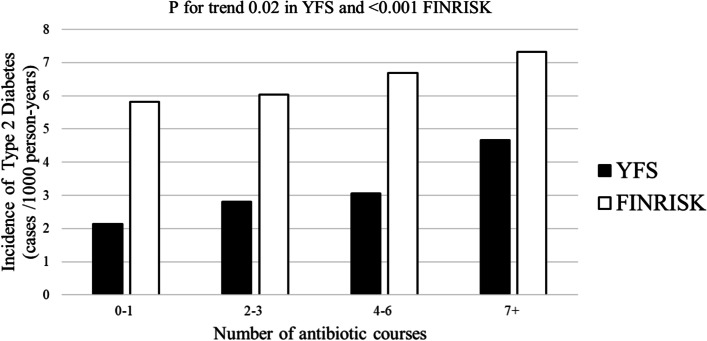
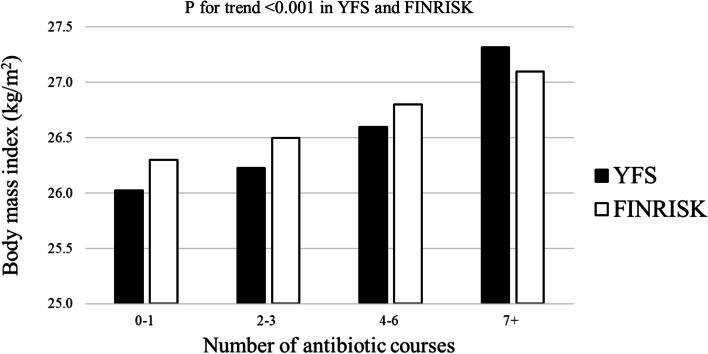
Results: Prior antibiotic exposure (> 5 versus 0-1 antibiotic courses) was associated with subsequent type 2 diabetes in both YFS (OR 2.29; 95%CI 1.33-3.96) and FINRISK (HR 1.73; 95%CI 1.51-1.99). An increased risk for type 2 diabetes was observed in YFS (OR 1.043; 95%CI 1.013-1.074) and FINRISK (HR 1.022; 95%CI 1.016-1.029) per course. Exposure to antibiotics increased the risk of overweight/obesity (BMI > 25 kg/m2) after a 10-year follow-up in YFS (OR 1.043; 95%CI 1.019-1.068) and in FINRISK (OR 1.023; 95%CI 1.018-1.029) at baseline per antibiotic course. Adjustments for confounders from early life in YFS and at baseline in FINRISK, including BMI, socioeconomic status, smoking, insulin, blood pressure, and physical activity, did not appreciably alter the findings.
Conclusion: Our results show that exposure to antibiotics was associated with increased risk for future type 2 diabetes and overweight/obesity and support judicious antibiotic prescribing.
Keywords: Antibiotics; Obesity; Type 2 diabetes.
© 2022. The Author(s).
Conflict of interest statement
None. VS has consulted for Novo Nordisk and Sanofi and received honoraria from these companies. He also has ongoing research collaboration with Bayer Ag. (All unrelated to the present study).
Figures
Similar articles
-
Childhood exposure to parental smoking and life-course overweight and central obesity.Ann Med. 2021 Dec;53(1):208-216. doi: 10.1080/07853890.2020.1853215. Ann Med. 2021. PMID: 33305629 Free PMC article.
-
Risk of cardiovascular disease and mortality in overweight and obese patients with type 2 diabetes: an observational study in 13,087 patients.Diabetologia. 2009 Jan;52(1):65-73. doi: 10.1007/s00125-008-1190-x. Epub 2008 Nov 5. Diabetologia. 2009. PMID: 18985314
-
Youth overweight and metabolic disturbances in predicting carotid intima-media thickness, type 2 diabetes, and metabolic syndrome in adulthood: the Cardiovascular Risk in Young Finns study.Diabetes Care. 2014 Jul;37(7):1870-7. doi: 10.2337/dc14-0008. Epub 2014 Apr 17. Diabetes Care. 2014. PMID: 24742659
-
The Effect of Liquid Meal Replacements on Cardiometabolic Risk Factors in Overweight/Obese Individuals With Type 2 Diabetes: A Systematic Review and Meta-analysis of Randomized Controlled Trials.Diabetes Care. 2019 May;42(5):767-776. doi: 10.2337/dc18-2270. Epub 2019 Mar 28. Diabetes Care. 2019. PMID: 30923163
-
Dose-response association of early-life antibiotic exposure and subsequent overweight or obesity in children: A meta-analysis of prospective studies.Obes Rev. 2021 Nov;22(11):e13321. doi: 10.1111/obr.13321. Epub 2021 Jul 29. Obes Rev. 2021. PMID: 34328260 Review.
Cited by
-
Long-Term or Recurrent Antibiotic Use in Early Life and the Risk of Type 2 Diabetes: A Population-Based Prospective Cohort and a Case-Control Study.J Diabetes. 2025 Jun;17(6):e70113. doi: 10.1111/1753-0407.70113. J Diabetes. 2025. PMID: 40533417 Free PMC article.
-
Exposure to antibiotics and risk of latent autoimmune diabetes in adults and type 2 diabetes: results from a Swedish case-control study (ESTRID) and the Norwegian HUNT study.Diabetologia. 2025 Jan;68(1):69-81. doi: 10.1007/s00125-024-06302-5. Epub 2024 Oct 28. Diabetologia. 2025. PMID: 39467872 Free PMC article.
-
Exploring the causal genetic relationship between 41 inflammatory cytokines and osteoporosis: a bidirectional Mendelian randomization analysis.SAGE Open Med. 2025 Jul 29;13:20503121251360176. doi: 10.1177/20503121251360176. eCollection 2025. SAGE Open Med. 2025. PMID: 40756619 Free PMC article.
-
Is There Evidence to Support Probiotic Use for Healthy People?Adv Nutr. 2024 Aug;15(8):100265. doi: 10.1016/j.advnut.2024.100265. Epub 2024 Jul 6. Adv Nutr. 2024. PMID: 38977065 Free PMC article. Review.
-
Triclosan promotes neurotoxicity in diabetic conditions: an in vivo molecular assessment using zebrafish model.3 Biotech. 2025 Jun;15(6):169. doi: 10.1007/s13205-025-04352-z. Epub 2025 May 15. 3 Biotech. 2025. PMID: 40386628
References
-
- Abarca-Gómez L, Abdeen ZA, Hamid ZA, et al. Worldwide trends in body-mass index, underweight, overweight, and obesity from 1975 to 2016: a pooled analysis of 2416 population-based measurement studies in 128·9 million children, adolescents, and adults. Lancet. 2017;390(10113):2627–2642. doi: 10.1016/S0140-6736(17)32129-3. - DOI - PMC - PubMed
MeSH terms
Substances
LinkOut - more resources
Full Text Sources
Medical
