Observational Study
. 2022 Nov 19;23(1):145.
doi: 10.1186/s10194-022-01520-x.

Microvascular decompression in trigeminal neuralgia - a prospective study of 115 patients

Affiliations
Observational Study

Microvascular decompression in trigeminal neuralgia - a prospective study of 115 patients

Anne Sofie Schott Andersen et al. J Headache Pain. .

Abstract

Background: Trigeminal neuralgia is a severe facial pain disorder. Microvascular decompression is first choice surgical treatment of patients with classical TN. There exist few prospective studies with an independent evaluation of efficacy and complications after MVD.

Objectives: We aimed to assess outcome and complications after microvascular decompression from our center.

Methods: We prospectively recorded clinical characteristics, outcome, and complications from consecutive patients with either classical or idiopathic (only patients with a neurovascular contact) trigeminal neuralgia undergoing microvascular decompression. Neurovascular contact was evaluated by 3.0 Tesla MRI. Patients were assessed before and 3, 6, 12, and 24 months after surgery by independent assessors.

Results: Of 115 included patients, 86% had a clinically significant outcome (i.e., BNI I - BNI IIIb). There was a significant association between an excellent surgical outcome and the male sex (OR 4.9 (CI 1.9-12.8), p = 0.001) and neurovascular contact with morphological changes (OR 2.5 (CI 1.1-6.0), p = 0.036). Significantly more women (12/62 = 19%) than men (2/53 = 4%) had a failed outcome, p = 0.019. The most frequent major complications were permanent hearing impairment (10%), permanent severe hypoesthesia (7%), permanent ataxia (7%), and stroke (6%). Most patients (94%) recommend surgery to others.

Conclusion: Microvascular decompression is an effective treatment for classical and idiopathic (only patients with a neurovascular contact) trigeminal neuralgia with a high chance of a long-lasting effect. The chance of an excellent outcome was highest in men and in patients with classical trigeminal neuralgia. Complications are relatively frequent warranting thorough patient evaluation and information preoperatively.

Trial registration: Clinical.

Trials: gov registration no. NCT04445766 .

Keywords: Complication; Neurosurgery; Outcome.


Conflict of interest statement

None declared.

Figures
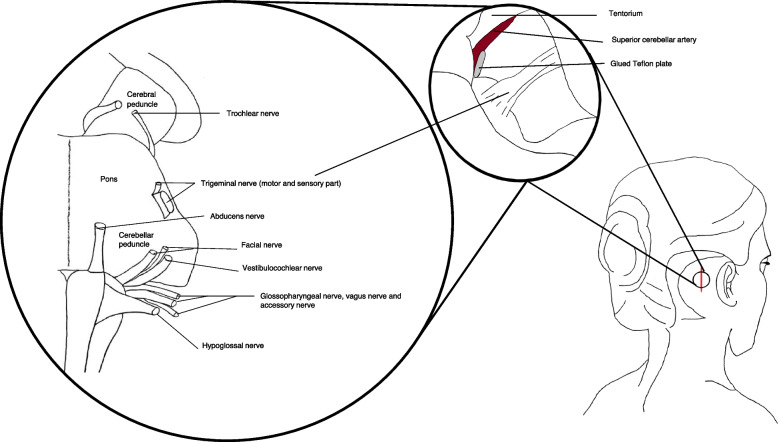
Fig. 1
Fig. 1
Illustration of the principles of microvascular decompression and the cranial nerves in proximity to the surgical area. The anatomical localization of the entry of the cranial nerves into the brainstem and the surgical field of microvascular decompression. The procedure was performed with the patient in a park bench position under general anaesthesia via an approximately 2 × 3 cm retrosigmoid craniectomy. Via a supracerebellar infratentorial approach, the cerebellopontine angle was visualized, and the trigeminal nerve and compressing vessel(s) were identified (Fig. 1). If the superior cerebellar artery was causing the compression, the nerve was alleviated by transposition of the blood vessel towards the tentorium, where it was fixed with Teflon and glue. If the compression was caused by the posterior or anterior inferior cerebellar artery the blood vessel was transposed caudally and fixed with Teflon if possible. If the surgeon was unable to transpose the artery, a piece of Teflon was interposed between the trigeminal nerve and the conflicting artery. If a vein was causing the compression, the vein was either divided to avoid avulsion or if possible, a piece of Teflon was interposed between the trigeminal nerve and the vein. The surgeon preferred not to coagulate veins and in particular sought to preserve the superior petrosal vein. Surgery was performed without the use of neuronavigation or brainstem auditory evoked responses or other neuromonitoring. Cerebellar retraction was not used, and neither were specific relaxation techniques. All procedures were performed microscopically
Fig. 2
Fig. 2
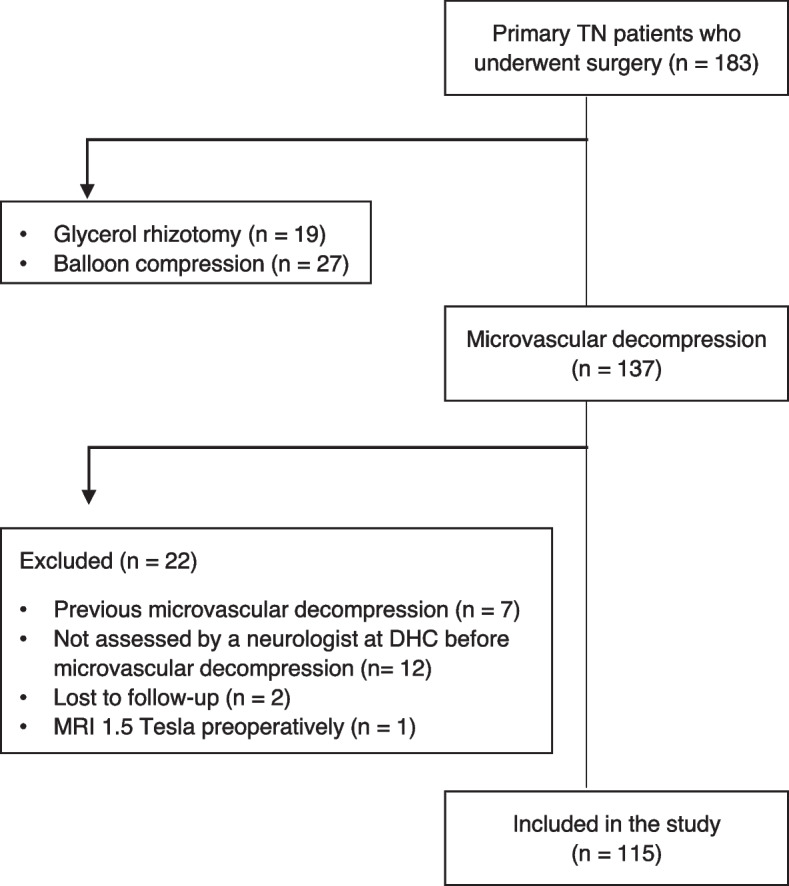
Flowchart of inclusion of patients with trigeminal neuralgia. TN trigeminal neuralgia, DHC Danish Headache Center
Fig. 3
Fig. 3
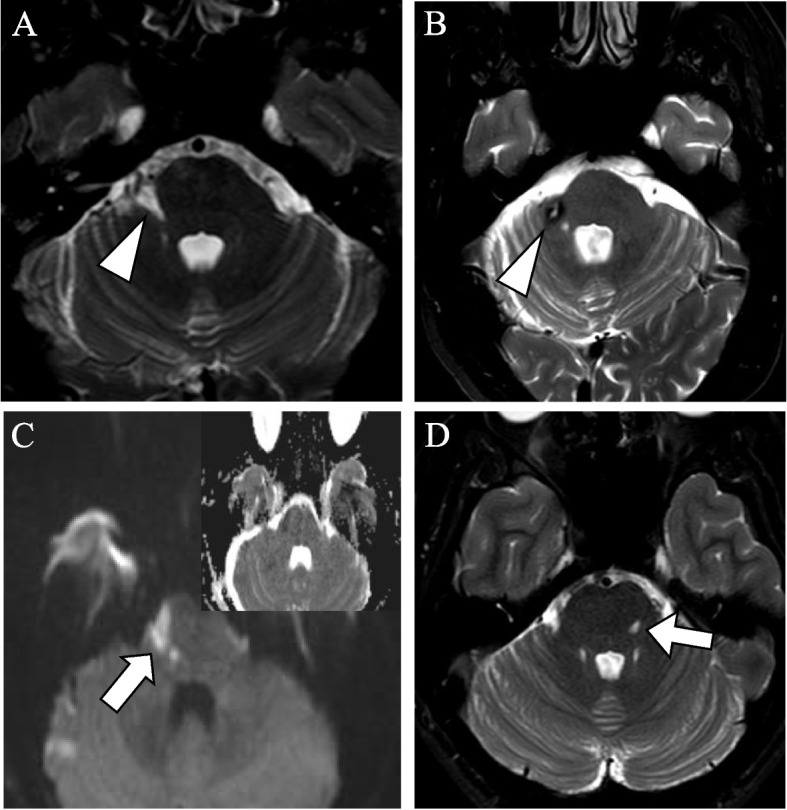
Postoperative MRIs of patients with stroke after microvascular decompression. Postoperative MRI of patients after MVD. (a) axial T2 DRIVE weighted sequence shows chronic infarction (arrowhead) in the right cerebellar peduncle of patient no 1 (Supplementary material B). (b) axial T2 DRIVE weighted sequence shows sequelae after hemorrhage (arrowhead) at the right cerebellar peduncle of patient no. 7. c) axial diffusion-weighted sequence shows subacute infarction (arrow) in the right side of the pons of patient no. 3. (d) axial T2 DRIVE weighted sequence shows chronic infarction (arrow) in the left side of the pons in patient no. 4

References

    1. Maarbjerg S, Gozalov A, Olesen J, Bendtsen L. Trigeminal neuralgia - a prospective systematic study of clinical characteristics in 158 patients. Headache. 2014;54:1574–1582. doi: 10.1111/head.12441. - DOI - PubMed
    1. Katusic S, Beard CM, Bergstralth E, Kurland LT. Incidence and clinical features of trigeminal neuralgia, Rochester, Minnesota, 1945–1984. Ann Neurol. 1990;27:89–95. doi: 10.1002/ANA.410270114. - DOI - PubMed
    1. Antonini G, Di Pasquale A, Cruccu G, et al. MRI contribution for diagnosing symptomatic neurovascular contact in classic trigeminal neuralgia. A blinded case-control study and meta-analysis. Pain. 2014;155:1464–1471. doi: 10.1016/j.pain.2014.04.020. - DOI - PubMed
    1. Maarbjerg S, Wolfram F, Gozalov A, et al. Significance of neurovascular contact in classical trigeminal neuralgia. Brain. 2015;138:311–319. doi: 10.1093/brain/awu349. - DOI - PubMed
    1. Haines SJ, Jannetta PJ, Zorub DS. Microvascular relations of the trigeminal nerve an anatomical study with clinical correlation. J Neurosurg. 1980;52:381–386. doi: 10.3171/jns.1980.52.3.0381. - DOI - PubMed

Publication types

Associated data