


Genome-wide analyses identify novel risk loci for cluster headache in Han Chinese residing in Taiwan
- PMID: 36404298
- PMCID: PMC9677903
- DOI: 10.1186/s10194-022-01517-6
Genome-wide analyses identify novel risk loci for cluster headache in Han Chinese residing in Taiwan
Abstract
Background: Cluster headache is a highly debilitating neurological disorder with considerable inter-ethnic differences. Genome-wide association studies (GWAS) recently identified replicable genomic loci for cluster headache in Europeans, but the genetic underpinnings for cluster headache in Asians remain unclear. The objective of this study is to investigate the genetic architecture and susceptibility loci of cluster headache in Han Chinese resided in Taiwan.
Methods: We conducted a two-stage genome-wide association study in a Taiwanese cohort enrolled from 2007 through 2022 to identify the genetic variants associated with cluster headache. Diagnosis of cluster headache was retrospectively ascertained with the criteria of International Classification of Headache Disorders, third edition. Control subjects were enrolled from the Taiwan Biobank. Genotyping was conducted with the Axiom Genome-Wide Array TWB chip, followed by whole genome imputation. A polygenic risk score was developed to differentiate patients from controls. Downstream analyses including gene-set and tissue enrichment, linkage disequilibrium score regression, and pathway analyses were performed.
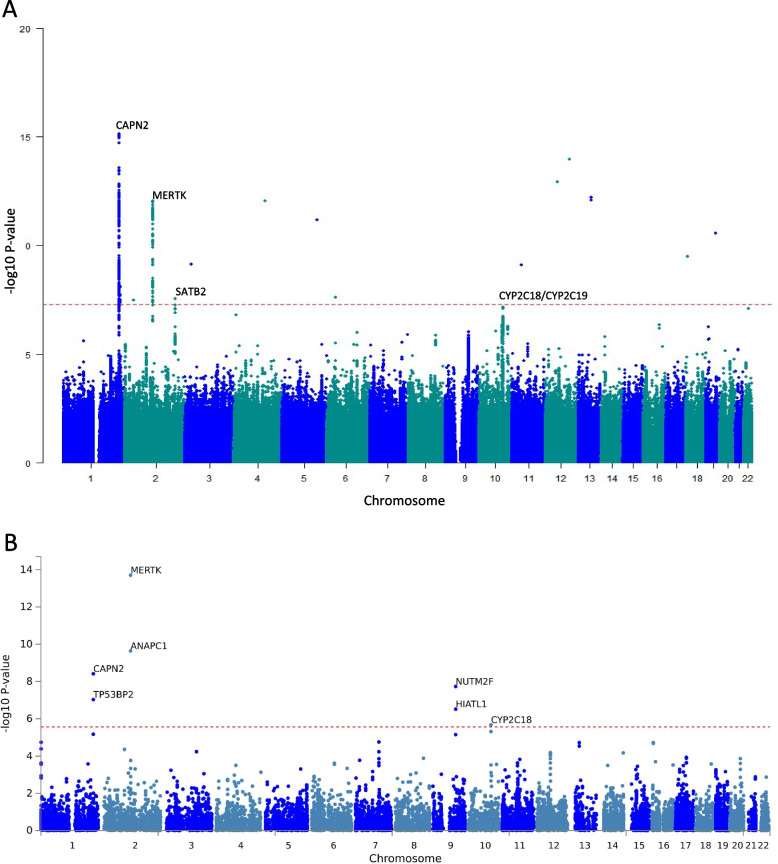
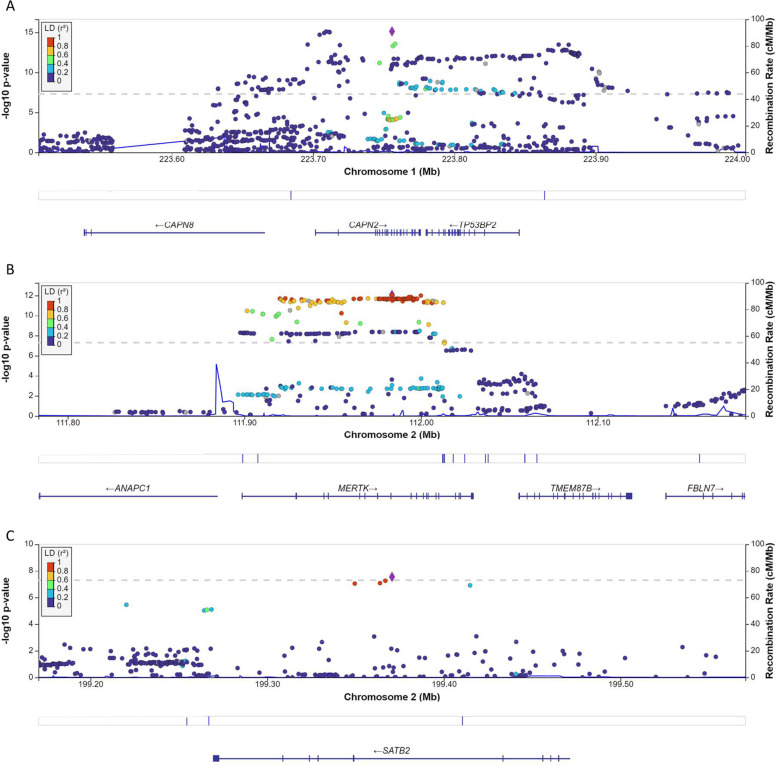
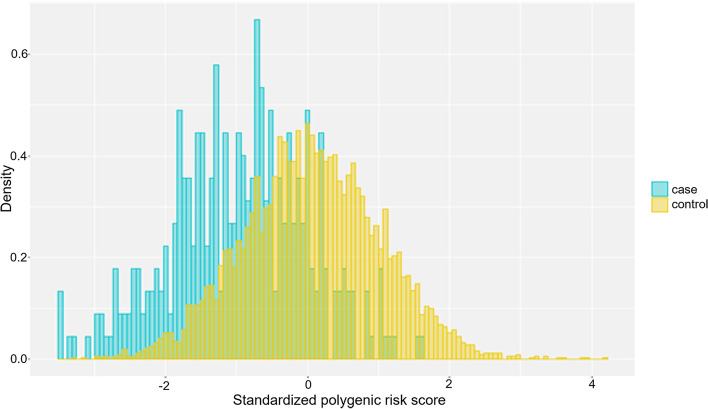
Results: We enrolled 734 patients with cluster headache and 9,846 population-based controls. We identified three replicable loci, with the lead SNPs being rs1556780 in CAPN2 (odds ratio = 1.59, 95% CI 1.42‒1.78, p = 7.61 × 10⁻¹⁶), rs10188640 in MERTK (odds ratio = 1.52, 95% CI 1.33‒1.73, p = 8.58 × 10⁻¹³), and rs13028839 in STAB2 (odds ratio = 0.63, 95% CI 0.52‒0.78, p = 2.81 × 10⁻⁸), with the latter two replicating the findings in European populations. Several previously reported genes also showed significant associations with cluster headache in our samples. Polygenic risk score differentiated patients from controls with an area under the receiver operating characteristic curve of 0.77. Downstream analyses implicated circadian regulation and immunological processes in the pathogenesis of cluster headache.
Conclusions: This study revealed the genetic architecture and novel susceptible loci of cluster headache in Han Chinese residing in Taiwan. Our findings support the common genetic contributions of cluster headache across ethnicities and provide novel mechanistic insights into the pathogenesis of cluster headache.
Keywords: CAPN2; Cluster headache; Genome-wide association study; MERTK; STAB2.
© 2022. The Author(s).
Conflict of interest statement
The authors declared no potential conflicts of interest with respect to the research, authorship, and/or publication of this article.
Figures
References
-
- Headache Classification Committee of the International Headache Society (IHS) (2018) The International Classification of Headache Disorders, 3rd edition. Cephalalgia 38(1):1–211. 10.1177/0333102417738202 - PubMed
MeSH terms
Grants and funding
- MOST-108-2314-B-010 -022 -MY3 & 110-2326-B-A49A-501-MY3/Ministry of Science and Technology, Taiwan
- MOST 109-2314-B-001-006-MY2/Ministry of Science and Technology, Taiwan
- MOST 108-2321-B-010-014-MY2, 108-2321-B-010-001-, 108-2314-B-010-023-MY3, 110-2321-B-010-005- & 111-2321-B-A49-004/Ministry of Science and Technology, Taiwan
- V110C-102, VGH-111-C-158, V109D52-001-MY3-2, VGHUST110-G1-3-1/Taipei Veterans General Hospital, Taiwan
- VGH-106-D9-001-MY2-2, VGH-111-C-111 & VGH-111-C-006-1/Taipei Veterans General Hospital, Taiwan
LinkOut - more resources
Full Text Sources
Miscellaneous
