


Is Long COVID Syndrome a Transient Mitochondriopathy Newly Discovered: Implications of CPET
- PMID: 36405232
- PMCID: PMC9635775
- DOI: 10.14740/cr1419
Is Long COVID Syndrome a Transient Mitochondriopathy Newly Discovered: Implications of CPET
Abstract
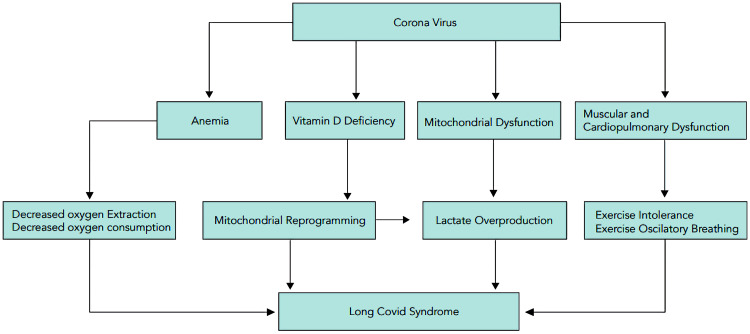
The new outbreak of the severe acute respiratory syndrome coronavirus 2 (SARS-CoV-2) infection has an impact worldwide, primarily as a medical emergency. Even that the total constellation is considered as a pandemic of acute respiratory disease, coronavirus disease 2019 (COVID-19) gives rise to dysfunction in multiple organs (e.g., brain, lungs, heart, muscles) that impairs cardiopulmonary (CP) function. Parallel to the CP consequences of COVID-19 is a significant reduction in physical activity. Cardiopulmonary exercise testing (CPET) is daily used in clinical practice to define prognosis, provide risk stratification and treatment strategy. As such, the significance of CPET is crucial concerning clinical assessments of COVID-19 patients. Furthermore, new studies aim at understanding the effects of SARS-CoV-2 infection in long term. Multiple studies have investigated the cardiopulmonary function and impairment of exercise endurance in such patients, as well as a possible prolonged physical impairment. With this review, we summarize the COVID-19-associated pathophysiology for the Long COVID (LC) syndrome as well as the importance of performing CPET.
Keywords: Cardiopulmonary exercise test; Long COVID syndrome; Mitochondriopathy.
Copyright 2022, Sakellaropoulos et al.
Conflict of interest statement
None to declare.
Figures
References
-
- John Hopkins University Coronavirus Resource Center. https://coronavirus.jhu.edu/ [2022 Mar 3]
-
- Ayoubkhani D, Pawelek P. Off Natl Stat. 2022. Prevalence of ongoing symptoms following coronavirus (COVID-19) infection in the UK: 3 February 2022 (Online) pp. 1–6.
-
- Puntmann VO, Carerj ML, Wieters I, Fahim M, Arendt C, Hoffmann J, Shchendrygina A. et al. Outcomes of cardiovascular magnetic resonance imaging in patients recently recovered from coronavirus disease 2019 (COVID-19) JAMA Cardiol. 2020;5(11):1265–1273. doi: 10.1001/jamacardio.2020.3557. - DOI - PMC - PubMed
Publication types
LinkOut - more resources
Full Text Sources
Research Materials
Miscellaneous