


What Constitutes Student Well-Being: A Scoping Review Of Students' Perspectives
- PMID: 36405573
- PMCID: PMC9668225
- DOI: 10.1007/s12187-022-09990-w
What Constitutes Student Well-Being: A Scoping Review Of Students' Perspectives
Abstract
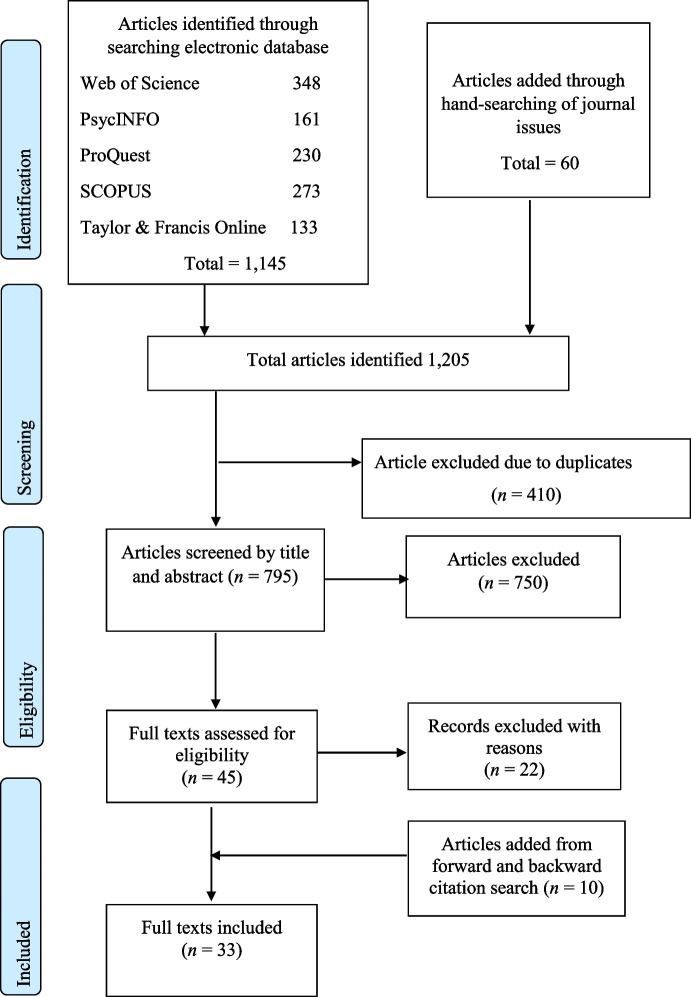
Student well-being has recently emerged as a critical educational agenda due to its wide-reaching benefits for students in performing better at school and later as adults. With the emergence of student well-being as a priority area in educational policy and practice, efforts to measure and monitor student well-being have increased, and so has the number of student well-being domains proposed. Presently, a lack of consensus exists about what domains are appropriate to investigate and understand student well-being, resulting in a fragmented body of work. This paper aims to clarify the construct of student well-being by summarising and mapping different conceptualisations, approaches used to measure, and domains that entail well-being. The search of multiple databases identified 33 studies published in academic journals between 1989 and 2020. There were four approaches to conceptualising student well-being found in the reviewed studies. They were: Hedonic, eudaimonic, integrative (i.e., combining both hedonic and eudaimonic), and others. Results identified eight overarching domains of student well-being: Positive emotion, (lack of) Negative emotion, Relationships, Engagement, Accomplishment, Purpose at school, Intrapersonal/Internal factors, and Contextual/External factors. Recommendations for further research are offered, including the need for more qualitative research on student well-being as perceived and experienced by students and for research to be conducted in a non-western context.
Keywords: Domain; Eudaimonic; Hedonic; Scoping review; Student well-being.
© The Author(s), under exclusive licence to Springer Nature B.V. 2022, Springer Nature or its licensor (e.g. a society or other partner) holds exclusive rights to this article under a publishing agreement with the author(s) or other rightsholder(s); author self-archiving of the accepted manuscript version of this article is solely governed by the terms of such publishing agreement and applicable law.
Conflict of interest statement
Conflicts of/Competing InterestsThe authors have no conflicts of interest to declare that are relevant to the content of this article.
References
-
- Aarons GA, Fettes DL, Sommerfeld DH, Palinkas L. Mixed methods for implementation research: Application to evidence-based practice implementation and staff turnover in community based organisations providing child welfare services. Child Maltreatment. 2012;17(1):1–7. doi: 10.1177/1077559511426908. - DOI - PMC - PubMed
-
- Allardt, E. (2003). Having, Loving, Being: An Alternative to the Swedish Model of Welfare Research. The Quality of Life,88–94,. 10.1093/0198287976.003.0008
-
- Anderson DL, Graham AP. Improving student wellbeing: Having a say at school. School Effectiveness and School Improvement. 2016;27(3):348–366. doi: 10.1080/09243453.2015.1084336. - DOI
-
- Arksey H, O’Malley L. Scoping studies: towards a methodological framework. International Journal of Social Research Methodology. 2005;8(1):19–32. doi: 10.1017/S0922156508005621. - DOI
-
- Arslan G, Renshaw TL. Student subjective wellbeing as a predictor of adolescent problem behaviors: A comparison of first-order and second-order factor effects. Child Indicators Research. 2018;11(2):507–521. doi: 10.1007/s12187-017-9444-0. - DOI
Publication types
LinkOut - more resources
Full Text Sources