


Supplementation with honeysuckle extract improves growth performance, immune performance, gut morphology, and cecal microbes in geese
- PMID: 36406074
- PMCID: PMC9669450
- DOI: 10.3389/fvets.2022.1006318
Supplementation with honeysuckle extract improves growth performance, immune performance, gut morphology, and cecal microbes in geese
Abstract
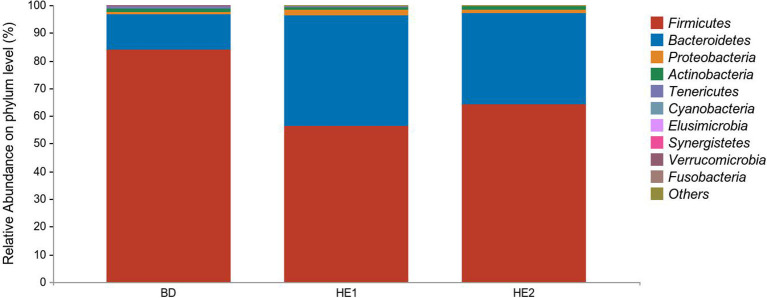
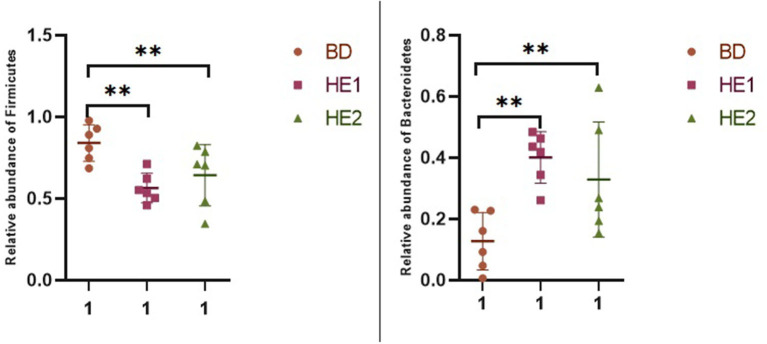
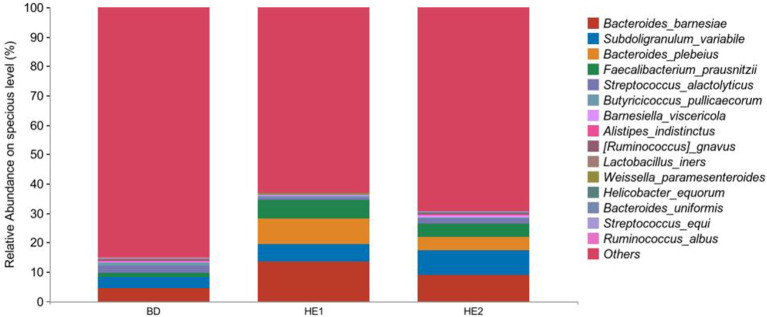
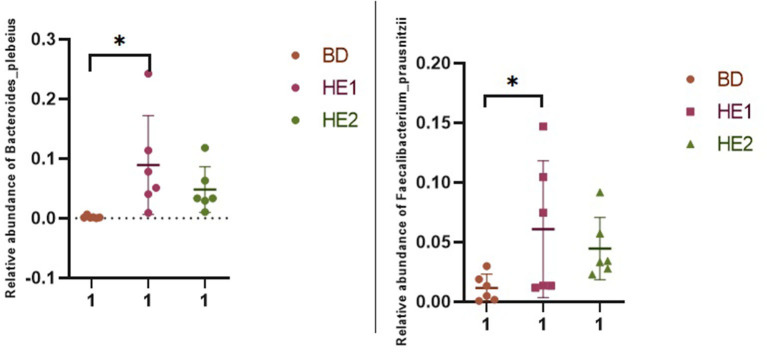
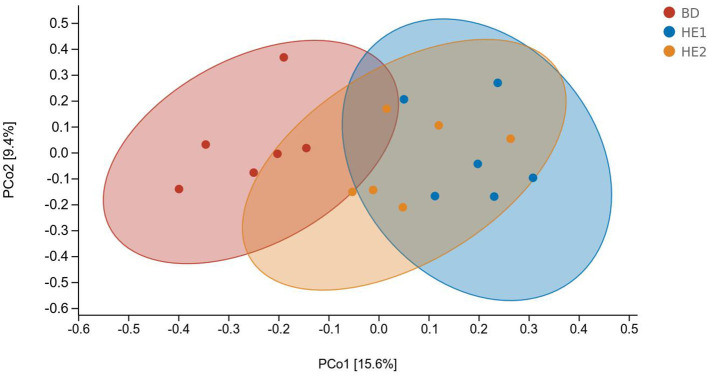
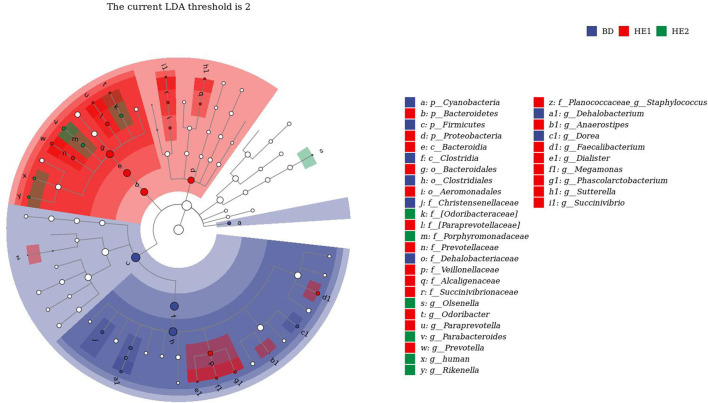
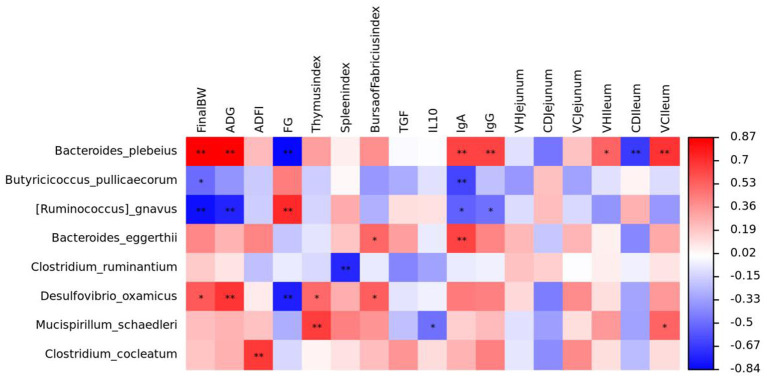
The study aimed to investigate the effects of honeysuckle extract (HE) on growth performance, serum biochemical indexes, immune organ indexes, gut morphology, and gut microbes in geese. A total of 180 28-day-old Holdobaki geese were randomly divided into three groups. Each group contained 6 replicates (10 geese, with 5 males and 5 females). The BD group was fed the basal diet, the HE1 group was fed the basal diet supplemented with 1 g/kg of HE, and the HE2 group was fed the basal diet supplemented with 2 g/kg of HE. The experiment lasted for 42 days. The results showed that, compared with the BD group, the average daily gain (ADG) of the HE1 and HE2 groups tended to increase (0.05 < P < 0.10), but the average daily feed intake (ADFI) and final body weight (BW) did not differ significantly, and the feed/gain ratio (F/G) was significantly lower (P < 0.01). The bursa index and the thymus index tended to increase (0.05 < P < 0.10), and serum immunoglobulin A (IgA) and immunoglobulin G (IgG) levels increased significantly (P < 0.05). In the HE1 and HE2 groups, the crypt depth (CD) in the jejunum tended to decrease (0.05 < P < 0.10), and the villus height/crypt depth ratio (V/C) increased significantly in the jejunum and the ileum (P < 0.05). According to 16sRNA microbial community diversity analysis, Firmicutes, Bacteroidetes, Proteobacteria, and Actinobacteria were the dominant phyla. The abundance of Firmicutes was significantly decreased (P < 0.01), while that of Bacteroidetes was significantly increased (P < 0.01), in the HE1 and HE2 groups compared with the BD group. Bacteroides barnesiae, Subdoligranulum variabile, Bacteroides plebeius, and Faecalibacterium prausnitzii were the dominant species, and the abundance of B. plebeius and F. prausnitzii was significantly increased (P < 0.05). According to the LEfSe analysis, BD enriched g_Dorea and g_Dehalobacterium; HE1 enriched g_Faecalibacterium, g_Dialister, g_Prevotella, g_Megamonas, g_Phascolarctobacterium, g_Paraprevotella, g_Anaerostipes, g_Staphylococcus, g_Odoribacter, g_Succinivibrio, and g_Sutterella; and HE2 enriched g_Parabacteroides, g_Olsenella, g_human, and g_Rikenella. According to the Spearman correlation analysis, Bacteroides plebeius was positively correlated with final BW, ADG, IgA, IgG, VH (ileum), and V/C (ileum) and was negatively correlated with F/G and CD (ileum); Ruminococcus gnavus was negatively correlated with final BW, ADG, IgA, and IgG. HE supplementation at 1 g/kg improved growth performance, immune performance, gut morphology, and cecal microbes.
Keywords: cecal microbiome; goose; growth performance; immune; intestinal morphology.
Copyright © 2022 Li, Wang, Liu, Wang, Yang, Gong, Zhu, He and Wang.
Conflict of interest statement
The authors declare that the research was conducted in the absence of any commercial or financial relationships that could be construed as a potential conflict of interest.
Figures
References
-
- Muniyappan M, Jeon SY, Choi M-K, Kim IH. Dietary inclusion of Achyranthes japonica extract to corn-soybean meal-wheat-based diet on the growth performance, nutrient digestibility, cecal microflora, excreta noxious gas emission, and meat quality of broiler chickens. Poult Sci. (2022) 101:101852. 10.1016/j.psj.2022.101852 - DOI - PMC - PubMed
-
- Kim KC, Sin S-I, Ri M-R, Jo CH, Mun S-H. Effect of dietary Pinus densiflora bark extract on activity and mRNA expression of antioxidant enzyme in weaning piglets. Lives Sci. (2022) 260:104931. 10.1016/j.livsci.2022.104931 - DOI
-
- Pan DB, Wang J, Cheng J, Sun X, Zhou L, Yuan Y, et al. Effects of Radix Bupleuri extract supplementation on lactation performance and rumen fermentation in heat-stressed lactating Holstein cows. Anim Feed Sci Technol. (2014) 187:1–8. 10.1016/j.anifeedsci.2013.09.008 - DOI
LinkOut - more resources
Full Text Sources
Miscellaneous
