


Association between circadian rhythm and sleep quality among nursing interns: A latent profile and moderation analysis
- PMID: 36408420
- PMCID: PMC9669491
- DOI: 10.3389/fnins.2022.995775
Association between circadian rhythm and sleep quality among nursing interns: A latent profile and moderation analysis
Abstract
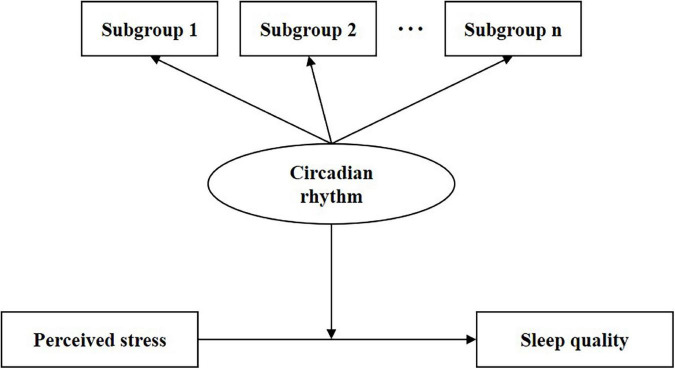
Background: Disturbances in circadian rhythms are common among night-shift workers and result in poor sleep quality. Nevertheless, the heterogeneity of circadian rhythms and their relationship with sleep quality is less explored in nursing interns. Therefore, we aimed to identify the latent subtypes of circadian rhythm, explore their relationship with sleep quality, and evaluate their moderating role between perceived stress and sleep quality in nursing interns.
Materials and methods: In all, 452 nursing interns were recruited between October 2020 and January 2021 from Be Resilient to Nursing Career (BRNC), which is a multicenter, prospective cohort of a career growth program for nursing students. They were assessed using the 10-item Chinese Perceived Stress Scale, Circadian Type Inventory, and Pittsburgh Sleep Quality Index. Latent profile analysis and moderation analysis were performed.
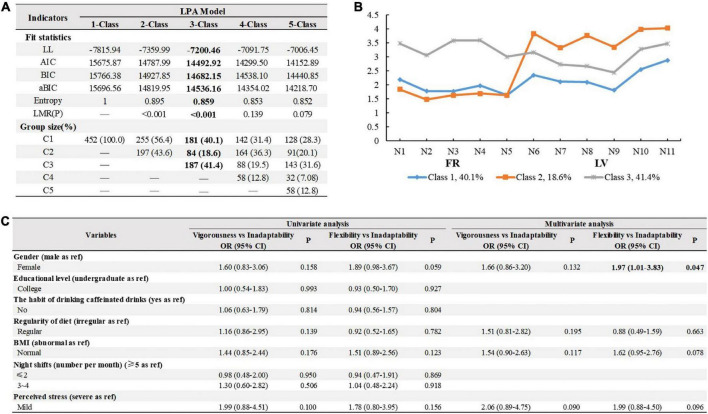
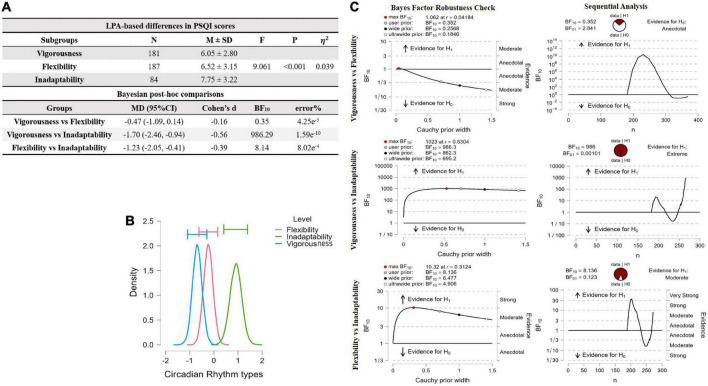
Results: Overall, 72.3% of the nursing interns reported poor sleep quality. We identified three latent subtypes of circadian rhythms, namely, Vigorousness (40.1%), Inadaptability (18.6%), and Flexibility (41.1%). Females (OR = 1.97, 95% Cl: 1.01-3.83, P = 0.047) with normal body mass index (OR = 1.62, 95% CI: 0.95-2.76, P = 0.078) were prone to Flexibility. Circadian rhythm types significantly moderated the association between perceived stress and sleep quality (P < 0.05).
Conclusion: Nursing interns suffer from poor sleep. There exists heterogeneity of circadian rhythm subtypes in nursing interns, and attention should be paid to those with Inadaptability type. The association between perceived stress and sleep quality is significantly moderated by circadian rhythm subtypes.
Keywords: Be Resilient to Nursing Career (BRNC); circadian rhythm; latent profile analysis; moderation analysis; nursing interns; perceived stress; sleep quality.
Copyright © 2022 Wu, Lu, Xie, Chen, Zhang, Zhou and Ye.
Conflict of interest statement
The authors declare that the research was conducted in the absence of any commercial or financial relationships that could be construed as a potential conflict of interest.
Figures
References
-
- Bixler E. O., Papaliaga M. N., Vgontzas A. N., Lin H. M., Pejovic S., Karataraki M., et al. (2009). Women sleep objectively better than men and the sleep of young women is more resilient to external stressors: Effects of age and menopause. J. Sleep Res. 18 221–228. 10.1111/j.1365-2869.2008.00713.x - DOI - PMC - PubMed
LinkOut - more resources
Full Text Sources
