. 2022 Dec 21;60(12):e0122722.
doi: 10.1128/jcm.01227-22. Epub 2022 Nov 21.

Performance Characteristics of Six Immunoglobulin M Enzyme-Linked Immunosorbent Assays Used for Laboratory Confirmation of Measles

Affiliations

Performance Characteristics of Six Immunoglobulin M Enzyme-Linked Immunosorbent Assays Used for Laboratory Confirmation of Measles

Sun B Sowers et al. J Clin Microbiol. .

Abstract

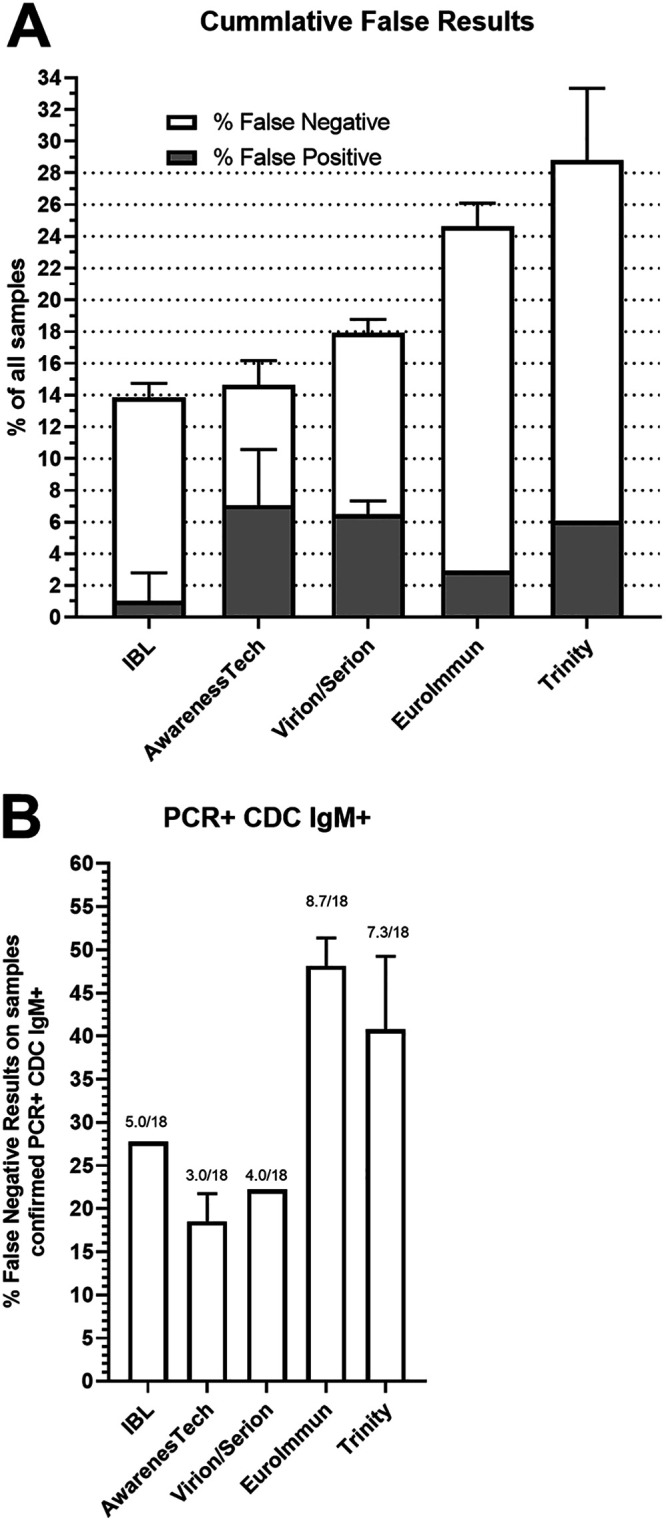
Laboratory confirmation of infection is an essential component of measles surveillance. Detection of measles-specific IgM in serum by enzyme-linked immunosorbent assay (ELISA) is the most common method used to confirm measles infection. ELISA formats vary, as does the sensitivity and specificity of each assay. Specimens collected within 3 days of rash onset can yield a false-negative result, which can delay confirmation of measles cases. Interfering substances can yield a false-positive result, leading to unnecessary public health interventions. The IgM capture assay developed at the Centers for Disease Control (CDC) was compared against five commercially available ELISA kits for the ability to detect measles virus-specific IgM in a panel of 90 well-characterized specimens. Serum samples were tested in triplicate using each commercial kit as recommended by the manufacturer. Using the CDC measles IgM capture assay as the reference test; the sensitivity and specificity for each commercial kit ranged from 50 to 83% and 86.9 to 98%, respectively. Discrepant results were observed for samples tested with all five commercial kits and ranged from 13.8 to 28.8% of the specimens tested. False-positive results occurred in 2.0 to 13.1% of sera, while negative results were observed in 16.7 to 50% of sera that were positive by the CDC measles IgM capture assay. Evaluation and interpretation of measles IgM serologic results can be complex, particularly in measles elimination settings. The performance characteristics of a measles IgM assay should be carefully considered when selecting an assay to achieve high-quality measles surveillance.

Keywords: ELISA; IgM; MMR; measles.


Conflict of interest statement

The authors declare no conflict of interest.

Figures
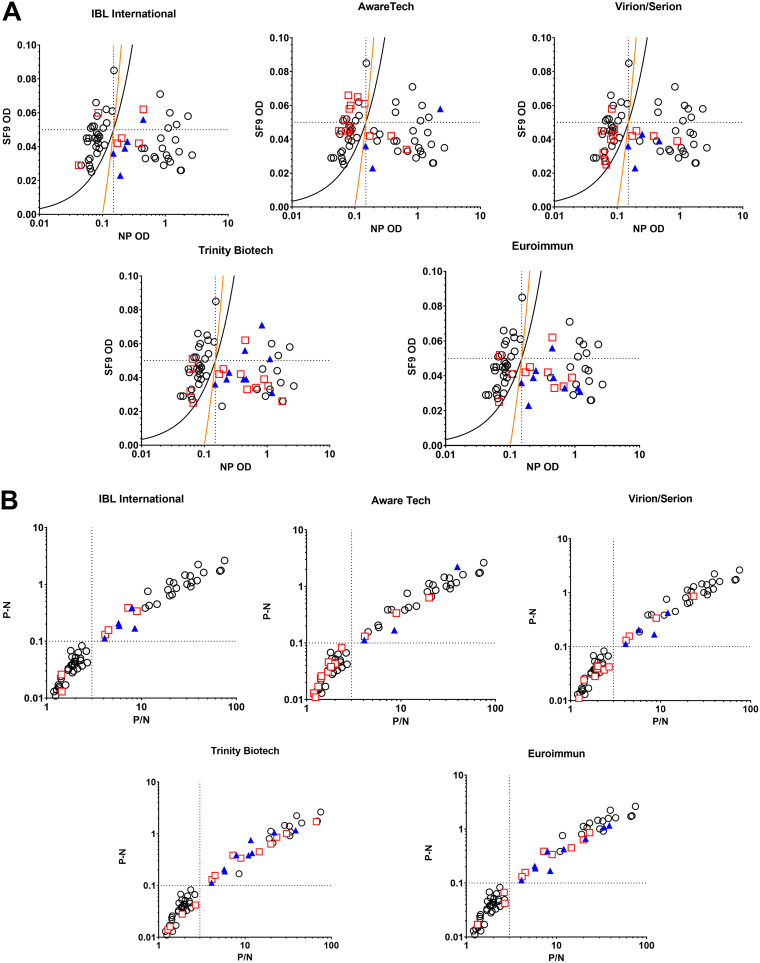
FIG 1
FIG 1
Performance of each commercial IgM assay kit relative to the CDC IgM ELISA. (A) Absorbance values for samples tested by the CDC IgM ELISA for each commercial kit. The absorbance values of the positive (measles NP antigen) and negative (SF9 control antigen) are shown for each sample used on the comparison for each commercial ELISA. The cutoff criteria for the negative and positive results are indicated by the orange line (P-N = 0.1) and the black line (P/N = 3.0). Black circles indicate CDC IgM results that qualitatively agree with the indicated commercial test. Red squares indicate false-positive results. Blue triangles indicate false-negative results that were confirmed as positive by PCR. (B) Positive and Negative cutoff values for samples tested by the CDC IgM ELISA in comparison for each commercial kit. The cutoff criteria for P/N versus P-N values are indicated by dotted lines. Black circles indicate CDC IgM results that qualitatively agree with the indicated commercial test. Red squares indicate false-positive results. Blue triangles indicate false-negative results that were confirmed as positive by PCR.
FIG 2
FIG 2
False-negative and false-positive IgM results from commercial ELISA kits. (A) Cumulative false-negative and false-positive results from each commercial ELISA were calculated based on agreement with the CDC IgM ELISA. The false results are expressed as a percentage of the total samples tested. (B) The fraction of false-negative results from each commercial kit are shown for cases that were IgM positive by the CDC ELISA and confirmed by RT-PCR in accompanying throat swabs.

References

    1. Gastanaduy PA, Paul P, Fiebelkorn AP, Redd SB, Lopman BA, Gambhir M, Wallace GS. 2017. Assessment of the status of measles elimination in the United States, 2001–2014. Am J Epidemiol 185:562–569. 10.1093/aje/kww168. - DOI - PMC - PubMed
    1. Katz SL, Hinman AR. 2004. Summary and conclusions: measles elimination meeting, 16–17 March 2000. J Infect Dis 189(Suppl 1):S43–S47. - PubMed
    1. Orenstein WA, Papania MJ, Wharton ME. 2004. Measles elimination in the United States. J Infect Dis 189(Suppl 1):S1–S3. 10.1086/377693. - DOI - PubMed
    1. Strebel PM, Henao-Restrepo AM, Hoekstra E, Olive JM, Papania MJ, Cochi SL. 2004. Global measles elimination efforts: the significance of measles elimination in the United States. J Infect Dis 189(Suppl 1):S251–S257. 10.1086/378092. - DOI - PubMed
    1. Patel M, Lee AD, Redd SB, Clemmons NS, McNall RJ, Cohn AC, Gastanaduy PA. 2019. Increase in measles cases—United States, January 1–April 26, 2019. MMWR Morb Mortal Wkly Rep 68:402–404. 10.15585/mmwr.mm6817e1. - DOI - PubMed