


Historical development of accelerometry measures and methods for physical activity and sedentary behavior research worldwide: A scoping review of observational studies of adults
- PMID: 36409738
- PMCID: PMC9678297
- DOI: 10.1371/journal.pone.0276890
Historical development of accelerometry measures and methods for physical activity and sedentary behavior research worldwide: A scoping review of observational studies of adults
Abstract
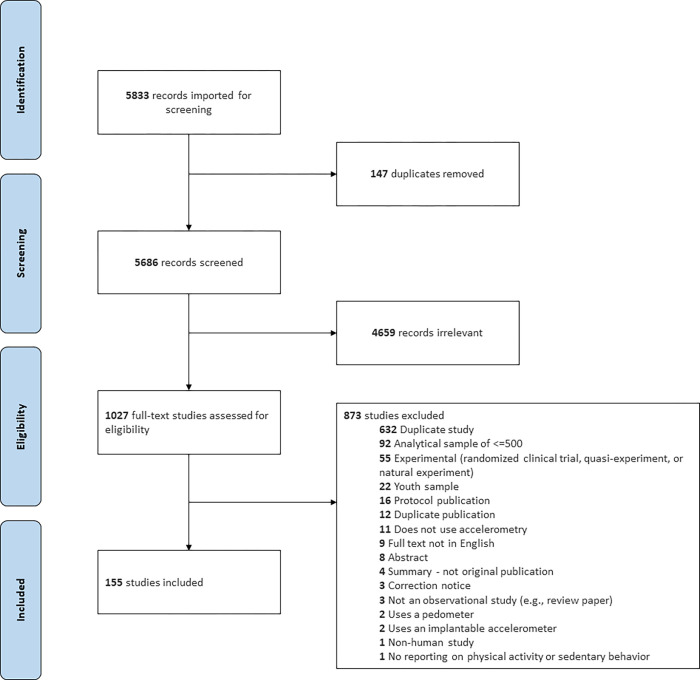
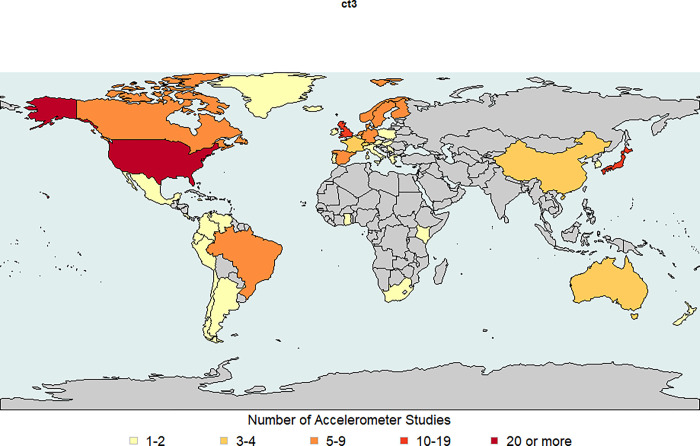
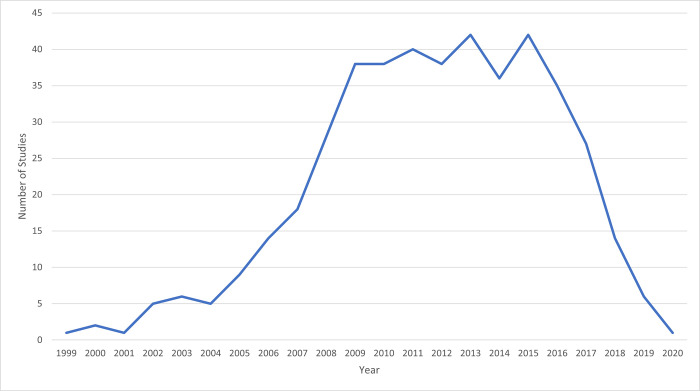
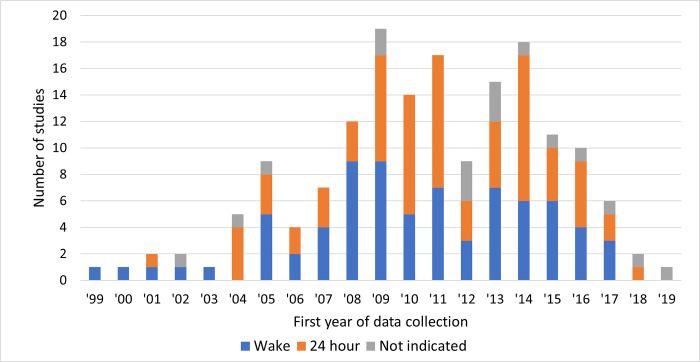
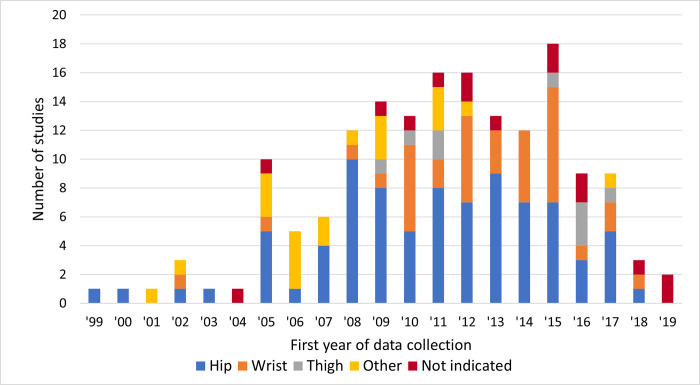
This scoping review identified observational studies of adults that utilized accelerometry to assess physical activity and sedentary behavior. Key elements on accelerometry data collection were abstracted to describe current practices and completeness of reporting. We searched three databases (PubMed, Web of Science, and SPORTDiscus) on June 1, 2021 for articles published up to that date. We included studies of non-institutionalized adults with an analytic sample size of at least 500. The search returned 5686 unique records. After reviewing 1027 full-text publications, we identified and abstracted accelerometry characteristics on 155 unique observational studies (154 cross-sectional/cohort studies and 1 case control study). The countries with the highest number of studies included the United States, the United Kingdom, and Japan. Fewer studies were identified from the continent of Africa. Five of these studies were distributed donor studies, where participants connected their devices to an application and voluntarily shared data with researchers. Data collection occurred between 1999 to 2019. Most studies used one accelerometer (94.2%), but 8 studies (5.2%) used 2 accelerometers and 1 study (0.6%) used 4 accelerometers. Accelerometers were more commonly worn on the hip (48.4%) as compared to the wrist (22.3%), thigh (5.4%), other locations (14.9%), or not reported (9.0%). Overall, 12.7% of the accelerometers collected raw accelerations and 44.6% were worn for 24 hours/day throughout the collection period. The review identified 155 observational studies of adults that collected accelerometry, utilizing a wide range of accelerometer data processing methods. Researchers inconsistently reported key aspects of the process from collection to analysis, which needs addressing to support accurate comparisons across studies.
Copyright: © 2022 Evenson et al. This is an open access article distributed under the terms of the Creative Commons Attribution License, which permits unrestricted use, distribution, and reproduction in any medium, provided the original author and source are credited.
Conflict of interest statement
The authors have declared that no competing interests exist.
Figures
References
-
- Walter P. The history of the accelerometer: 1920s-1996—prologue and epilogue, 2006. Sound and Vibration. 2007;41(1):84–92.
-
- Saunders JB, Inman VT, Eberhart HD. The major determinants in normal and pathological gait. J Bone Joint Surg Am. 1953;35-A(3):543–58. - PubMed
Publication types
MeSH terms
Grants and funding
LinkOut - more resources
Full Text Sources
Medical
