Randomized Controlled Trial
. 2022 Dec;17(12):1763-1774.
doi: 10.2215/CJN.02400222. Epub 2022 Nov 21.

Effects of Bardoxolone Methyl in Alport Syndrome

Affiliations
Randomized Controlled Trial

Effects of Bardoxolone Methyl in Alport Syndrome

Bradley A Warady et al. Clin J Am Soc Nephrol. 2022 Dec.

Abstract

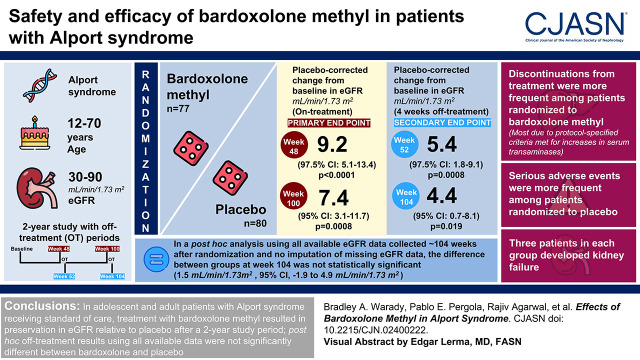
Background and objectives: Alport syndrome is an inherited disease characterized by progressive loss of kidney function. We aimed to evaluate the safety and efficacy of bardoxolone methyl in patients with Alport syndrome.

Design, setting, participants, & measurements: We randomly assigned patients with Alport syndrome, ages 12-70 years and eGFR 30-90 ml/min per 1.73 m2, to bardoxolone methyl (n=77) or placebo (n=80). Primary efficacy end points were change from baseline in eGFR at weeks 48 and 100. Key secondary efficacy end points were change from baseline in eGFR at weeks 52 and 104, after an intended 4 weeks off treatment. Safety was assessed by monitoring for adverse events and change from baseline in vital signs, 12-lead electrocardiograms, laboratory measurements (including, but not limited to, aminotransferases, urinary albumin-creatinine ratio, magnesium, and B-type natriuretic peptide), and body weight.

Results: Patients randomized to bardoxolone methyl experienced preservation in eGFR relative to placebo at 48 and 100 weeks (between-group differences: 9.2 [97.5% confidence interval, 5.1 to 13.4; P<0.001] and 7.4 [95% confidence interval, 3.1 to 11.7; P=0.0008] ml/min per 1.73 m2, respectively). After a 4-week off-treatment period, corresponding mean differences in eGFR were 5.4 (97.5% confidence interval, 1.8 to 9.1; P<0.001) and 4.4 (95% confidence interval, 0.7 to 8.1; P=0.02) ml/min per 1.73 m2 at 52 and 104 weeks, respectively. In a post hoc analysis with no imputation of missing eGFR data, the difference at week 104 was not statistically significant (1.5 [95% confidence interval, -1.9 to 4.9] ml/min per 1.73 m2). Discontinuations from treatment were more frequent among patients randomized to bardoxolone methyl; most discontinuations were due to protocol-specified criteria being met for increases in serum transaminases. Serious adverse events were more frequent among patients randomized to placebo. Three patients in each group developed kidney failure.

Conclusions: In adolescent and adult patients with Alport syndrome receiving standard of care, treatment with bardoxolone methyl resulted in preservation in eGFR relative to placebo after a 2-year study period; off-treatment results using all available data were not significantly different.

Clinical trial registry name and registration number: A Phase 2/3 Trial of the Efficacy and Safety of Bardoxolone Methyl in Patients with Alport Syndrome - CARDINAL (CARDINAL), NCT03019185.

Keywords: Alport syndrome; CKD; bardoxolone methyl.


Figures

None
Graphical abstract
Figure 1.
Figure 1.
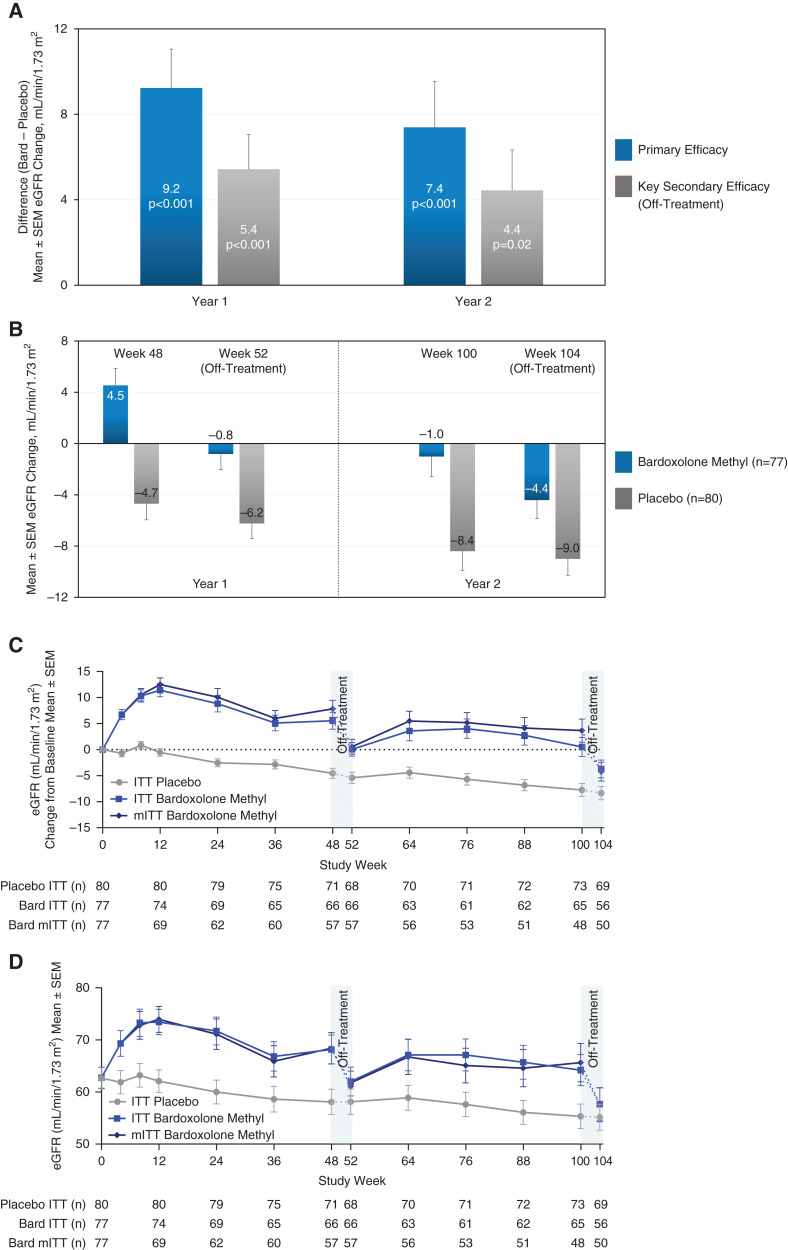
Primary and key secondary efficacy results from CARDINAL (intention-to-treat population). (A) Mean difference between treatment groups for the primary end point, changes from baseline in eGFR at 48 weeks (year 1) and 100 weeks (year 2), and for the key secondary end point, off-treatment changes from baseline in eGFR at 52 weeks (year 1) and 104 weeks (year 2). The primary end point was analyzed using mixed model repeated measures. The model included all available eGFR values collected through week 100 (excluding week 52) for the intention-to-treat (ITT) population (n=157, with n=80 for placebo and n=77 for bardoxolone methyl). eGFR data were available for 71 patients randomized to placebo and 66 patients randomized to bardoxolone methyl (bard) at 48 weeks, and for 73 patients randomized to placebo and 65 patients randomized to bardoxolone methyl at 100 weeks, and missing data were not imputed. We assessed key secondary end points 4 weeks after last dose in year 1 at 52 weeks and in year 2 at 104 weeks and analyzed using analysis of covariance for the ITT population (n=157, with n=80 for placebo and n=77 for bardoxolone methyl). Off-treatment eGFR data (collected 4 weeks after last dose) were available for 68 patients randomized to placebo and 66 patients randomized to bardoxolone methyl at 52 weeks, and for 69 patients randomized to placebo and 56 patients randomized to bardoxolone methyl at 104 weeks. For the key secondary end points, we imputed missing data using multiple imputation on the basis of the randomized treatment group. (B) Mean changes from baseline in patients randomized to bardoxolone methyl (n=77) and placebo (n=80) contributing to primary (at 48 and 100 weeks) and key secondary (at 52 and 104 weeks) efficacy analyses. (C) Observed mean (±SEM) change from year 1 baseline (i.e., before starting intervention) in eGFR for the ITT population and the modified ITT population (mITT) through the 104 weeks of the study. The mITT analysis assesses the effect of receiving study drug in the ITT population and excludes any eGFR values collected after final dose (detailed in Supplemental Table 3). Off-treatment periods are represented by the dash and only include eGFR data collected 4 weeks after last dose. Additional eGFR values, collected approximately 104 weeks after randomization, irrespective of time off study drug, were available for a total of 78 patients randomized to placebo and 72 patients randomized to bardoxolone methyl (Table 2). (D) Observed mean (±SEM) eGFR values for the ITT population and the mITT population through the 104 weeks of the study. The mITT analysis assesses the effect of receiving study drug in the ITT population and excludes any eGFR values collected after final dose. Off-treatment periods are represented by the dash.
Figure 2.
Figure 2.
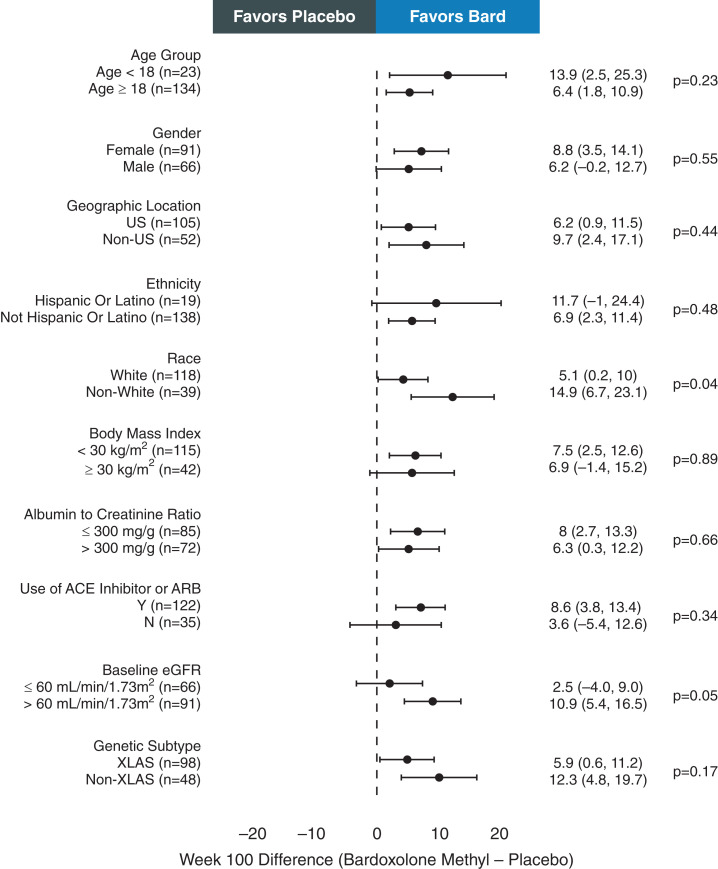
Forest plot of eGFR change from baseline to week 100 by subgroups. Forest plot summarizing mean±95% confidence interval difference between bardoxolone methyl (bard) and placebo groups in the change from baseline in eGFR at 100 weeks for subgroups on the basis of baseline characteristics at randomization. Mean difference between treatment groups at 100 weeks was analyzed for each subgroup using mixed model repeated measures and included all available eGFR values collected through week 100 for the intention-to-treat (ITT) population, with the number of patients contributing to the analysis for each subgroup noted in the figure and the P value indicating the difference between subgroups. ACE, angiotensin-converting enzyme; N, no; US, United States; XLAS, X-linked Alport syndrome; Y, yes.
Figure 3.
Figure 3.
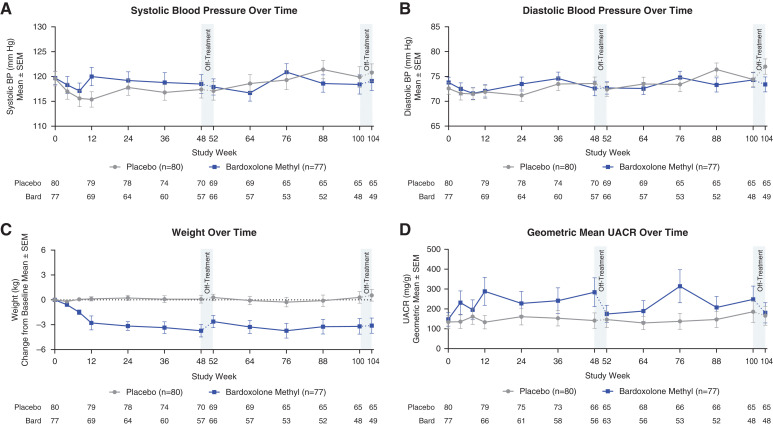
Safety parameters over time. (A and B) Mean (±SEM) systolic and diastolic BP for patients randomized to bardoxolone methyl (bard; n=77) or placebo (n=80) through the 104 weeks of the study. Data collected during the on-treatment period are represented by the solid line, and off-treatment data are represented by the dashed line. Mean values at 52 and 104 weeks include data collected 28 days after last dose for patients that discontinued early in the first or second year of treatment, respectively. (C) Mean (±SEM) change from baseline in weight for patients randomized to bardoxolone methyl (n=77) and patients randomized placebo (n=80) through 104 weeks. Data collected during the on-treatment period are represented by the solid line, and off-treatment data are represented by the dashed line. Mean values at 52 and 104 weeks include data collected 28 days after last dose for patients that discontinued early in the first or second year of treatment, respectively. (D) Geometric mean (±SEM) urinary albumin-creatinine ratio (UACR) for patients randomized to bardoxolone methyl (n=77) and patients randomized to placebo (n=80) through 104 weeks. Data collected during the on-treatment period are represented by the solid line, and off-treatment data are represented by the interrupted line. Mean values at 52 and 104 weeks include data collected 28 days after last dose for patients that discontinued early in the first or second year of treatment, respectively.

Comment in

References

    1. Kruegel J, Rubel D, Gross O: Alport syndrome--Insights from basic and clinical research. Nat Rev Nephrol 9: 170–178, 2013 - PubMed
    1. Jais JP, Knebelmann B, Giatras I, Marchi M, Rizzoni G, Renieri A, Weber M, Gross O, Netzer KO, Flinter F, Pirson Y, Verellen C, Wieslander J, Persson U, Tryggvason K, Martin P, Hertz JM, Schröder C, Sanak M, Krejcova S, Carvalho MF, Saus J, Antignac C, Smeets H, Gubler MC: X-linked Alport syndrome: Natural history in 195 families and genotype- phenotype correlations in males. J Am Soc Nephrol 11: 649–657, 2000 - PubMed
    1. Jais JP, Knebelmann B, Giatras I, De Marchi M, Rizzoni G, Renieri A, Weber M, Gross O, Netzer KO, Flinter F, Pirson Y, Dahan K, Wieslander J, Persson U, Tryggvason K, Martin P, Hertz JM, Schröder C, Sanak M, Carvalho MF, Saus J, Antignac C, Smeets H, Gubler MC: X-linked Alport syndrome: Natural history and genotype-phenotype correlations in girls and women belonging to 195 families: A “European Community Alport Syndrome Concerted Action” study. J Am Soc Nephrol 14: 2603–2610, 2003 - PubMed
    1. Kamiyoshi N, Nozu K, Fu XJ, Morisada N, Nozu Y, Ye MJ, Imafuku A, Miura K, Yamamura T, Minamikawa S, Shono A, Ninchoji T, Morioka I, Nakanishi K, Yoshikawa N, Kaito H, Iijima K: Genetic, clinical, and pathologic backgrounds of patients with autosomal dominant Alport syndrome. Clin J Am Soc Nephrol 11: 1441–1449, 2016 - PMC - PubMed
    1. Savige J, Gregory M, Gross O, Kashtan C, Ding J, Flinter F: Expert guidelines for the management of Alport syndrome and thin basement membrane nephropathy. J Am Soc Nephrol 24: 364–375, 2013 - PubMed

Publication types

Associated data