. 2022 Nov 21;22(1):277.
doi: 10.1186/s12866-022-02701-z.

Anti-Helicobacter pylori activity of potential probiotic Lactiplantibacillus pentosus SLC13

Affiliations

Anti-Helicobacter pylori activity of potential probiotic Lactiplantibacillus pentosus SLC13

Tran Thi Dieu Thuy et al. BMC Microbiol. .

Abstract

Background: Here, we aimed to evaluate and compare the anti-Helicobacter pylori activity of potential probiotic Lactiplantibacillus pentosus SLC13 to Lactobacillus gasseri BCRC 14619 T and Lacticaseibacillus rhamnosus LGG. Phenotypic assays including growth curve, cell adhesion, and cellular cytotoxicity were performed to characterize SLC13. Anti-H. pylori activity of lactobacilli was determined by the disk diffusion method and co-culture assay. Exopolysaccharide (EPS) was extracted from lactobacilli to test its immune modulation activity, and IL-8 expression in AGS and GES-1 was determined by RT-qPCR.

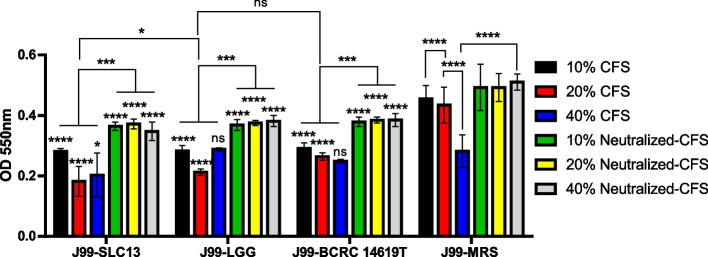
Results: All three lactobacilli strains were tolerant to the simulated gastrointestinal conditions. SLC13 showed the highest adhesion ability to AGS and GES-1 cells, compared to LGG and BCRC 14619 T. The coculture assays of SLC13, LGG, and BCRC 14619 T with cells for 4 h showed no significant cytotoxic effects on cells. All tested strains exhibited an inhibitory effect against H. pylori J99. The cell-free supernatant (CFS) of three strains showed activity to inhibit H. pylori urease activity in a dose-dependent manner and the CFS of SLC13 had the highest urease inhibitory activity, compared to LGG and BCRC 14619 T. Only the treatment of AGS cells with SLC13 EPS significantly decreased the IL-8 expression induced by H. pylori infection as compared to cells treated with LGG and BCRC 14619 T EPS.

Conclusions: SLC13 possesses potent antimicrobial activity against H. pylori growth, infection, and H. pylori-induced inflammation. These results suggest that SLC13 and its derivatives have the potential as alternative agents against H. pylori infection and alleviate inflammatory response.

Keywords: Adhesion; Exopolysaccharide; Helicobacter pylori; Lactiplantibacillus pentosus; Probiotic; Urease.


Conflict of interest statement

All authors have no conflicts of interest to declare.

Figures

Fig. 1
Fig. 1
Adhesion and cytotoxicity of SLC13, LGG, and BCRC 14619 T to AGS and GES-1. A SLC13, LGG, and BCRC 14619 T adhesion to AGS and GES-1 cells. B Cell viability was determined by MTT assay after 4 h of coculture (MOI = 100). Error bars represent the standard deviation of biological triplicates. *, p < 0.05; **, p < 0.01; ***, p < 0.001; ****, p < 0.0001; ns, no significant difference; pc, positive control (Triton X-100 treatment); nc, negative control (AGS or GES-1 cells only, without treatment)
Fig. 2
Fig. 2
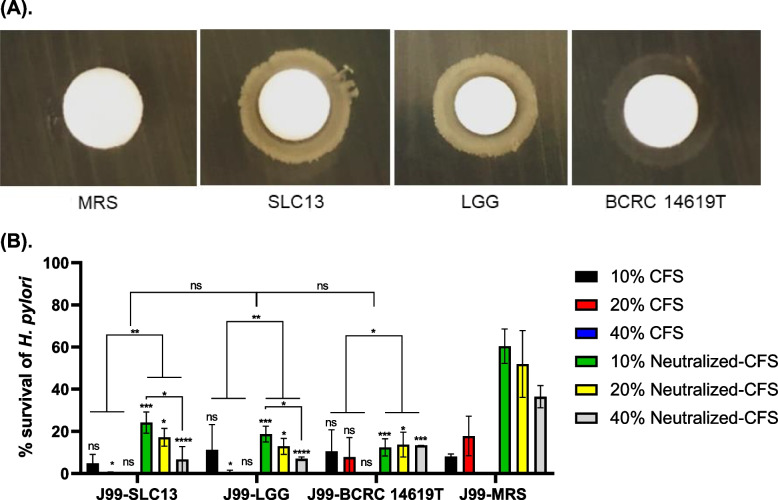
Anti-H. pylori activity of lactobacilli. A The inhibitory effect of lactobacilli on H. pylori J99 was determined by disk diffusion method. MRS broth alone was used as a negative control. B The survival rate of H. pylori in the presence of different concentrations (10%, 20%, and 40%) of CFS or neutralized-CFS (adjusted to pH 6.5 by NaOH) at microaerophilic conditions for 4 h. The viability of H. pylori after 72 h co-incubation with CFS was evaluated by determining the viable bacterial count on Brucella agar containing 10% horse serum plates after incubation at 37 °C under microaerophilic conditions. MRS broth pH 4.0 (acid-CFS control) and pH 6.5 (neutralized-CFS control) were used as controls of the reaction. CFS, cell-free supernatant. Error bars represent the standard deviation of biological triplicates. *, p < 0.05; **, p < 0.01; ns, no significant difference
Fig. 3
Fig. 3
Inhibition of urease activity of lactobacilli cell-free supernatant. Effect of lactobacilli CFS and neutralized-CFS (10%, 20%, and 40% concentrations) on urease activity of H. pylori was determined by measuring the absorbance of ammonium at 550 nm after 4 h co-incubaction. MRS broth pH 4.0 (acid-CFS control) and pH 6.5 (neutralized-CFS control) were used as controls of the reaction. CFS, cell-free supernatant. Error bars represent the standard deviation of biological triplicates (with technical replicates). *, p < 0.05; ***, p < 0.001; ****, p < 0.0001; ns, no significant difference
Fig. 4
Fig. 4
Anti-H. pylori adhesion activity of lactobacilli. Adhesion of H. pylori to GES-1 (A) and AGS cells (B) after pretreatment with lactobacilli for 30 min. Adhesion of H. pylori to GES-1 (C) and AGS cells (D) in the presence of lactobacilli CFS simultaneously. Survival of H. pylori in the presence of lactobacilli CFS simultaneously in RPMI cell culture medium for GES-1 cells (E) and F12 culture medium for AGS cells (F). H. pylori J99 alone was used as a control in these assays. Error bars represent the standard deviation of biological triplicates. *, p < 0.05; **, p < 0.01; ***, p < 0.001; ****, p < 0.0001; ns, no significant difference
Fig. 5
Fig. 5
Anti-H. pylori-induced inflammation of lactobacilli and their derived exopolysaccharide. GES-1 (A) and AGS (B) cells were pretreated with lactobacilli SLC13, LGG, or BCRC 14619 T for 2 h, and then cells were infected with H. pylori J99 (MOI = 100) for 2 h. C. AGS cells were treated with EPS extracted from lactobacilli SLC13, LGG, or BCRC 14619 T at a concentration of 500 ng/mL with H. pylori J99 (MOI = 100) simultaneously for 2 h. After H. pylori infection, RNA was extracted from cells to determine the il-8 gene expression. AGS and GES-1 cells alone without any treatments were used as a negative control to normalize the measurements. Error bars represent the standard deviation of biological triplicates. *, p < 0.05; **, p < 0.01; ***, p < 0.001; ****, p < 0.0001; ns, no significant difference; EPS, exopolysaccharide

References

    1. Fijan S. Microorganisms with claimed probiotic properties: an overview of recent literature. Int J Environ Res Public Health. 2014;11(5):4745–4767. doi: 10.3390/ijerph110504745. - DOI - PMC - PubMed
    1. Abdalla AK, Ayyash MM, Olaimat AN, Osaili TM, Al-Nabulsi AA, Shah NP, et al. Exopolysaccharides as Antimicrobial Agents: Mechanism and Spectrum of Activity. Front Microbiol. 2021;12:664395. doi: 10.3389/fmicb.2021.664395. - DOI - PMC - PubMed
    1. Balta I, Butucel E, Mohylyuk V, Criste A, Dezmirean DS, Stef L, et al. Novel Insights into the Role of Probiotics in Respiratory Infections, Allergies, Cancer, and Neurological Abnormalities. Diseases. 2021;9(3):60. doi: 10.3390/diseases9030060. - DOI - PMC - PubMed
    1. Huang JY, Kao CY, Liu WS, Fang TJ. Characterization of high exopolysaccharide-producing Lactobacillus strains isolated from mustard pickles for potential probiotic applications. Int Microbiol. 2017;20(2):75–84. doi: 10.2436/20.1501.01.287. - DOI - PubMed
    1. Liu Y, Wang J, Wu C. Modulation of Gut Microbiota and Immune System by Probiotics, Pre-biotics, and Post-biotics. Front Nutr. 2021;8:634897. doi: 10.3389/fnut.2021.634897. - DOI - PMC - PubMed

Publication types

LinkOut - more resources