


Abnormal uterine bleeding patterns determined through menstrual tracking among participants in the Apple Women's Health Study
- PMID: 36414993
- PMCID: PMC9877138
- DOI: 10.1016/j.ajog.2022.10.029
Abnormal uterine bleeding patterns determined through menstrual tracking among participants in the Apple Women's Health Study
Abstract
Background: Use of menstrual tracking data to understand abnormal bleeding patterns has been limited because of lack of incorporation of key demographic and health characteristics and confirmation of menstrual tracking accuracy.
Objective: This study aimed to identify abnormal uterine bleeding patterns and their prevalence and confirm existing and expected associations between abnormal uterine bleeding patterns, demographics, and medical conditions.
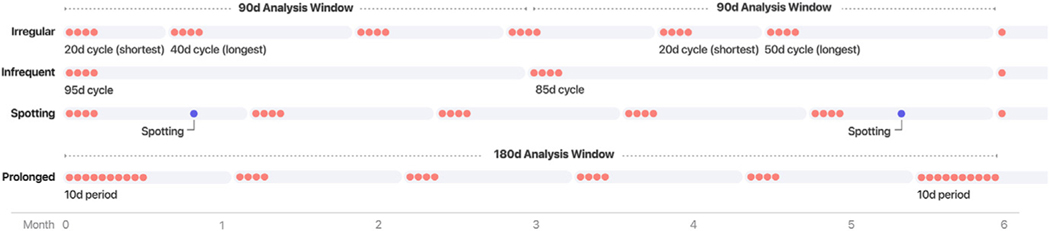
Study design: Apple Women's Health Study participants from November 2019 through July 2021 who contributed menstrual tracking data and did not report pregnancy, lactation, use of hormones, or menopause were included in the analysis. Four abnormal uterine bleeding patterns were evaluated: irregular menses, infrequent menses, prolonged menses, and irregular intermenstrual bleeding (spotting). Monthly tracking confirmation using survey responses was used to exclude inaccurate or incomplete digital records. We investigated the prevalence of abnormal uterine bleeding stratified by demographic characteristics and used logistic regression to evaluate the relationship of abnormal uterine bleeding to a number of self-reported medical conditions.
Results: There were 18,875 participants who met inclusion criteria, with a mean age of 33 (standard deviation, 8.2) years, mean body mass index of 29.3 (standard deviation, 8.0), and with 68.9% (95% confidence interval, 68.2-69.5) identifying as White, non-Hispanic. Abnormal uterine bleeding was found in 16.4% of participants (n=3103; 95% confidence interval, 15.9-17.0) after accurate tracking was confirmed; 2.9% had irregular menses (95% confidence interval, 2.7-3.1), 8.4% had infrequent menses (95% confidence interval, 8.0-8.8), 2.3% had prolonged menses (95% confidence interval, 2.1-2.5), and 6.1% had spotting (95% confidence interval, 5.7-6.4). Black participants had 33% higher prevalence (prevalence ratio, 1.33; 95% confidence interval, 1.09-1.61) of infrequent menses compared with White, non-Hispanic participants after controlling for age and body mass index. The prevalence of infrequent menses was increased in class 1, 2, and 3 obesity (class 1: body mass index, 30-34.9; prevalence ratio, 1.31; 95% confidence interval, 1.13-1.52; class 2: body mass index, 35-39.9; prevalence ratio, 1.25; 95% confidence interval, 1.05-1.49; class 3: body mass index, >40; prevalence ratio, 1.51; 95% confidence interval, 1.21-1.88) after controlling for age and race/ethnicity. Those with class 3 obesity had 18% higher prevalence of abnormal uterine bleeding compared with healthy-weight participants (prevalence ratio, 1.18; 95% confidence interval, 1.02-1.38). Participants with polycystic ovary syndrome had 19% higher prevalence of abnormal uterine bleeding compared with participants without this condition (prevalence ratio, 1.19; 95% confidence interval, 1.08-1.31). Participants with hyperthyroidism (prevalence ratio, 1.34; 95% confidence interval, 1.13-1.59) and hypothyroidism (prevalence ratio, 1.17; 95% confidence interval, 1.05-1.31) had a higher prevalence of abnormal uterine bleeding, as did those reporting endometriosis (prevalence ratio, 1.28; 95% confidence interval, 1.12-1.45), cervical dysplasia (prevalence ratio, 1.20; 95% confidence interval, 1.03-1.39), and fibroids (prevalence ratio, 1.14; 95% confidence interval, 1.00-1.30).
Conclusion: In this cohort, abnormal uterine bleeding was present in 16.4% of those with confirmed menstrual tracking. Black or obese participants had increased prevalence of abnormal uterine bleeding. Participants reporting conditions such as polycystic ovary syndrome, thyroid disease, endometriosis, and cervical dysplasia had a higher prevalence of abnormal uterine bleeding.
Trial registration: ClinicalTrials.gov NCT04196595.
Keywords: chronic nongestational abnormal uterine bleeding; digital health; menstrual cycles.
Copyright © 2022 The Author(s). Published by Elsevier Inc. All rights reserved.
Figures
Comment in
-
Excerpts from World Medical Literature: Gynaecology.J Obstet Gynaecol Can. 2023 Dec;45(12):102247. doi: 10.1016/j.jogc.2023.102247. J Obstet Gynaecol Can. 2023. PMID: 38049283 No abstract available.
-
Extraits de la littérature médicale mondiale : Gynécologie.J Obstet Gynaecol Can. 2023 Dec;45(12):102296. doi: 10.1016/j.jogc.2023.102296. J Obstet Gynaecol Can. 2023. PMID: 38049284 No abstract available.
References
-
- American Academy of Pediatrics Committee on Adolescence,; American College of Obstetricians and Gynecologists Committee on Adolescent Health Care, Diaz A, Laufer MR, Breech LL. Menstruation in girls and adolescents: using the menstrual cycle as a vital sign. Pediatrics 2006;118:2245–50. - PubMed
-
- Sanfilippo JS. Is the menstrual cycle truly a vital sign? J Pediatr Adolesc Gynecol 2014;27: 307–8. - PubMed
-
- Real FG, Svanes C, Omenaas ER, et al. Menstrual irregularity and asthma and lung function. J Allergy Clin Immunol 2007;120:557–64. - PubMed
Publication types
MeSH terms
Associated data
Grants and funding
LinkOut - more resources
Full Text Sources
Medical
Miscellaneous
