


Pharmacokinetics, the Immunological Impact, and the Effect on HIV Ex-Vivo Infectivity of Maraviroc, Raltegravir, and Lopinavir in Men Who Have Sex with Men Using Postexposure Prophylaxis
- PMID: 36416229
- PMCID: PMC10325810
- DOI: 10.1089/AID.2021.0232
Pharmacokinetics, the Immunological Impact, and the Effect on HIV Ex-Vivo Infectivity of Maraviroc, Raltegravir, and Lopinavir in Men Who Have Sex with Men Using Postexposure Prophylaxis
Abstract
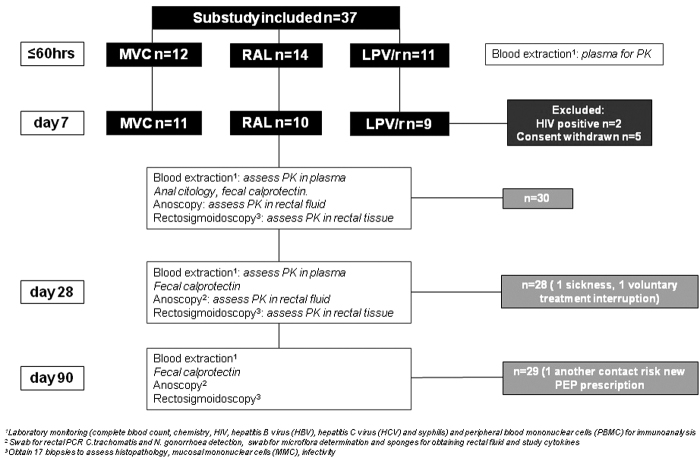
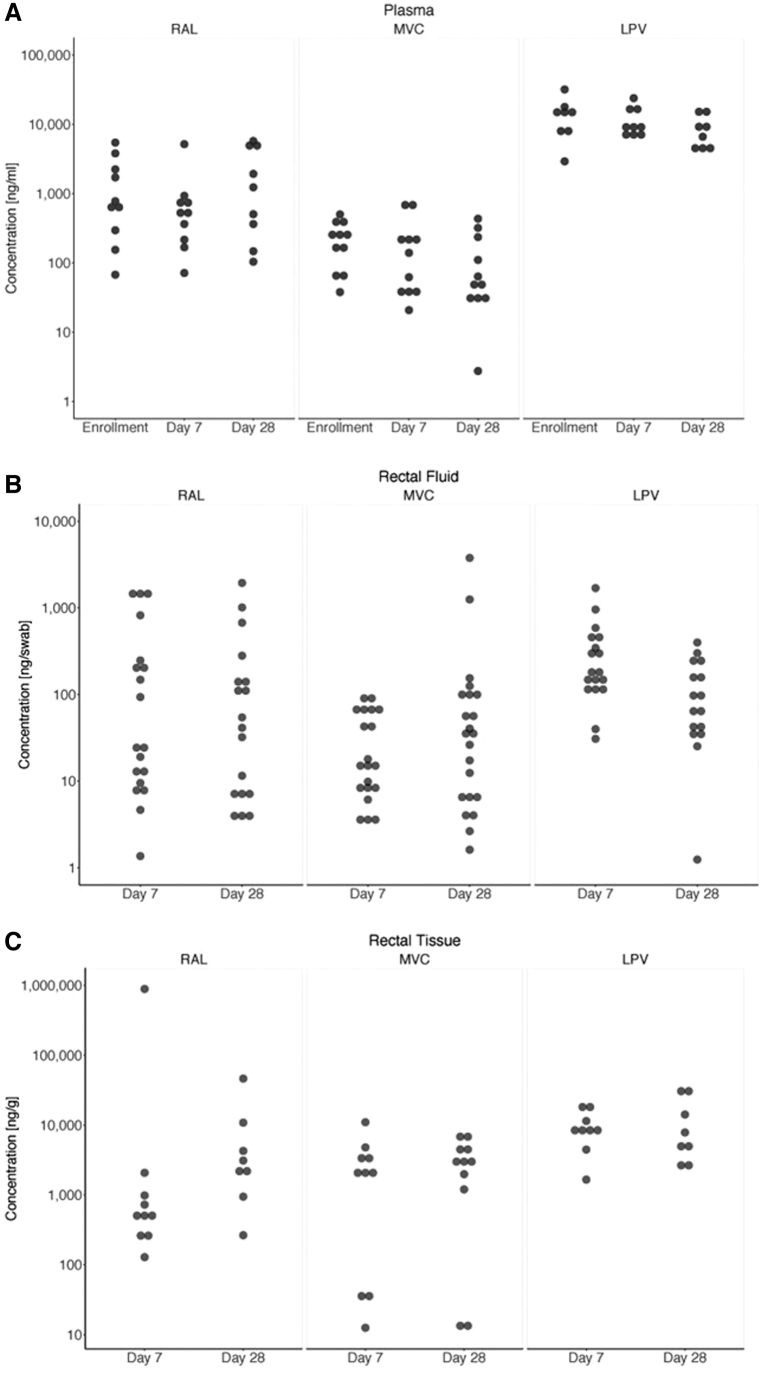
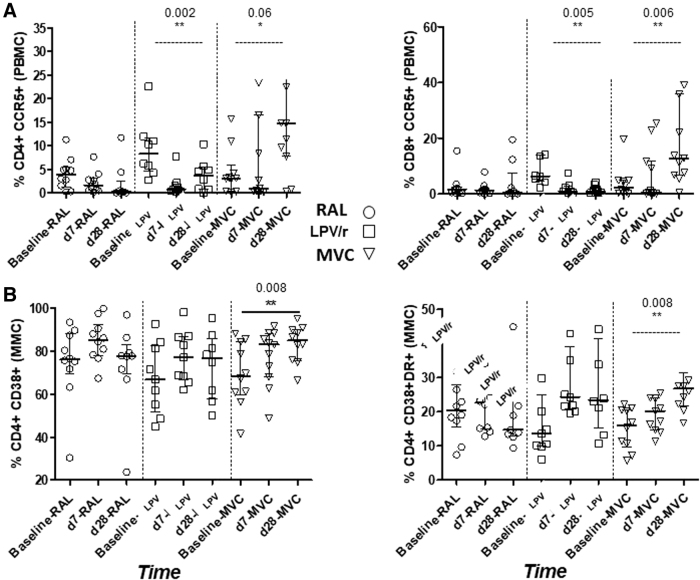
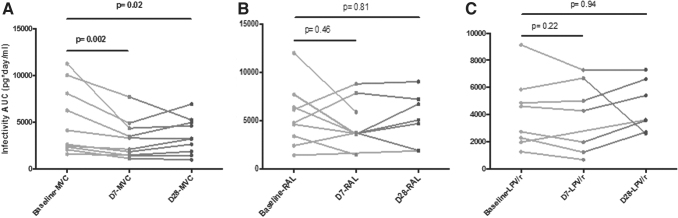
Most of the studies using the colorectal tissue explants challenge model have been conducted after one single dose and before reaching a steady state. We consider that longer exposure as in 28-day postexposure prophylaxis (PEP) course and in an at-risk setting, such as after a sexual risk exposure to HIV could give us valuable information about these drugs. In a substudy we assessed pharmacokinetics, changes on immune system and ex-vivo rectal mucosal susceptibility to HIV-1 infection after taking maraviroc (MVC), raltegravir (RAL), and ritonavir-boosted lopinavir (LPV/r) PEP-based regimens in 30 men who have sex with men. Participants received 28 days of twice-daily MVC (n = 11), RAL (n = 10) or LPV/r (n = 9) all with tenofovir/emtricitabine (TDF/FTC) backbone. Blood, rectal fluid, and rectal tissue samples were collected at days 7, 28, and 90 after starting PEP. The samples obtained at day 90 were considered baseline. All studied antiretrovirals were quantifiable at 7 and 28 days in all tissues. Activation markers were increased in CD4 mucosal mononuclear cells (MMCs) after 28 days of MVC: CD38 + 68.5 versus 85.1, p = .008 and CD38+DR +16.1 versus 26.7, p = .008. Exposure to MVC at both endpoints (7 and 28 days) was associated with significant suppression of HIV-1BAL (p = .005 and p = .028), but we did not observe this effect with RAL or LPV/r. Merging together changes in MMC in all arms, we found a positive correlation in the CD8 T cell lineage between the infectivity at day 7 and activation (CD38+ r = 0.43, p = .025, DR + r = 0.547, p = .003 and 38+DR+ r = 0.526, p = .05), senescence (CD57+CD28- r = 0.479, p = .012), naive cells (RA+CCR7+ r = 0.484, p = .01), and CCR5 expression (r = 0.593, p = .001). We conclude that MVC in combination with TDF/FTC was associated with viral suppression in rectal explants and that overall ex-vivo HIV infectivity correlated with activation and senescence in CD8 MMCs.
Keywords: HIV; maraviroc; postexposure prophylaxis; prevention; rectal explants.
Conflict of interest statement
J.M.G. has received honoraria for speaking and advisory boards and his institution research grants from ViiV, MSD, Janssen, and Gilead. Since May 1st 2018, J.M.G. is a full-time employee of ViiV Healthcare. The rest of the authors do not have a commercial or other association that might pose a conflict of interest.
Figures
References
-
- UNAIDS Data 2021. Licence: CC BY-NC-SA 3.0 IGO. Joint United Nations Programme on HIV/AIDS: Geneva; 2021.
Publication types
MeSH terms
Substances
Grants and funding
LinkOut - more resources
Full Text Sources
Medical
Research Materials
Miscellaneous
