


Exercise increases information content and affects long-term stability of hippocampal place codes
- PMID: 36417871
- PMCID: PMC9715913
- DOI: 10.1016/j.celrep.2022.111695
Exercise increases information content and affects long-term stability of hippocampal place codes
Abstract
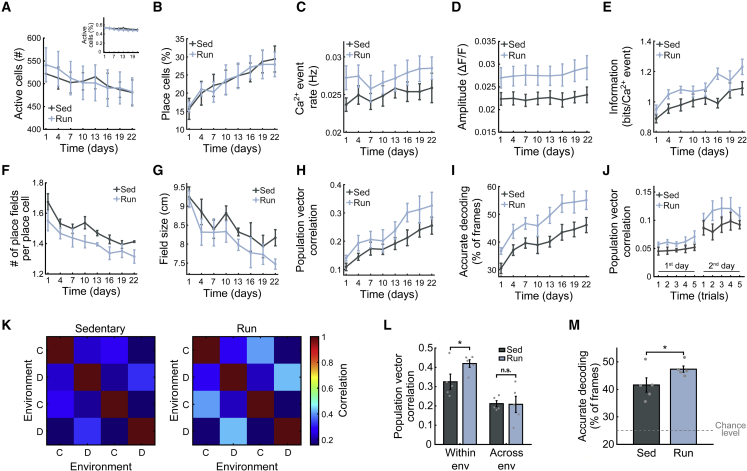
Physical exercise is known to augment brain functioning, improving memory and cognition. However, while some of the physiological effects of physical activity on the brain are known, little is known about its effects on the neural code. Using calcium imaging in freely behaving mice, we study how voluntary exercise affects the quality and long-term stability of hippocampal place codes. We find that running accelerates the emergence of a more informative spatial code in novel environments and increases code stability over days and weeks. Paradoxically, although runners demonstrated an overall more stable place code than their sedentary peers, their place code changed faster when controlling for code quality level. A model-based simulation shows that the combination of improved code quality and faster representational drift in runners, but neither of these effects alone, could account for our results. Thus, exercise may enhance hippocampal function via a more informative and dynamic place code.
Keywords: CP: Neuroscience; adult neurogenesis; calcium imaging; hippocampus; memory; neural coding; physical activity; place cells; representational drift; running.
Copyright © 2022 The Author(s). Published by Elsevier Inc. All rights reserved.
Conflict of interest statement
Declaration of interests The authors declare no competing interests.
Figures




References
Publication types
MeSH terms
Substances
LinkOut - more resources
Full Text Sources
Miscellaneous
