


Outpatient antibiotic prescribing for acute respiratory infections in Vietnamese primary care settings by the WHO AWaRe (Access, Watch and Reserve) classification: An analysis using routinely collected electronic prescription data
- PMID: 36419738
- PMCID: PMC9677071
- DOI: 10.1016/j.lanwpc.2022.100611
Outpatient antibiotic prescribing for acute respiratory infections in Vietnamese primary care settings by the WHO AWaRe (Access, Watch and Reserve) classification: An analysis using routinely collected electronic prescription data
Abstract
Background: This study aims to investigate patterns of antibiotic prescribing and to determine patient-specific factors associated with the choice of antibiotics by the World Health Organization's Access-Watch-Reserve (WHO AWaRe) class for acute respiratory infections (ARIs) in rural primary care settings in northern Vietnam.
Methods: We retrospectively reviewed health records for outpatients who were registered with the Vietnamese Health Insurance Scheme, visited one of 112 commune health centres in 6 rural districts of Nam Dinh province, Vietnam during 2019, and were diagnosed with ARIs. Patient-level prescription data were collected from the electronic patient databases. We used descriptive statistics to investigate patterns of antibiotic prescribing, with the primary outcomes including total antibiotic prescriptions and prescriptions by WHO AWaRe group. We identified patient-specific factors associated with watch-group antibiotic prescribing through multivariable logistic regression analysis.
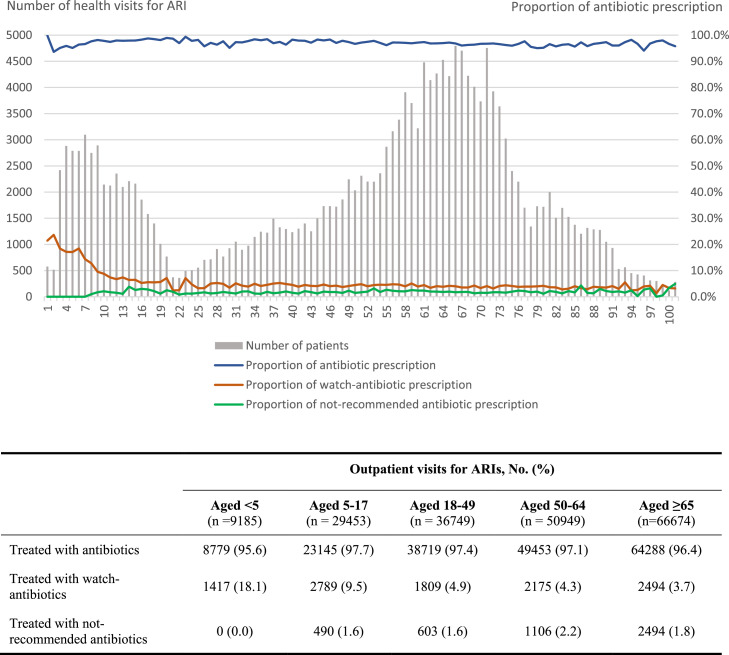
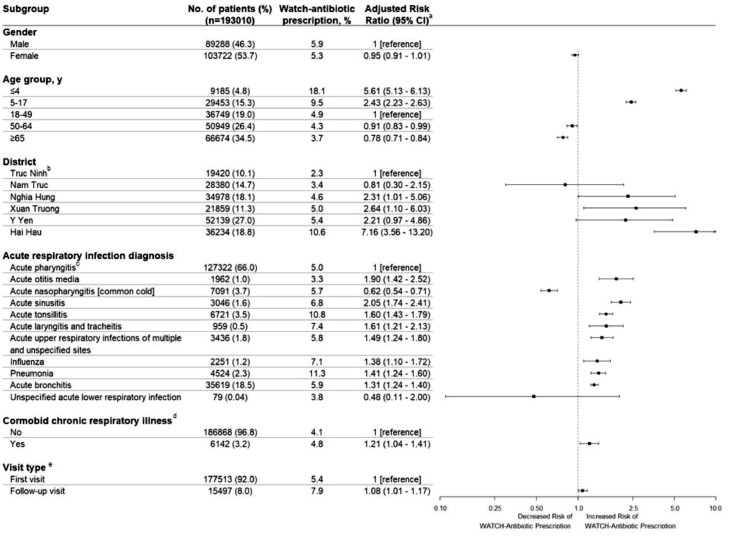
Findings: Among 193,010 outpatient visits for ARIs observed in this study, 187,144 (97.0%) resulted in an antibiotic prescription, of which 172,976 (92.5%) were access-antibiotics, 10,765 (5.6%) were watch-antibiotics, 3366 (1.8%) were not-recommended antibiotics. No patients were treated with reserve-antibiotics. The proportion of watch-antibiotic prescription was highest amongst children under 5-years old (18.1%, compared to 9.5% for 5-17-years, 4.9% for 18-49-years, 4.3% for 50-64-years, and 3.7% for 65-and-above-years). In multivariable logistic regression, children, district, ARI-type, comobid chronic respiratory illness, and follow-up visit were associated with higher likelihood of prescribing watch-group antibiotics.
Interpretation: The alarmingly high proportion of antibiotic prescriptions for ARIs in primary care, and the frequent use of watch-antibiotics for children, heighten concerns around antibiotic overuse at the community level. Antimicrobial stewardship interventions and policy attention are needed in primary care settings to tackle the growing threat of antibiotic resistance.
Funding: This work was supported through Australian government and UK aid from the UK government funding to FIND (Foundation for Innovative New Diagnostics) grant number FO17-0015, in addition to a Wellcome Trust grant (213920/Z/18/Z), and an Oxford University Clinical Research Unit internal grant from the Wellcome Trust Africa Asia Programme core grant in Vietnam (106680/Z/14/Z).
Keywords: Acute respiratory infections; Antibiotics; Antimicrobial resistance; Primary care; Vietnam; WHO AWaRe.
Crown Copyright © 2022 Published by Elsevier Ltd.
Conflict of interest statement
The authors declared no conflicts of interest.
Figures


References
-
- Ivanovska V, Hek K, Mantel Teeuwisse AK, Leufkens HG, Nielen MM, van Dijk L. Antibiotic prescribing for children in primary care and adherence to treatment guidelines. J Antimicrob Chemother. 2016;71(6):1707–1714. - PubMed
LinkOut - more resources
Full Text Sources
