


A systematic review of the efficacy, effectiveness and cost-effectiveness of workplace-based interventions for the prevention and treatment of problematic substance use
- PMID: 36419993
- PMCID: PMC9676969
- DOI: 10.3389/fpubh.2022.1051119
A systematic review of the efficacy, effectiveness and cost-effectiveness of workplace-based interventions for the prevention and treatment of problematic substance use
Abstract
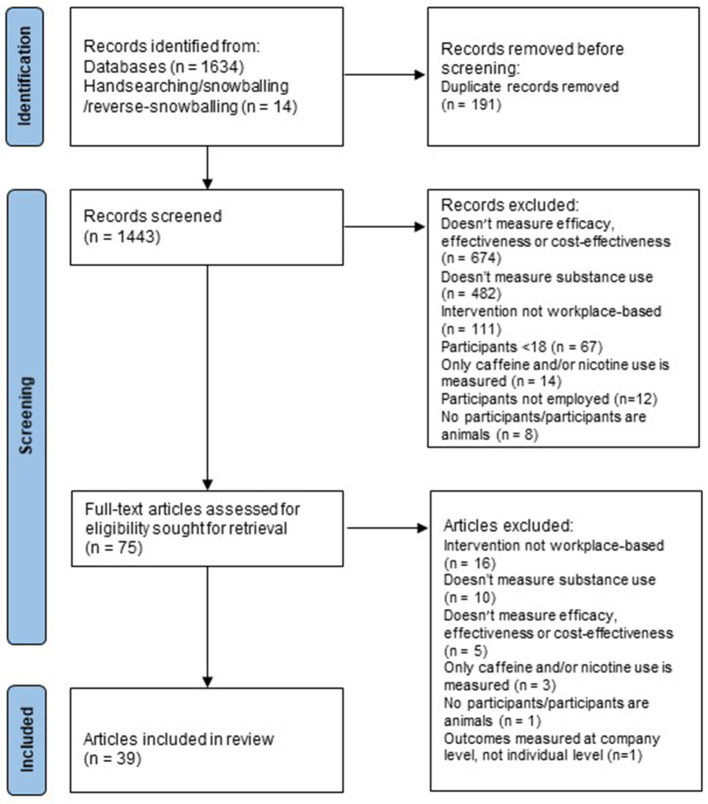
Employee alcohol and other drug use can negatively impact the workplace, resulting in absenteeism, reduced productivity, high turnover, and worksite safety issues. As the workplace can influence employee substance use through environmental and cultural factors, it also presents a key opportunity to deliver interventions, particularly to employees who may not otherwise seek help. This is a systematic review of workplace-based interventions for the prevention and treatment of problematic substance use. Five databases were searched for efficacy, effectiveness and/or cost-effectiveness studies and reviews published since 2010 that measured use of psychoactive substances (i.e., alcohol, cannabis, hallucinogens, inhalants, opioids, sedatives, hypnotics, anxiolytics, and stimulants) as a primary or secondary outcome, in employees aged over 18. Thirty-nine articles were identified, 28 describing primary research and 11 reviews, most of which focused solely on alcohol use. Heterogeneity between studies with respect to intervention and evaluation design limited the degree to which findings could be synthesized, however, there is some promising evidence for workplace-based universal health promotion interventions, targeted brief interventions, and universal substance use screening. The few studies that examined implementation in the workplace revealed specific barriers including lack of engagement with e-health interventions, heavy use and reluctance to seek help amongst male employees, and confidentiality concerns. Tailoring interventions to each workplace, and ease of implementation and employee engagement emerged as facilitators. Further high-quality research is needed to examine the effectiveness of workplace substance use testing, Employee Assistance Programs, and strategies targeting the use of substances other than alcohol in the workplace.
Systematic review registration: https://www.crd.york.ac.uk/prospero/display_record.php?RecordID=227598, PROSPERO [CRD42021227598].
Keywords: alcohol use; drug use; substance use; systematic review; workplace.
Copyright © 2022 Morse, Askovic, Sercombe, Dean, Fisher, Marel, Chatterton, Kay-Lambkin, Barrett, Sunderland, Harvey, Peach, Teesson and Mills.
Conflict of interest statement
The authors declare that the research was conducted in the absence of any commercial or financial relationships that could be construed as a potential conflict of interest.
Similar articles
-
Systematic review of the efficacy, effectiveness, and cost-effectiveness of stepped-care interventions for the prevention and treatment of problematic substance use.J Subst Abuse Treat. 2023 Jan;144:108928. doi: 10.1016/j.jsat.2022.108928. Epub 2022 Nov 4. J Subst Abuse Treat. 2023. PMID: 36370469
-
The impact of knowledge on attitudes of emergency department staff towards patients with substance related presentations: a quantitative systematic review protocol.JBI Database System Rev Implement Rep. 2015 Oct;13(10):133-45. doi: 10.11124/jbisrir-2015-2203. JBI Database System Rev Implement Rep. 2015. PMID: 26571289
-
Examining the Effectiveness of Web-Based Interventions to Enhance Resilience in Health Care Professionals: Systematic Review.JMIR Med Educ. 2022 Sep 6;8(3):e34230. doi: 10.2196/34230. JMIR Med Educ. 2022. PMID: 36066962 Free PMC article. Review.
-
Supporting active ageing before retirement: a systematic review and meta-analysis of workplace physical activity interventions targeting older employees.BMJ Open. 2021 Jun 30;11(6):e045818. doi: 10.1136/bmjopen-2020-045818. BMJ Open. 2021. PMID: 34193489 Free PMC article.
-
A systematic review of the effectiveness of employer-led interventions for drug misuse.J Occup Health. 2020 Jan;62(1):e12133. doi: 10.1002/1348-9585.12133. J Occup Health. 2020. PMID: 32533807 Free PMC article.
Cited by
-
Alcohol and other drug use by Australian workers: insights from a nationally representative cross-sectional survey.Health Promot Int. 2025 Mar 5;40(2):daaf048. doi: 10.1093/heapro/daaf048. Health Promot Int. 2025. PMID: 40252001 Free PMC article.
-
Interventions in the workplace to reduce risk factors for noncommunicable diseases: an umbrella review of systematic reviews of effectiveness.J Occup Health. 2024 Jan 4;66(1):uiae044. doi: 10.1093/joccuh/uiae044. J Occup Health. 2024. PMID: 39096275 Free PMC article.
-
Substance Use Right Before or During Work Among the Young US Workers: Evidence From the National Longitudinal Survey of Youth 1997 Cohort.Am J Ind Med. 2025 Aug;68(8):679-687. doi: 10.1002/ajim.23737. Epub 2025 May 15. Am J Ind Med. 2025. PMID: 40372126 Free PMC article.
-
Treatment Use Among U.S. Adults with a Substance Use Disorder: Associations with Symptom Severity, Problem Self-Perception, Comorbid Mental Illness, and Mental Health Treatment.Int J Environ Res Public Health. 2025 Apr 18;22(4):640. doi: 10.3390/ijerph22040640. Int J Environ Res Public Health. 2025. PMID: 40283861 Free PMC article.
References
-
- Smith DE, Marzilli L, Davidson LD. Strategies of Drug Prevention in the Workplace: an International Perspective of Drug Testing and Employee Assistance Programs. Textbook Addiction Treatment. New York, NY: Springer; (2021). p. 733-56. 10.1007/978-3-030-36391-8_51 - DOI
-
- Frone MR. Employee psychoactive substance involvement: historical context, key findings, and future directions. Annu Rev Organ Psychol Organ Behav. (2019) 6:273–97. 10.1146/annurev-orgpsych-012218-015231 - DOI
Publication types
MeSH terms
Substances
LinkOut - more resources
Full Text Sources
Medical
Research Materials
