


HIV retention in care: results and lessons learned from the Positive Pathways Implementation Trial
- PMID: 36424550
- PMCID: PMC9685944
- DOI: 10.1186/s12875-022-01909-2
HIV retention in care: results and lessons learned from the Positive Pathways Implementation Trial
Abstract
Background: Sustained, routine care is vital to the health of people with HIV (PWH) and decreasing transmission of HIV. We evaluated whether the identification of PWH at-risk of falling out of care and prompts for outreach were effective in retaining PWH in care in the United States.
Methods: In this cluster randomized controlled trial, 20 AIDS Healthcare Foundation Healthcare Centers (HCCs) were randomized to the intervention (n = 10) or control (n = 10) arm; all maintained existing retention efforts. The intervention included daily automated flags in CHORUS™, a mobile app and web-based reporting solution utilizing electronic health record data, that identified PWH at-risk of falling out of care to clinic staff. Among flagged PWH, the association between the intervention and visits after a flag was assessed using logistic regression models fit with generalized estimating equations (independent correlation structure) to account for clustering. To adjust for differences between HCCs, models included geographic region, number of PWH at HCC, and proportions of PWH who self-identified as Hispanic or had the Ryan White Program as a payer.
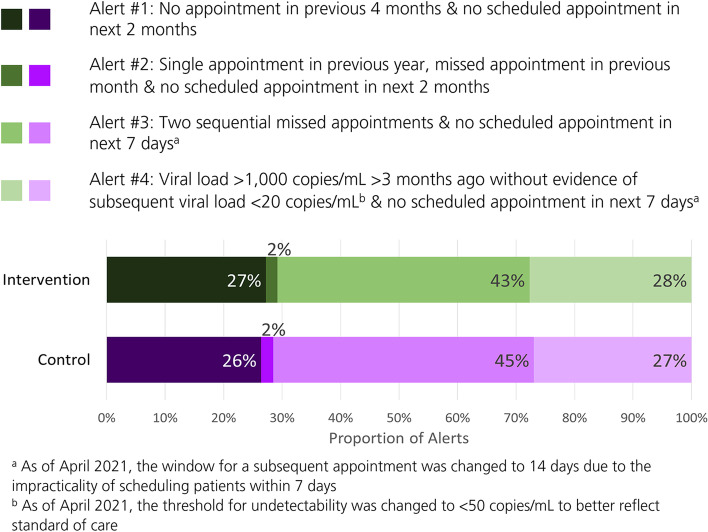
Results: Of 15,875 PWH in care, 56% were flagged; 76% (intervention) and 75% (control) resulted in a visit, of which 76% were within 2 months of the flag. In adjusted analyses, flags had higher odds of being followed by a visit (odds ratio [OR]: 1.08, 95% confidence interval [CI]: 0.97, 1.21) or a visit within 2 months (OR: 1.07, 95% CI: 0.97, 1.17) at intervention than control HCCs. Among at-risk PWH with viral loads at baseline and study end, the proportion with < 50 copies/mL increased in both study arms, but more so at intervention (65% to 74%) than control (62% to 67%) HCCs.
Conclusion: Despite challenges of the COVID-19 pandemic, adding an intervention to existing retention efforts, and the reality that behavior change takes time, PWH flagged as at-risk of falling out of care were marginally more likely to return for care at intervention than control HCCs and a greater proportion achieved undetectability. Sustained use of the retention module in CHORUS™ has the potential to streamline retention efforts, retain more PWH in care, and ultimately decrease transmission of HIV.
Trial registration: The study was first registered at Clinical Trials.gov (NCT04147832, https://clinicaltrials.gov/show/NCT04147832 ) on 01/11/2019.
Keywords: Alerts; Clinical Decision Support System; HIV; HIV Treatment and Prevention; Re-engagement; Retention in Care.
© 2022. The Author(s).
Conflict of interest statement
MBW has participated in post-conference advisory boards for the Conference on Retroviruses and Opportunistic Infections (CROI) and International AIDS Conference (IAC) and serves as a principal investigator on ViiV Healthcare clinical trials but does not receive personal compensation for this work, which goes directly to the AIDS Healthcare Foundation. MBW is also a member of the Epidemiology and Clinical Advisory Board for Epividian, Inc. RPW, LB, JSF, and GPF are employed by Epividian, Inc.; Epividian has had research funded by the AIDS Healthcare Foundation, EMD Serono, Gilead Sciences, Janssen Pharmaceutica, Merck & Co., Theratechnologies Inc., and ViiV Healthcare. CU, QC, MP, and CM have no conflicts of interest to declare. TE is employed by ViiV Healthcare and holds stocks and shares in GSK as part of their employment.
Figures

References
-
- Mugavero MJ, Westfall AO, Cole SR, Geng EH, Crane HM, Kitahata MM, Mathews WC, Napravnik S, Eron JJ, Moore RD, et al. Beyond core indicators of retention in HIV care: missed clinic visits are independently associated with all-cause mortality. Clin Infect Dis. 2014;59(10):1471–9. doi: 10.1093/cid/ciu603. - DOI - PMC - PubMed
Publication types
MeSH terms
Associated data
LinkOut - more resources
Full Text Sources
Medical