


Incidence of Carpal Tunnel Syndrome after Distal Radius Fracture
- PMID: 36425367
- PMCID: PMC9678711
- DOI: 10.1016/j.jhsg.2022.08.001
Incidence of Carpal Tunnel Syndrome after Distal Radius Fracture
Abstract
Purpose: Carpal tunnel syndrome (CTS) can present following distal radius fracture (DRF) and may progress to require carpal tunnel release (CTR). The primary aim of this study was to determine the incidence of CTS within 6 months of a DRF and the rate of CTR in this population.
Methods: We used the PearlDiver national insurance database to determine the incidence of CTS after DRF. Patients were identified by International Classification of Diseases-10 codes, and treatment modalities for DRF and CTS were determined by respective Current Procedural Terminology codes. Patients with less than 6 months of follow-up, bilateral DRF, or preexisting CTS were excluded. Patient demographic characteristics were recorded. The time from DRF diagnosis to CTS diagnosis and CTR was determined. A multivariable analysis was performed to determine the differences between patients who underwent a CTR compared with those who were treated conservatively.
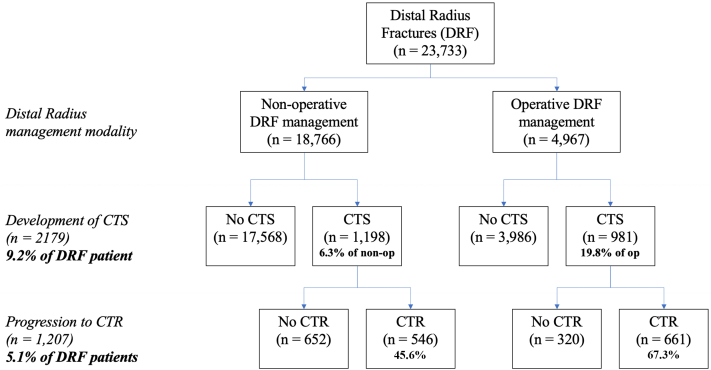
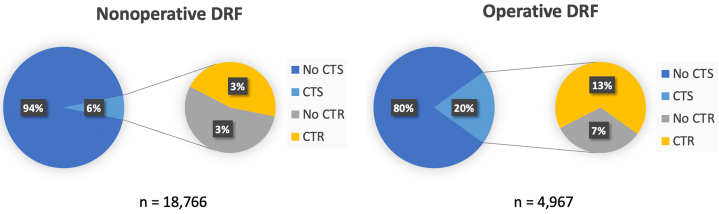
Results: We identified 23,733 patients (6,015 men; 17,718 women) who sustained a DRF. Of these patients, 79.1% were treated nonsurgically and 20.9% underwent surgical fixation. In total, 9.2% (N = 2,179) were diagnosed with CTS in their ipsilateral extremity within 6 months of sustaining the DRF. Of the patients whose DRF was treated nonsurgically, 6.3% (N = 1,198) developed CTS and 2.9% (N = 546) required CTR. Of those patients whose DRF was treated surgically, 19.8% (N = 981) developed CTS and 13.3% (N = 661) required CTR. Of those patients with symptoms severe enough to warrant CTR, 18.5% required a second surgical intervention for the CTR.
Conclusions: Distal radius fractures severe enough to require surgical fixation are associated with a higher incidence of perioperative CTS. Accordingly, careful evaluation for and counseling on CTS during surgical fixation may decrease the chance of a second surgery. We have identified a cohort of patients with DRFs who may benefit from prophylactic CTR.
Type of study/level of evidence: Diagnostic IV.
Keywords: Carpal tunnel release; Carpal tunnel syndrome; Distal radius fracture; Retrospective.
© 2022 The Authors.
Figures
References
-
- Cooney W.P., Dobyns J.H., Linscheid R.L. Complications of Colles' fractures. J Bone Joint Surg Am. 1980;62(4):613–619. - PubMed
-
- Kinley D.L., Evarts C.M. Carpal tunnel syndrome due to a small displaced fragment of bone. Report of a case. Cleve Clin Q. 1968;35(4):215–221. - PubMed
-
- Aro H., Koivunen T., Katevuo K., Nieminen S., Aho A.J. Late compression neuropathies after Colles' fractures. Clin Orthop Relat Res. 1988;233:217–225. - PubMed
-
- Brüske J., Niedźwiedź Z., Bednarski M., Zyluk A. [Acute carpal tunnel syndrome after distal radius fractures--long term results of surgical treatment with decompression and external fixator application] Chir Narzadow Ruchu Ortop Pol. 2002;67(1):47–53. - PubMed
-
- Adamson J.E., Srouji S.J., Horton C.E., Mladick R.A. The acute carpal tunnel syndrome. Plast Reconstr Surg. 1971;47(4):332–336. - PubMed
LinkOut - more resources
Full Text Sources
Research Materials
