


Whole genome sequence data of Stenotrophomonas maltophilia SCAID WND1-2022 (370)
- PMID: 36425995
- PMCID: PMC9679662
- DOI: 10.1016/j.dib.2022.108694
Whole genome sequence data of Stenotrophomonas maltophilia SCAID WND1-2022 (370)
Abstract
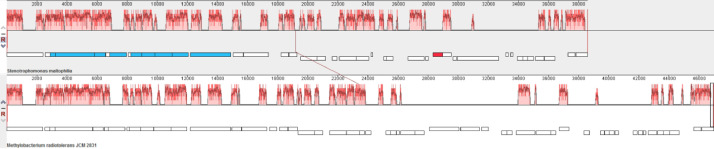
The whole genome sequence of a hospital infection agent, Stenotrophomonas maltophilia SCAID WND1-2022 (370), is reported. Raw PacBio generated reads and the genome sequence were deposited at NCBI under BioProject PRJNA754843. The genome comprises two replicons: 4,880,425 bp long chromosome comprising 4524 proteins and functional RNA coding genes and 38,606 bp long plasmid containing 40 CDS. Both replicons were methylated at third cytosine residues of ACCTC motifs. The taxonomic provenance of SCAID WND1-2022 (370) was determined by calculating sequence similarity to the reference genomes at NCBI that showed the highest 97.35% identity to S. maltophilia ISMMS4. Many antibiotic resistance and virulence genes were identified on the chromosome of S. maltophilia SCAID WND1-2022 (370), which include multiple efflux pumps, beta-lactamases, and genes involved in biofilm formation. The plasmid sequence was dissimilar to any known plasmid and seemingly was acquired from a distant microorganism. Plasmid-born genes possibly contributed to the virulence of the pathogens, but not to its drug resistance.
Keywords: Antimicrobial resistance; Hospital-associated pathogen; Methylation; Multidrug-resistant; Sequencing.
© 2022 The Author(s).
Conflict of interest statement
The authors declare that they have no known competing financial interests or personal relationships that could have appeared to influence the work reported in this paper.
Figures


References
-
- Li X.Z., Li J. Vol. 2. Springer; Cham: 2017. Antimicrobial resistance in stenotrophomonas maltophilia: mechanisms and clinical implications; pp. 937–958. (Antimicrobial Drug Resistance). - DOI
-
- CLSI . Vol. 30. CLSI; 2010. (Performance Standards for Antimicrobial Disk Susceptibility Test).
-
- Korotetskiy I.S., Jumagaziyeva A.B., Kerimzhanova B., Reva O.N., Shilov S.V., Kuznetsova T.V., Ivanova L., Korotetskaya N., Bekmukhamedova A., Satyigankyzy G., Klivleyeva N.G. Complete genome sequences of gram-positive opportunistic pathogens isolated from hospitals in Almaty, Kazakhstan. Microbiol. Resour. Announc. 2022;11(4) doi: 10.1128/mra.00093-22. e00093-22. - DOI - PMC - PubMed
LinkOut - more resources
Full Text Sources
Molecular Biology Databases
