


Editorial
doi: 10.3390/cells11223567.
Frontiers in Neurogenesis
Affiliations
- PMID: 36428996
- PMCID: PMC9688671
- DOI: 10.3390/cells11223567
Item in Clipboard
Editorial
Frontiers in Neurogenesis
Cells.
.
Abstract
One of the most intriguing dogmas in neurosciences-the empirical lack of brain neuronal regeneration in adulthood onwards to late life-began to be debunked initially by research groups focused on understanding postnatal (early days/weeks of murine and guinea pigs) neurodevelopmental and neuroplastic events [...].
Conflict of interest statement
The authors declare no conflict of interest.
Figures
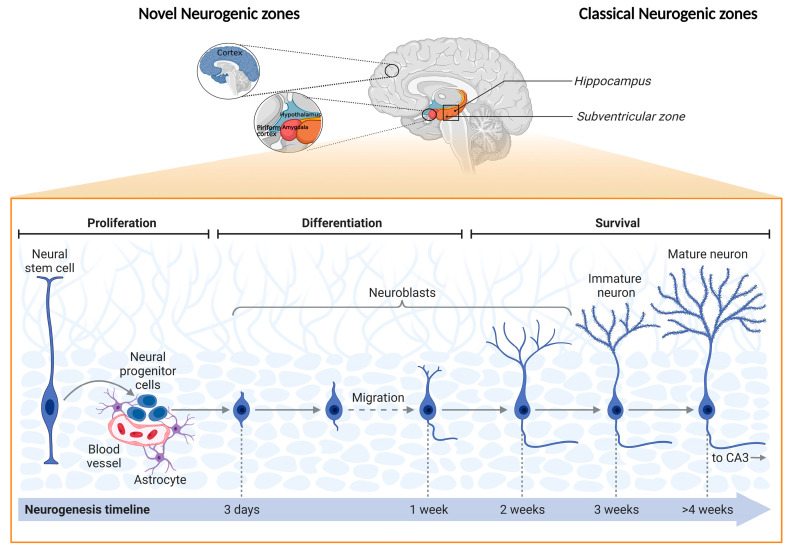
Schematic representation of “novel” and classical adult neurogenic zones, as well as their main cellular stages. Representation of the source of progenitor cells in different brain regions: the “novel” adult neurogenic zones—the prefrontal cortex, hypothalamus, striatum, amygdala, and piriform cortex—and the prime adult neurogenic zones—the hippocampus and subventricular zone (SVZ) [5]. The generation of new neurons has been extensively studied in the hippocampal dentate gyrus (DG) and the SVZ. In the DG, progenitor cells located in the subgranular zone (SGZ) divide and give rise to quiescent radial glial cells (neural stem cells) that can commit to neural progenitor cells and mature into neurons. These neurons will migrate to the granule cell layer to integrate into existing hippocampal circuitries. Experimental evidence has proposed that progenitor cells can deviate from the normal route in the DG and SVZ and differentiate as well as maturate in different brain regions, namely the prefrontal cortex, striatum, substantia nigra, and amygdala, considered the “novel neurogenic zones” [5,6]. Figure created with BioRender.com (Accessed on 25 October 2022).
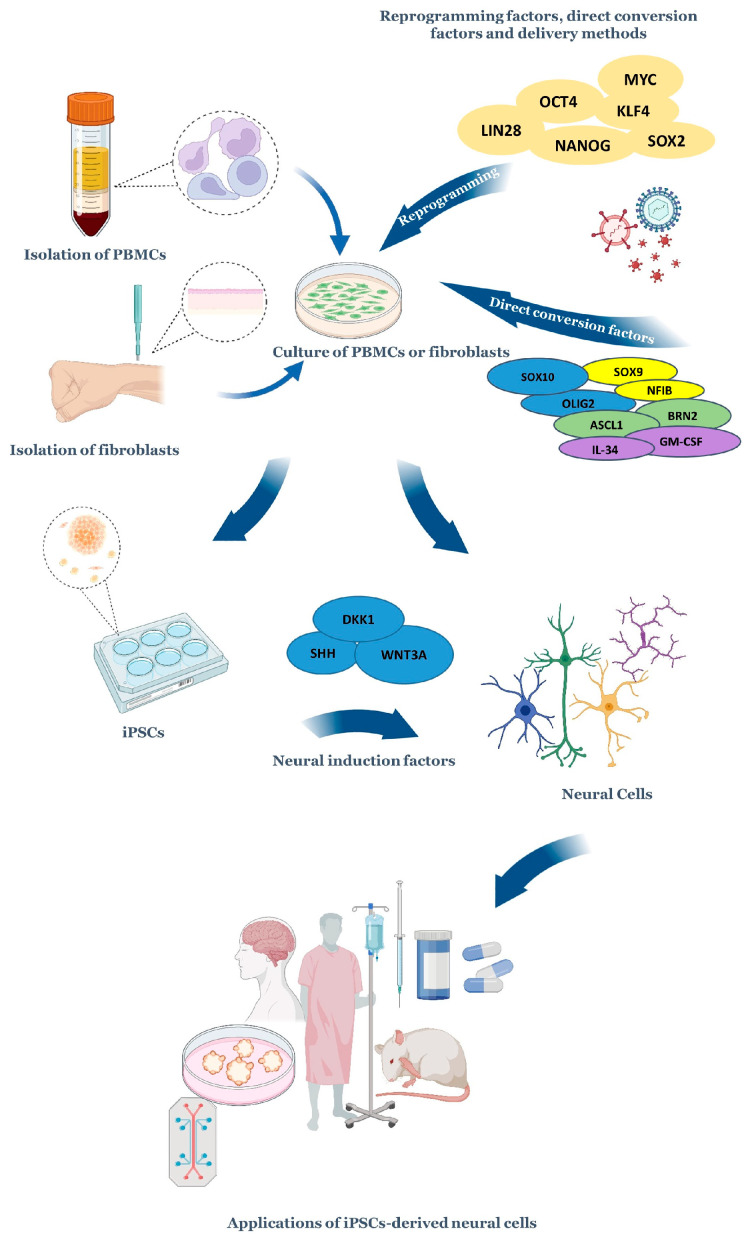
A summary of the process of obtaining and exploiting iPSC-derived neural cells. Somatic cells, such as peripheral blood mononuclear cells and fibroblasts, are typically collected from persons, as these cells are easy and not excessively painful to obtain. After their collection, these cells have different fates: (1) They can be reprogrammed into iPSCs through delivery strategies that include episomal vectors, non-integrating viral vectors, transient DNA transfection, transposons, and protein transduction. Therefore, these cells are forced to express specific transcription factors that reprogram the cells into a pluripotent state (e.g., SOX2, OCT4, and others highlighted in the image). The exposure to lineage-specific neural induction factors promotes the differentiation into neural cells. (2) They can be induced into neural cells in a process called transdifferentiation. This can be achieved through the overexpression of transcription factors, miRNAs, and exposure to chemical cocktails/direct conversion factors that mimic the signaling environment of the developing brain (growth factors and other signaling molecules [37,38]). Depending on the study’s needs, neural cells can be attained in 2D models or more complex 3D models that include brain organoids alone or connected to other organoids on platforms commonly known as organoids-on-a-chip, which can aid drug discovery and evaluate drug efficacy as well as some parameters, including toxicity. Several teams have transplanted iPSC-derived neuronal cells into the brains of mice to understand the peculiarities of circuit dynamics, and humans have already received iPSC-derived cellular transplants [39,40,41]. Adapted from [42]. Figure created with Microsoft PowerPoint® (2016) BioRender.com (Accessed on 25 October 2022).
References
Publication types
MeSH terms
LinkOut - more resources
Full Text Sources
