


Visualization and Analysis of Global Vision Zero Studies and Policy Orientation in China
- PMID: 36429560
- PMCID: PMC9690604
- DOI: 10.3390/ijerph192214841
Visualization and Analysis of Global Vision Zero Studies and Policy Orientation in China
Abstract
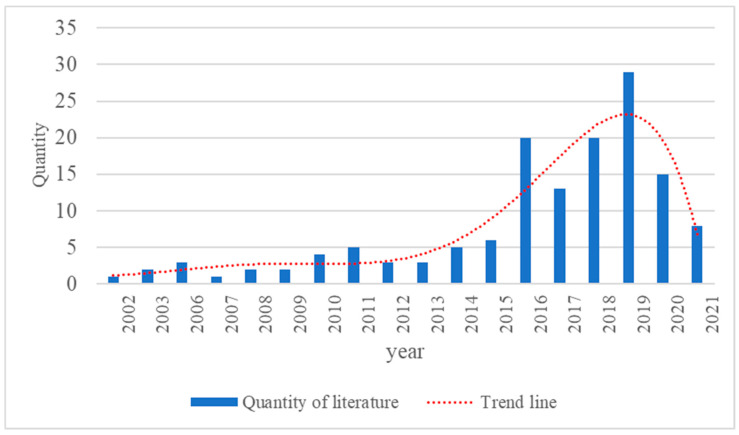
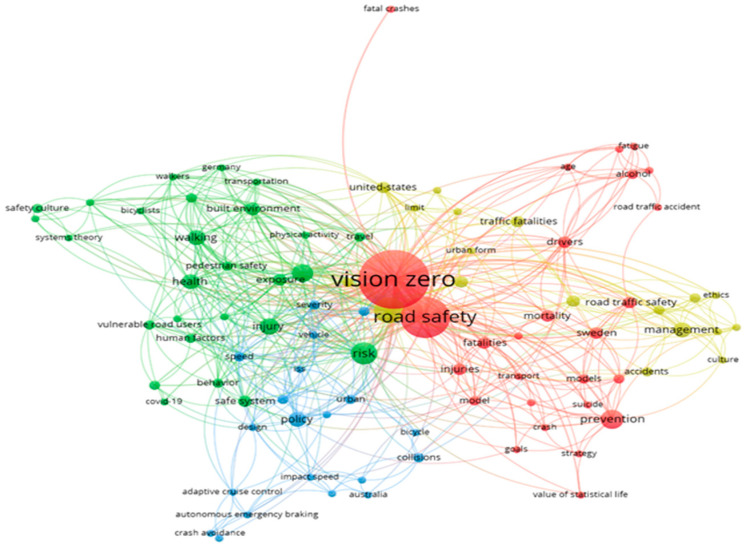
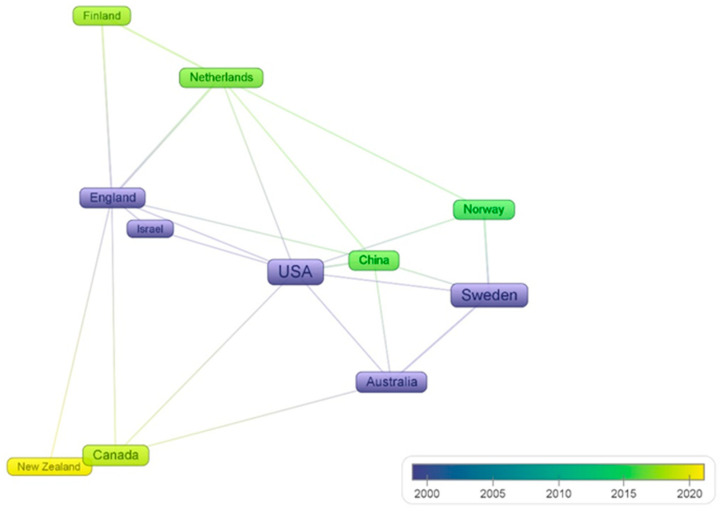
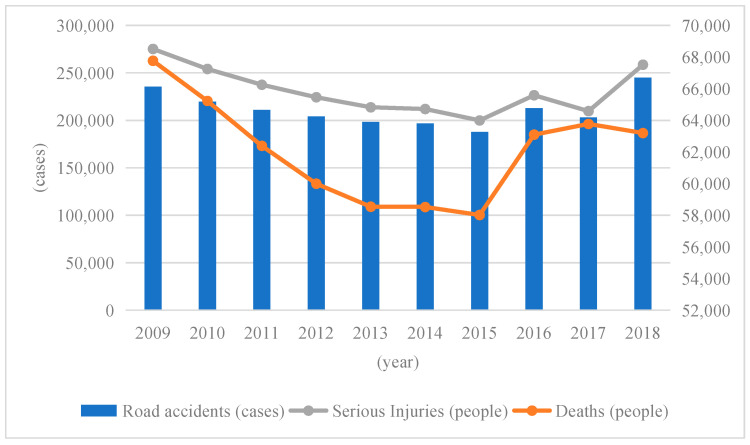
As a policy that is widely used worldwide, Vision Zero is a long-term strategic goal for road safety in China. The aim of this paper is to examine the literature in the field of Vision Zero retrieved by the Web of Science (WOS) Core Collection database from 1997 to 2021 based on mapping knowledge domain (MKD) and bibliometric methods. In this paper, we analyzed the overall development level of Vision Zero at different stages using the statistical analysis of the distribution of literature years. Based on the analysis, four major research directions of Vision Zero are obtained through keywords co-occurrence analysis, including "Vision Zero in road safety", "vulnerable road users' risks", "effect of speed on severity", and "responsibility management for crashes". Furthermore, we explore the influence and development potential of each country and region of Vision Zero based on the number and citation frequency of the literature, and the distribution of time dimensions. Among the research topics, all countries and regions are clustered into four clusters, and the current status of Vision Zero for countries in the most influential clusters, which include Sweden, the United States, Australia, China, and Norway, have been presented. Finally, an analysis of road safety in China is carried out, which includes displaying the changes in the number of road accidents, fatalities, and serious injuries in China between 2009 and 2018, comparing the fatalities per 10,000 vehicles and the fatalities per 100,000 people between China and other countries, and describing China's strategic routes toward Vision Zero.
Keywords: VOSviewer; Vision Zero; mapping knowledge domain; road safety; visualization analysis.
Conflict of interest statement
The authors declare no conflict of interest. The funders had no role in the design of the study; in the collection, analyses, or interpretation of data; in the writing of the manuscript, or in the decision to publish the results.
Figures


Similar articles
-
Visualization and analysis of mapping knowledge domain of road safety studies.Accid Anal Prev. 2018 Sep;118:131-145. doi: 10.1016/j.aap.2018.06.010. Epub 2018 Jun 27. Accid Anal Prev. 2018. PMID: 29958121
-
Incidence of seriously injured road users in a Swedish region, 2003-2014, from the perspective of a national road safety policy.BMC Public Health. 2019 Nov 27;19(1):1576. doi: 10.1186/s12889-019-7937-0. BMC Public Health. 2019. PMID: 31775706 Free PMC article.
-
Mapping the knowledge domain of road safety studies: A scientometric analysis.Accid Anal Prev. 2019 Nov;132:105243. doi: 10.1016/j.aap.2019.07.019. Epub 2019 Sep 5. Accid Anal Prev. 2019. PMID: 31494404 Review.
-
Vision Zero--a road safety policy innovation.Int J Inj Contr Saf Promot. 2012;19(2):171-9. doi: 10.1080/17457300.2011.635213. Epub 2011 Dec 14. Int J Inj Contr Saf Promot. 2012. PMID: 22166010
-
A bibliometric analysis of the published road traffic injuries research in India, post-1990.Health Res Policy Syst. 2018 Mar 1;16(1):18. doi: 10.1186/s12961-018-0298-9. Health Res Policy Syst. 2018. PMID: 29490646 Free PMC article. Review.
Cited by
-
Public Health Involvement in United States' Vision Zero Initiatives: A Mixed-Methods Study.J Public Health Manag Pract. 2024 Jul-Aug 01;30(4):567-577. doi: 10.1097/PHH.0000000000001988. Epub 2024 Jun 12. J Public Health Manag Pract. 2024. PMID: 38870374 Free PMC article.
-
Vision Zero for industrial workplace safety innovative model development for metal manufacturing industry.Heliyon. 2023 Nov 2;9(11):e21504. doi: 10.1016/j.heliyon.2023.e21504. eCollection 2023 Nov. Heliyon. 2023. PMID: 38027721 Free PMC article.
References
-
- WHO . Global Status Report on Road Safety 2018: Summary. World Health Organization; Geneva, Switzerland: 2018.
-
- Dekker S.W. The bureaucratization of safety. Saf. Sci. 2014;70:348–357. doi: 10.1016/j.ssci.2014.07.015. - DOI
-
- Larsson P., Dekker S.W., Tingvall C. The need for a systems theory approach to road safety. Saf. Sci. 2010;48:1167–1174. doi: 10.1016/j.ssci.2009.10.006. - DOI
Publication types
MeSH terms
LinkOut - more resources
Full Text Sources
Research Materials
