. 2022 Nov 18;19(22):15227.
doi: 10.3390/ijerph192215227.

Identification of a Novel Anti-HIV-1 Protein from Momordica balsamina Leaf Extract

Affiliations

Identification of a Novel Anti-HIV-1 Protein from Momordica balsamina Leaf Extract

Morgan I Coleman et al. Int J Environ Res Public Health. .

Abstract

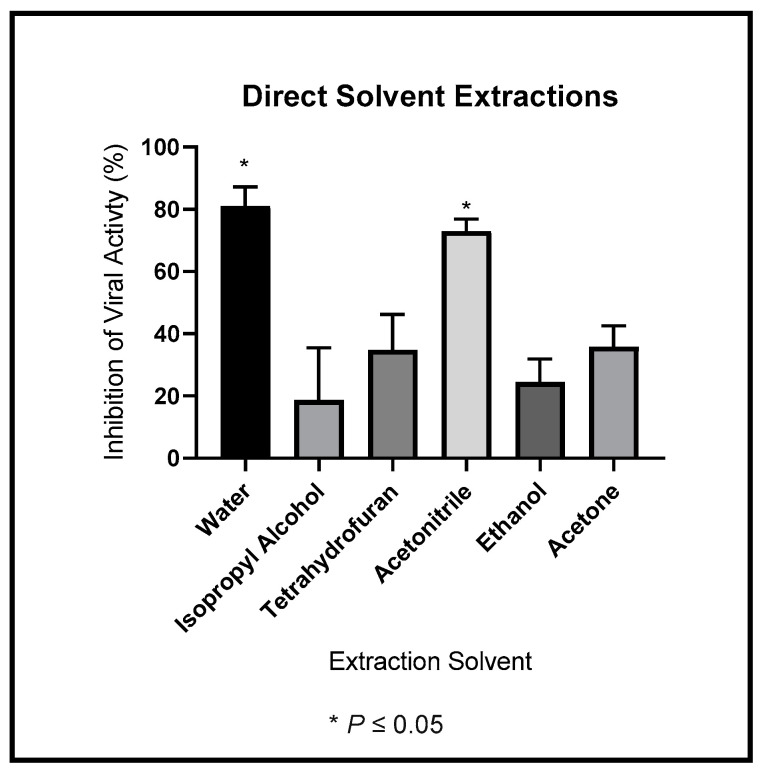
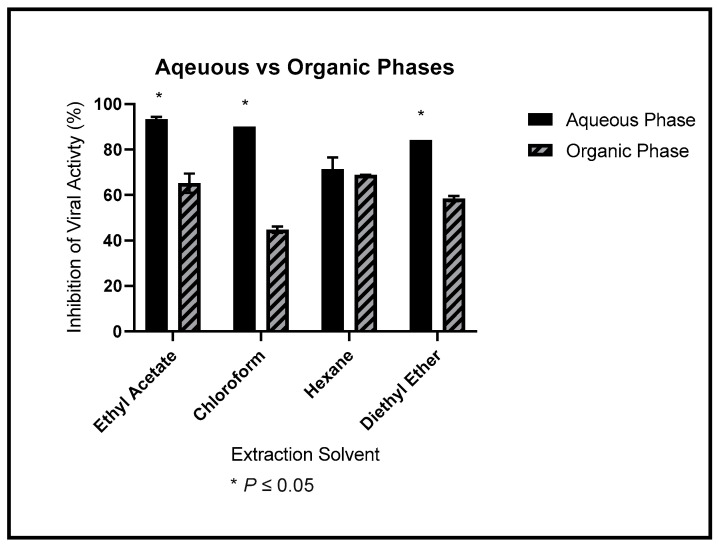
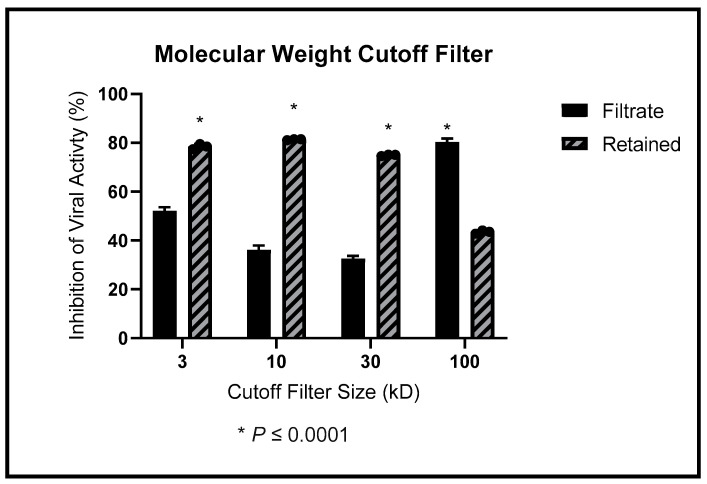
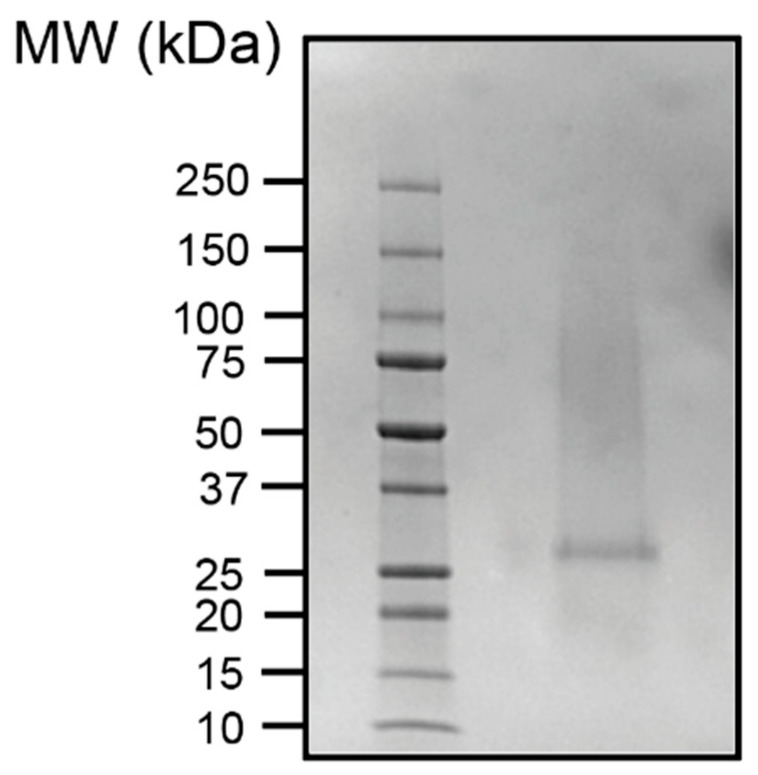
Our lab investigates the anti-HIV-1 activity in Momordica balsamina (M. balsamina) leaf extract. Traditional Senegalese healers have used M. balsamina leaf extract as a part of a plant-based treatment for HIV/AIDS infections. Our overall goal is to define and validate the scientific basis for using M. balsamina leaf extract as a part of the traditional Senegalese treatment. As an initial characterization of this extract, we used activity-guided fractionation to determine the active ingredient's solubility and relative size. We found that M. balsamina leaf extract inhibits HIV-1 infection by >50% at concentrations of 0.02 mg/mL and above and is not toxic over its inhibitory range (0-0.5 mg/mL). We observed significantly more antiviral activity in direct water and acetonitrile extractions (p ≤ 0.05). We also observed significantly more antiviral activity in the aqueous phases of ethyl acetate, chloroform, and diethyl ether extractions (p ≤ 0.05). Though most of the antiviral activity partitioned into the aqueous layers, some antiviral activity was present in the organic layers. We show that the active agent in the plant extracts is at least 30 kD in size. Significantly more antiviral activity was retained in 3, 10, and 30 kD molecular weight cutoff filters (p ≤ 0.05). In contrast, most of the antiviral activity passed through the 100 kD filter (p ≤ 0.05). Because the active anti-HIV-1 agent presented as a large, amphiphilic molecule we ran the purified extract on an SDS-page gel. We show that the anti-HIV-1 activity in the leaf extracts is attributed to a 30 kDa protein we call MoMo30. This article describes how MoMo30 was determined to be responsible for its anti-HIV-1 activity.

Keywords: HIV-1; MoMo30; antiviral; antiviral plant; antiviral protein; extract; fusion inhibitor.


Conflict of interest statement

The authors declare no conflict of interest.

Figures
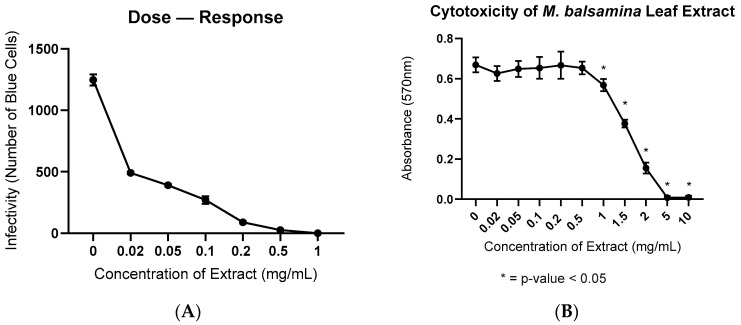
Figure 1
Figure 1
(A) This is a dose–response curve measuring the viral inhibition of the M. balsamina leaf extract against 1 ng of NL4-3. Treatment concentrations range from 0–1 mg/mL of extract. This assay was done in triplicate with the average infectivity for each concentration shown; (B) MTT assay. Concentrations of M. balsamina extract tested for cytotoxicity ranged from 0–10 mg/mL. The assay was done in triplicate.
Figure 2
Figure 2
Dried M. balsamina leaves were extracted into water, isopropyl alcohol, tetrahydrofuran, acetonitrile, ethanol, and acetone. We used the extracts to treat cells infected with 1 ng of HIV-1NL4-3. We show the average antiviral inhibitory effects.
Figure 3
Figure 3
Dried M. balsamina leaves were extracted into ethyl acetate, chloroform, hexane, and diethyl ether. We separated the extracts into an aqueous and organic layer and used the layers to treat cells infected with 1 ng of HIV-1NL4-3. We show the average anti-HIV-1 inhibitory effects. The solid bar represents the aqueous layer, and the dashed bar represents the organic layer. The assay was done in triplicate.
Figure 4
Figure 4
We passed through 3 kD, 10 kD, 30 kD, and 100 kD filters. The filtered and retained liquids were used to treat cells infected with 1 ng of HIV-1NL4-3. We show the average anti-HIV-1NL4-3 inhibitory effects. Solid bars present the filtrate, and dashed bars represent the retained liquid.
Figure 5
Figure 5
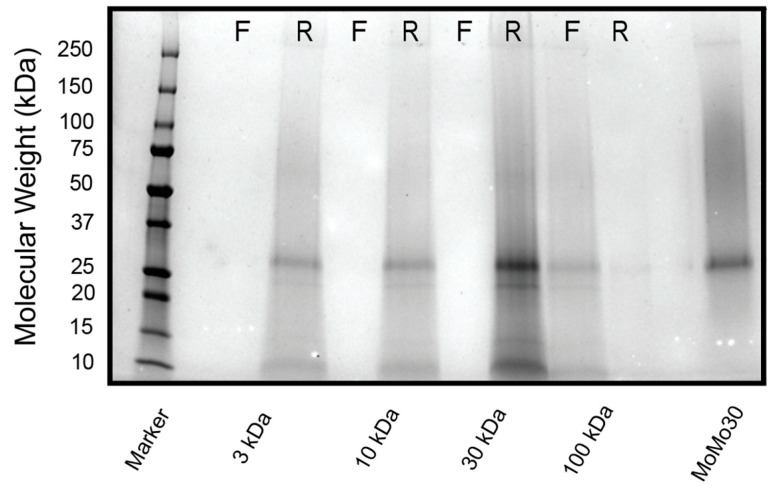
M. balsamina leaf extract was run on an SDS-PAGE gel. The gel was stained in C.B.B. to elucidate any possible proteins in the extract. Only one protein band appeared at approximately 30 kD.
Figure 6
Figure 6
M. balsamina leaf extract was run on an SDS-PAGE gel after passing through a series of molecular weight cutoff filters. “R” represents the liquid retained by the filter, and “F” represents the filtrate from the filter. The gel was stained in C.B.B. to elucidate any possible proteins in the extract.

References

    1. Patridge E., Gareiss P., Kinch M.S., Hoyer D. An analysis of FDA-approved drugs: Natural products and their derivatives. Drug Discov. Today. 2016;21:204–207. doi: 10.1016/j.drudis.2015.01.009. - DOI - PubMed
    1. Chan D.C., Kim P.S. HIV entry and its inhibition. Cell. 1998;93:681–684. doi: 10.1016/S0092-8674(00)81430-0. - DOI - PubMed
    1. Chawla A., Wang C., Patton C., Murray M., Punekar Y., de Ruiter A., Steinhart C. A review of long-term toxicity of antiretroviral treatment regimens and implications for an aging population. Infect. Dis. Ther. 2018;7:183–195. doi: 10.1007/s40121-018-0201-6. - DOI - PMC - PubMed
    1. Thakur G.S., Bag M., Sanodiya B.S., Bhadouriya P., Debnath M., Prasad G.B., Bisen P.S. Momordica balsamina: A medicinal and neutraceutical plant for health care management. Curr. Pharm. Biotechnol. 2009;10:667–682. doi: 10.2174/138920109789542066. - DOI - PubMed
    1. Ramalhete C., Gonçalves B.M.F., Barbosa F., Duarte N., Ferreira M.-J.U. Momordica balsamina: Phytochemistry and pharmacological potential of a gifted species. Phytochem. Rev. 2022;21:617–646. doi: 10.1007/s11101-022-09802-7. - DOI - PMC - PubMed

Publication types