


PAC1, VPAC1, and VPAC2 Receptor Expression in Rat and Human Trigeminal Ganglia: Characterization of PACAP-Responsive Receptor Antibodies
- PMID: 36430275
- PMCID: PMC9697343
- DOI: 10.3390/ijms232213797
PAC1, VPAC1, and VPAC2 Receptor Expression in Rat and Human Trigeminal Ganglia: Characterization of PACAP-Responsive Receptor Antibodies
Abstract
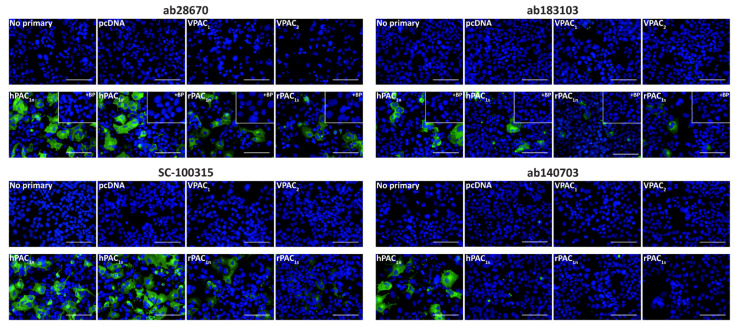
Pituitary adenylate cyclase-activating peptide (PACAP) is a neuropeptide expressed in the trigeminal ganglia (TG). The TG conducts nociceptive signals in the head and may play roles in migraine. PACAP infusion provokes headaches in healthy individuals and migraine-like attacks in patients; however, it is not clear whether targeting this system could be therapeutically efficacious. To effectively target the PACAP system, an understanding of PACAP receptor distribution is required. Therefore, this study aimed to characterize commercially available antibodies and use these to detect PACAP-responsive receptors in the TG. Antibodies were initially validated in receptor transfected cell models and then used to explore receptor expression in rat and human TG. Antibodies were identified that could detect PACAP-responsive receptors, including the first antibody to differentiate between the PAC1n and PAC1s receptor splice variants. PAC1, VPAC1, and VPAC2 receptor-like immunoreactivity were observed in subpopulations of both neuronal and glial-like cells in the TG. In this study, PAC1, VPAC1, and VPAC2 receptors were detected in the TG, suggesting they are all potential targets to treat migraine. These antibodies may be useful tools to help elucidate PACAP-responsive receptor expression in tissues. However, most antibodies exhibited limitations, requiring the use of multiple methodologies and the careful inclusion of controls.
Keywords: PAC1 receptor; PACAP; VIP; VPAC1 receptor; VPAC2 receptor; migraine; trigeminal ganglia.
Conflict of interest statement
Debbie L. Hay is or has been a consultant or speaker for Lilly, Amgen, Teva, Intarcia, Merck Sharp & Dohme and has received research funding from Living Cell Technologies (Sydney, Australia) and Abbvie Inc. (Mettawa, IL USA.) in the past three years. Christopher S. Walker has received research support from Living Cell Technologies and Abbvie Inc.
Figures


References
-
- Csati A., Tajti J., Kuris A., Tuka B., Edvinsson L., Warfvinge K. Distribution of vasoactive intestinal peptide, pituitary adenylate cyclase-activating peptide, nitric oxide synthase, and their receptors in human and rat sphenopalatine ganglion. Neuroscience. 2012;202:158–168. doi: 10.1016/j.neuroscience.2011.10.055. - DOI - PubMed
MeSH terms
Substances
Grants and funding
LinkOut - more resources
Full Text Sources
Medical
Molecular Biology Databases
Miscellaneous
