Review
. 2022 Nov 20;23(22):14436.
doi: 10.3390/ijms232214436.

TGF-β Signaling in Metastatic Colorectal Cancer (mCRC): From Underlying Mechanism to Potential Applications in Clinical Development

Affiliations
Review

TGF-β Signaling in Metastatic Colorectal Cancer (mCRC): From Underlying Mechanism to Potential Applications in Clinical Development

Xiaoshuang Li et al. Int J Mol Sci. .

Abstract

Colorectal cancer (CRC) is a serious public health issue, and it has the leading incidence and mortality among malignant tumors worldwide. CRC patients with metastasis in the liver, lung or other distant sites always have poor prognosis. Thus, there is an urgent need to discover the underlying mechanisms of metastatic colorectal cancer (mCRC) and to develop optimal therapy for mCRC. Transforming growth factor-β (TGF-β) signaling plays a significant role in various physiologic and pathologic processes, and aberrant TGF-β signal transduction contributes to mCRC progression. In this review, we summarize the alterations of the TGF-β signaling pathway in mCRC patients, the functional mechanisms of TGF-β signaling, its promotion of epithelial-mesenchymal transition, its facilitation of angiogenesis, its suppression of anti-tumor activity of immune cells in the microenvironment and its contribution to stemness of CRC cells. We also discuss the possible applications of TGF-β signaling in mCRC diagnosis, prognosis and targeted therapies in clinical trials. Hopefully, these research advances in TGF-β signaling in mCRC will improve the development of new strategies that can be combined with molecular targeted therapy, immunotherapy and traditional therapies to achieve better efficacy and benefit mCRC patients in the near future.

Keywords: TGF-β signaling; colorectal cancer; immune-suppressive; metastasis; targeting therapy.


Conflict of interest statement

The authors declare no conflict of interest.

Figures
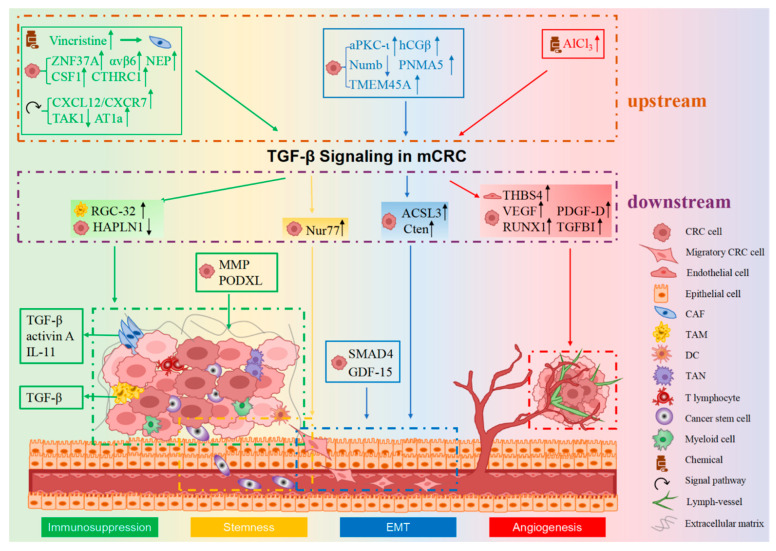
Figure 1
Figure 1
The mechanism of TGF-β signaling in CRC metastasis. TGF-β mainly affects CRC metastasis in four different ways: EMT, angiogenesis, immunosuppression and stemness. Together, they work to facilitate the metastasis of CRC. Tumor cells undergo the EMT process, acquire a mesenchymal-like phenotype in response to TGF-β signaling and then becoming more invasive and spread to distant sites. TGF-β signaling can mediate the formation of new blood vessels, which can promote intravasation of tumor cells from primary lesions into the blood vessels, resulting in tumor metastasis. In the tumor microenvironment (TME), immune cells such as CAFs and TAMs contribute to the immunosuppressive microenvironment and induce dissemination of tumor cells to distant places through TGF-β signaling. Moreover, TGF-β signaling can regulate CSCs in CRC, further promoting tumor metastasis. The molecules upstream or downstream of TGF-β signaling have been enclosed by dotted lines of different colors, and they function through EMT, angiogenesis, immunosuppression and stemness, respectively (distinguished by four different background colors). The symbols in front of the molecules represent whether it is a chemical, a signal factor or a molecule secreted by CRC cells, epithelial cells or immune cells in the TME. EMT, epithelial-to-mesenchymal transition. The legend for different cell types is shown in the lower right.

References

    1. Sung H., Ferlay J., Siegel R.L., Laversanne M., Soerjomataram I., Jemal A., Bray F. Global Cancer Statistics 2020: GLOBOCAN Estimates of Incidence and Mortality Worldwide for 36 Cancers in 185 Countries. CA Cancer J. Clin. 2021;71:209–249. doi: 10.3322/caac.21660. - DOI - PubMed
    1. Siegel R.L., Miller K.D., Fuchs H.E., Jemal A. Cancer statistics, 2022. CA Cancer J. Clin. 2022;72:7–33. doi: 10.3322/caac.21708. - DOI - PubMed
    1. Xia C., Dong X., Li H., Cao M., Sun D., He S., Yang F., Yan X., Zhang S., Li N., et al. Cancer statistics in China and United States, 2022: Profiles, trends, and determinants. Chin. Med. J. 2022;135:584–590. doi: 10.1097/CM9.0000000000002108. - DOI - PMC - PubMed
    1. Chen W., Zheng R., Baade P.D., Zhang S., Zeng H., Bray F., Jemal A., Yu X.Q., He J. Cancer statistics in China, 2015. CA Cancer J. Clin. 2016;66:115–132. doi: 10.3322/caac.21338. - DOI - PubMed
    1. Hutter C.M., Chang-Claude J., Slattery M.L., Pflugeisen B.M., Lin Y., Duggan D., Nan H., Lemire M., Rangrej J., Figueiredo J.C., et al. Characterization of gene-environment interactions for colorectal cancer susceptibility loci. Cancer Res. 2012;72:2036–2044. doi: 10.1158/0008-5472.CAN-11-4067. - DOI - PMC - PubMed

Substances

LinkOut - more resources
