


Viral Hepatitis C New Microelimination Pathways Objective: Psychiatric Communities HCV Free
- PMID: 36431008
- PMCID: PMC9697639
- DOI: 10.3390/life12111873
Viral Hepatitis C New Microelimination Pathways Objective: Psychiatric Communities HCV Free
Abstract
Background: People with psychiatric disorders have a high prevalence of HCV. For this reason, tailored interventions should be developed to reach this population.
Methods: We performed a retrospective study on patients treated for HCV infection in psychiatric nursing homes, approached with a quick diagnosis, staging and treatment.
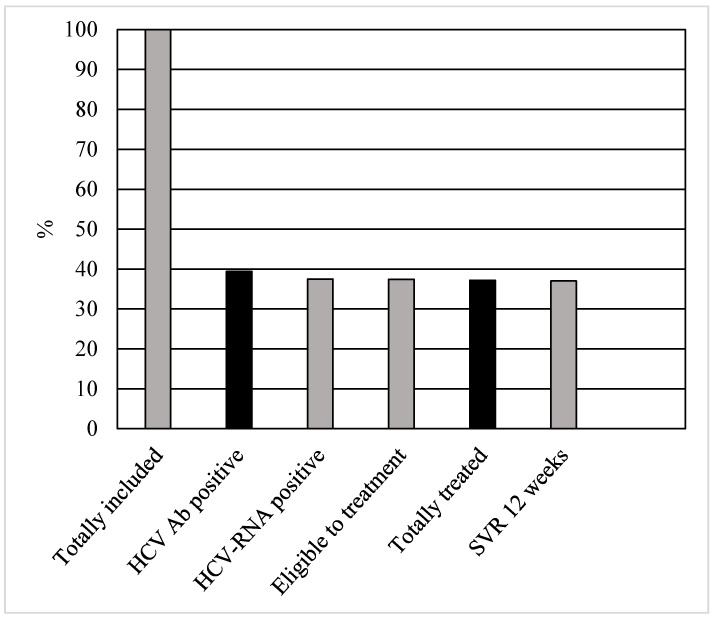
Results: We included data on 586 people screened for HCV with quick tests. High HCV seroprevalence was found in this population (231; 39.4%). Among people who tested positive, there were high rates of active infection (220; 95.2%). Out of the 220 patients with active infection, 95.9% were male, 85.5% were Italian, median age was 43 (IQR = 35-52) years old. In the majority of cases (162; 73.6%), the risk factor was unknown. The most common genotype was 3a (98; 44.5%), and patients mostly had a low fibrosis, according with FIB-4 value (142; 64.5%). Of them, one (0.45%) categorically refused the treatment, and one (0.45%) had liver cirrhosis and advanced hepatocellular carcinoma. Overall, 218 patients underwent eligibility for DAAs. The most prescribed treatment was glecaprevir/pibrentasvir (GLE/PIB (172; 78.2%)). The others practiced sofosbuvir/velpatasvir (SOF/VEL). All patients reached the end of treatment. One (0.45%) was lost to follow up, and all the others reached the SVR12.
Conclusions: The point-of-care testing and pangenotypic DAAs' availability represent one of the most important steps for a fast diagnostic and therapeutical option. Tailored microelimination pathways for every difficult-to-reach/to-treat populations are needed. This would allow us to move more easily towards HCV elimination.
Keywords: DAAs; chronic HCV hepatitis; microelimination programs; psychiatric disorders.
Conflict of interest statement
The authors declare no conflict of interest.
Figures
References
-
- WHO Hepatitis C factsheets. Switzerland. 2022. [(accessed on 29 September 2022)]. Available online: https://www.who.int/news-room/fact-sheets/detail/hepatitis-c.
LinkOut - more resources
Full Text Sources
