


Pesticide Residues in Vegetables and Fruits from Farmer Markets and Associated Dietary Risks
- PMID: 36432173
- PMCID: PMC9695969
- DOI: 10.3390/molecules27228072
Pesticide Residues in Vegetables and Fruits from Farmer Markets and Associated Dietary Risks
Abstract
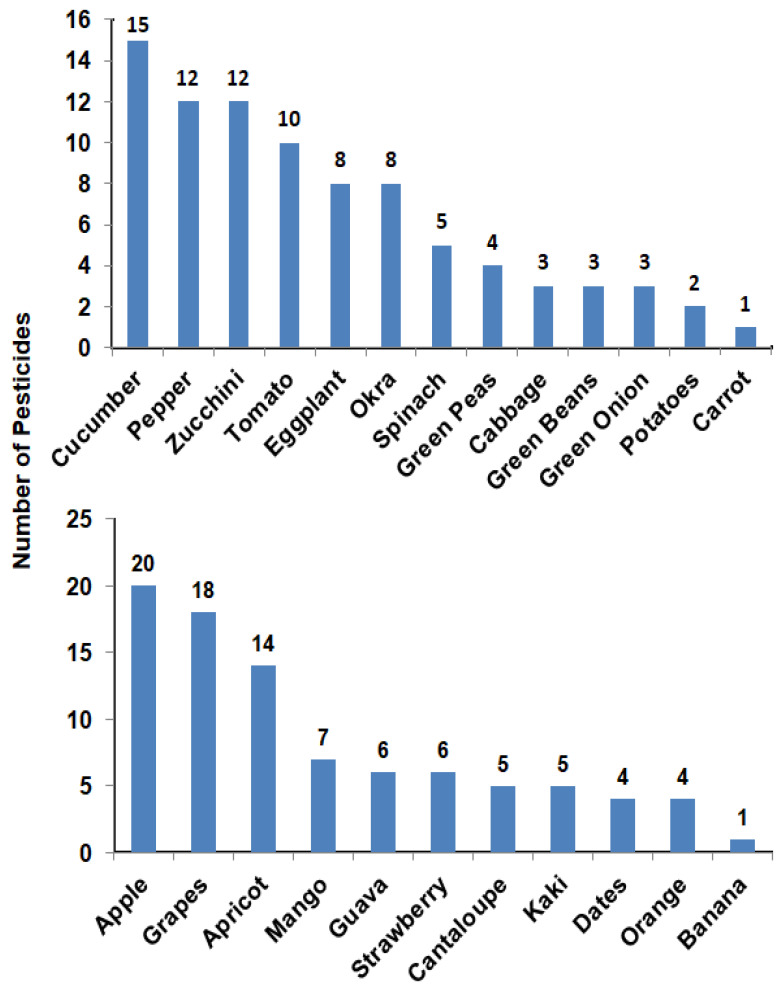
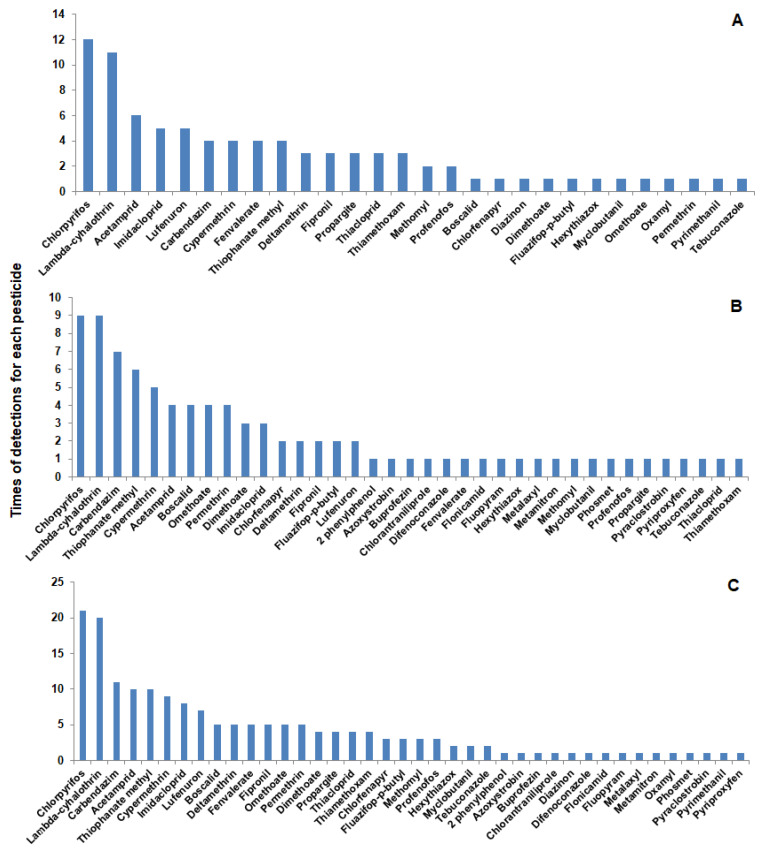
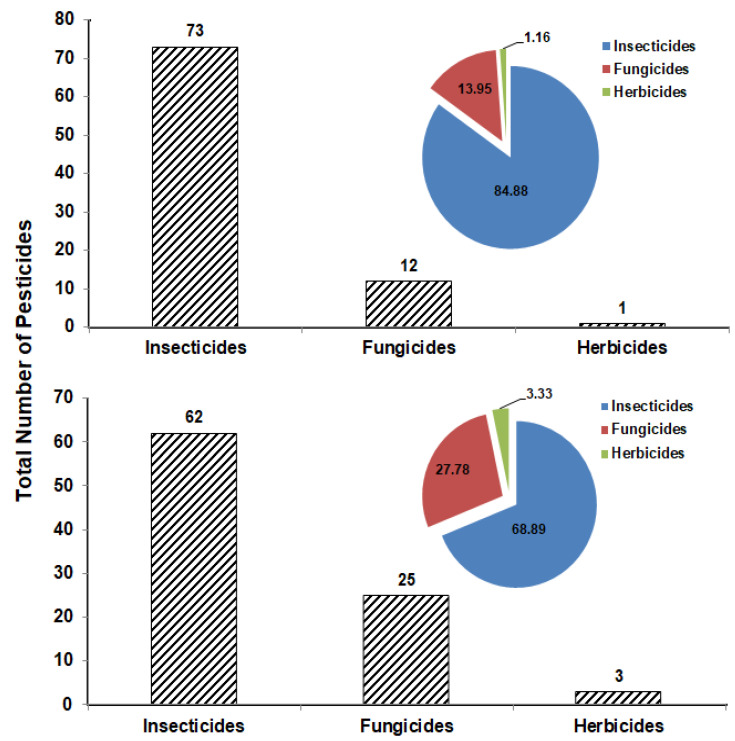
The use of pesticides leads to an increase in agricultural production but also causes harmful effects on human health when excessively used. For safe consumption, pesticide residues should be below the maximum residual limits (MRLs). In this study, the residual levels of pesticides in vegetables and fruits collected from farmers' markets in Sharkia Governorate, Egypt were investigated using LC-MS/MS and GC-MS/MS. A total number of 40 pesticides were detected in the tested vegetable and fruit samples. Insecticides were the highest group in detection frequency with 85% and 69% appearance in vegetables and fruits, respectively. Cucumber and apple samples were found to have the highest number of pesticide residues. The mean residue levels ranged from 7 to 951 µg kg-1 (in vegetable samples) and from 8 to 775 µg kg-1 (in fruit samples). It was found that 35 (40.7%) out of 86 pesticide residues detected in vegetables and 35 (38.9%) out of 90 pesticide residues detected in fruits exceeded MRLs. Results for lambda-cyhalothrin, fipronil, dimothoate, and omethoate in spinach, zucchini, kaki, and strawberry, respectively, can cause acute or chronic risks when consumed at 0.1 and 0.2 kg day-1. Therefore, it is necessary for food safety and security to continuously monitor pesticide residues in fruits and vegetables in markets.
Keywords: dietary risk exposure; fruits; pesticide residues; vegetables.
Conflict of interest statement
The authors declare no conflict of interest.
Figures
References
-
- Kolani L., Mawussi G., Sanda K. Assessment of organochlorine pesticide residues in vegetable samples from some agricultural areas in Togo. Am. J. Anal. Chem. 2016;7:332–341. doi: 10.4236/ajac.2016.74031. - DOI
-
- Chu Y., Tong Z., Dong X., Sun M., Gao T., Duan J., Wang M. Simultaneous determination of 98 pesticide residues in strawberries using UPLC-MS/MS and GC-MS/MS. Microchem. J. 2020;156:104975. doi: 10.1016/j.microc.2020.104975. - DOI
-
- FAO . World Food and Agriculture—Statistical Year Book 2021. FAO; Rome, Italy: 2021.
-
- FAO . Pesticides Use: Global, Regional and Country Trends, 1990–2018. FAO; Rome, Italy: 2021. (FAOSTAT Analytical Brief Series No. 16).
MeSH terms
Substances
Grants and funding
LinkOut - more resources
Full Text Sources
Medical
Miscellaneous
