. 2022 Nov 25;12(1):19888.
doi: 10.1038/s41598-022-22018-1.

Microbial pyrazine diamine is a novel electrolyte additive that shields high-voltage LiNi1/3Co1/3Mn1/3O2 cathodes

Affiliations

Microbial pyrazine diamine is a novel electrolyte additive that shields high-voltage LiNi1/3Co1/3Mn1/3O2 cathodes

Agman Gupta et al. Sci Rep. .

Abstract

The uncontrolled oxidative decomposition of electrolyte while operating at high potential (> 4.2 V vs Li/Li+) severely affects the performance of high-energy density transition metal oxide-based materials as cathodes in Li-ion batteries. To restrict this degradative response of electrolyte species, the need for functional molecules as electrolyte additives that can restrict the electrolytic decomposition is imminent. In this regard, bio-derived molecules are cost-effective, environment friendly, and non-toxic alternatives to their synthetic counter parts. Here, we report the application of microbially synthesized 2,5-dimethyl-3,6-bis(4-aminobenzyl)pyrazine (DMBAP) as an electrolyte additive that stabilizes high-voltage (4.5 V vs Li/Li+) LiNi1/3Mn1/3Co1/3O2 cathodes. The high-lying highest occupied molecular orbital of bio-additive (DMBAP) inspires its sacrificial in situ oxidative decomposition to form an organic passivation layer on the cathode surface. This restricts the excessive electrolyte decomposition to form a tailored cathode electrolyte interface to administer cyclic stability and enhance the capacity retention of the cathode.


Conflict of interest statement

The authors declare no competing interests.

Figures
Scheme 1
Scheme 1
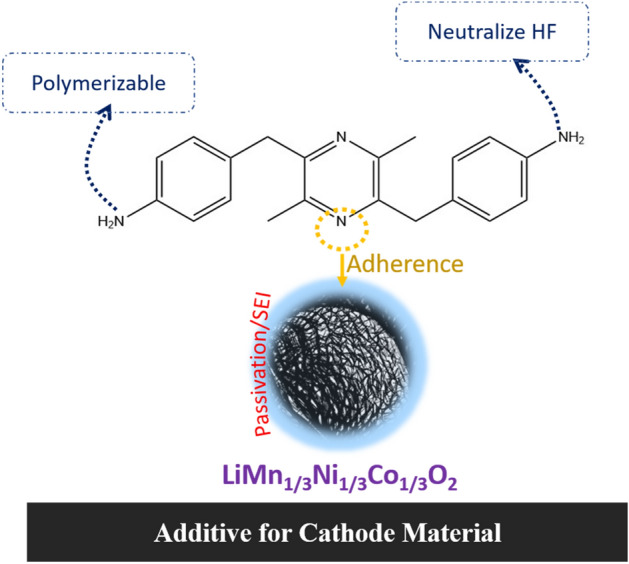
Structural significance and mode of action of DMBAP additive to stabilize LIB cathodes.
Figure 1
Figure 1
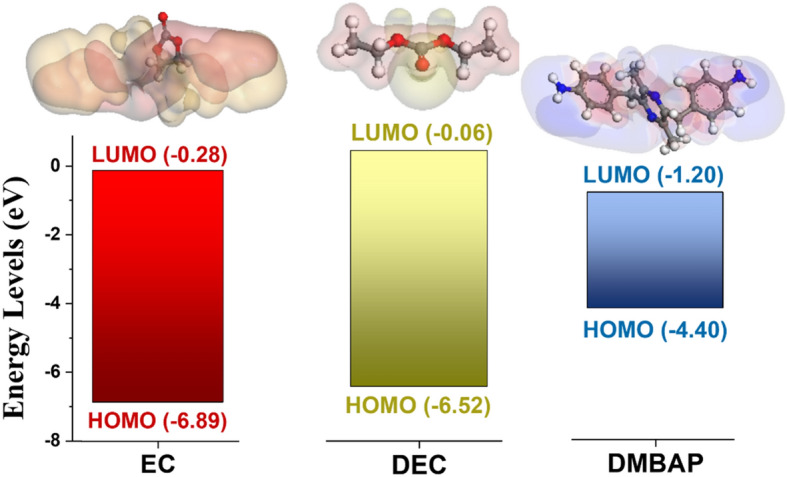
Theoretical evaluation of electrolyte components and DMBAP bio-additive. HOMO–LUMO band energy comparison between the electrolyte components ethylene carbonate (EC), diethyl carbonate (DEC), and DMBAP additive, respectively with their corresponding DFT optimized structures.
Figure 2
Figure 2
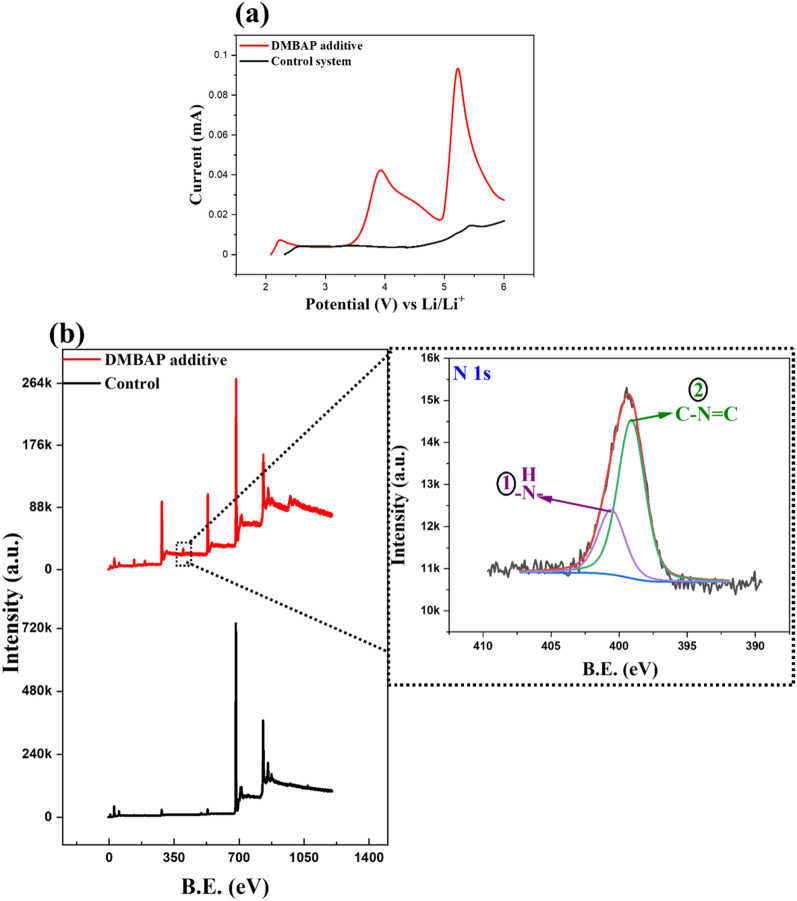
LSV studies and XPS characterization after LSV studies. (a) Oxidative linear sweep voltammogram from 0.0 to 6.0 V versus Li/Li+ at a scan rate of 1.0 mVs−1 and (b) XPS spectra recorded after LSV measurements to determine the fate of DMBAP additive after oxidative decomposition in comparison to the control system.
Figure 3
Figure 3
Charge–discharge studies. (a) Comparison between charge–discharge performance of control system and DMBAP-based cathodic half-cell at varying current-rates (rate studies), (b) long cycling performance of DMBAP-based cathodic half-cell at 1C rate against the control system with no additive, (c) comparison of capacity retention between the DMBAP additive-based half-cell and control system, (d) comparison of overpotential between the control system and DMBAP-based cathodic half-cells during long cycling at 1C-rate, and (e) reversible capacity versus cycle number comparison between DMBAP-based and control electrolyte-based full cells, respectively.
Figure 4
Figure 4
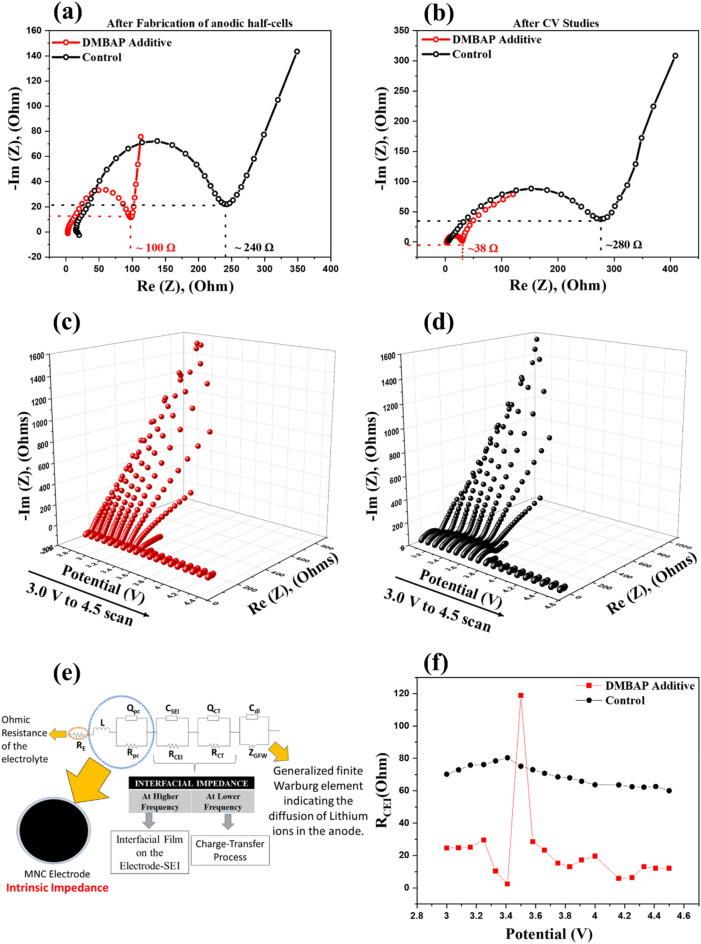
Impedance Spectroscopy Studies. Nyquist impedance profile comparison for DMBAP-based cathodic half-cell and control system (a) after fabrication and (b) after CV studies, respectively. DEIS 3-D Nyquist profiles after delithiation half-cycle of (c) DMBAP-based cathodic half-cell and (d) control system-based cathodic half-cell. (e) The best fit Equivalent Electrical Circuit Model (EECM) for computational simulation of 3D-Nyquist Impedance profiles for both systems, and (f) CEI impedance (RCEI) versus potential (V) comparison profiles during lithiation half-cycle in case of DMBAP-based cathodic half-cell and control system, respectively.
Figure 5
Figure 5
Study of surface morphology of LiNi1/3Mn1/3Co1/3O2 cathodes upon storage in electrolyte. SEM micrographs of (a) pristine cathode, (b) cathode stored in electrolyte with no additive, and (c) cathode stored in electrolyte with DMBAP additive, respectively.

References

    1. Scrosati B, Hassoun J, Sun Y-K. Lithium-ion batteries. A look into the future. Energy Environ. Sci. 2011;4:3287–3295. doi: 10.1039/c1ee01388b. - DOI
    1. Kang K, Meng YS, Bréger J, Grey CP, Ceder G. Electrodes with high power and high capacity for rechargeable lithium batteries. Science. 2006;311:977. doi: 10.1126/science.1122152. - DOI - PubMed
    1. Goodenough JB, Park K-S. The Li-ion rechargeable battery: A perspective. J. Am. Chem. Soc. 2013;135:1167–1176. doi: 10.1021/ja3091438. - DOI - PubMed
    1. Weiss M, et al. Fast charging of lithium-ion batteries: A review of materials aspects. Adv. Energy Mater. 2021;11:2101126. doi: 10.1002/aenm.202101126. - DOI
    1. Yan J, Liu X, Li B. Recent progress in Li-rich layered oxides as cathode materials for Li-ion batteries. RSC Adv. 2014;4:63268–63284. doi: 10.1039/C4RA12454E. - DOI

Publication types