. 2023 Jan 26;62(5):e202215678.
doi: 10.1002/anie.202215678. Epub 2022 Dec 19.

Parahydrogen-Induced Carbon-13 Radiofrequency Amplification by Stimulated Emission of Radiation

Affiliations

Parahydrogen-Induced Carbon-13 Radiofrequency Amplification by Stimulated Emission of Radiation

Christopher Nelson et al. Angew Chem Int Ed Engl. .

Abstract

The feasibility of Carbon-13 Radiofrequency (RF) Amplification by Stimulated Emission of Radiation (C-13 RASER) is demonstrated on a bolus of liquid hyperpolarized ethyl [1-13 C]acetate. Hyperpolarized ethyl [1-13 C]acetate was prepared via pairwise addition of parahydrogen to vinyl [1-13 C]acetate and polarization transfer from nascent parahydrogen-derived protons to the carbon-13 nucleus via magnetic field cycling yielding C-13 nuclear spin polarization of approximately 6 %. RASER signals were detected from samples with concentration ranging from 0.12 to 1 M concentration using a non-cryogenic 1.4T NMR spectrometer equipped with a radio-frequency detection coil with a quality factor (Q) of 32 without any modifications. C-13 RASER signals were observed for several minutes on a single bolus of hyperpolarized substrate to achieve 21 mHz NMR linewidths. The feasibility of creating long-lasting C-13 RASER on biomolecular carriers opens a wide range of new opportunities for the rapidly expanding field of C-13 magnetic resonance hyperpolarization.

Keywords: Carbon-13; Hyperpolarization; NMR Spectroscopy; Parahydrogen; RASER.


Figures

Figure 1.
Figure 1.
(top) schematic of pairwise parahydrogen (p-H2) addition to vinyl acetate (VA) precursor followed by polarization transfer from nascent p-H2-derived protons to the ethyl acetate 1-13C nucleus via magnetic field cycling (note the optional 13C labeling shown with asterisk); (bottom) schematic of experimental setup for p-H2 pairwise addition to unsaturated substrate, and polarization transfer to the 13C nucleus via magnetic field cycling (SI).
Figure 2.
Figure 2.
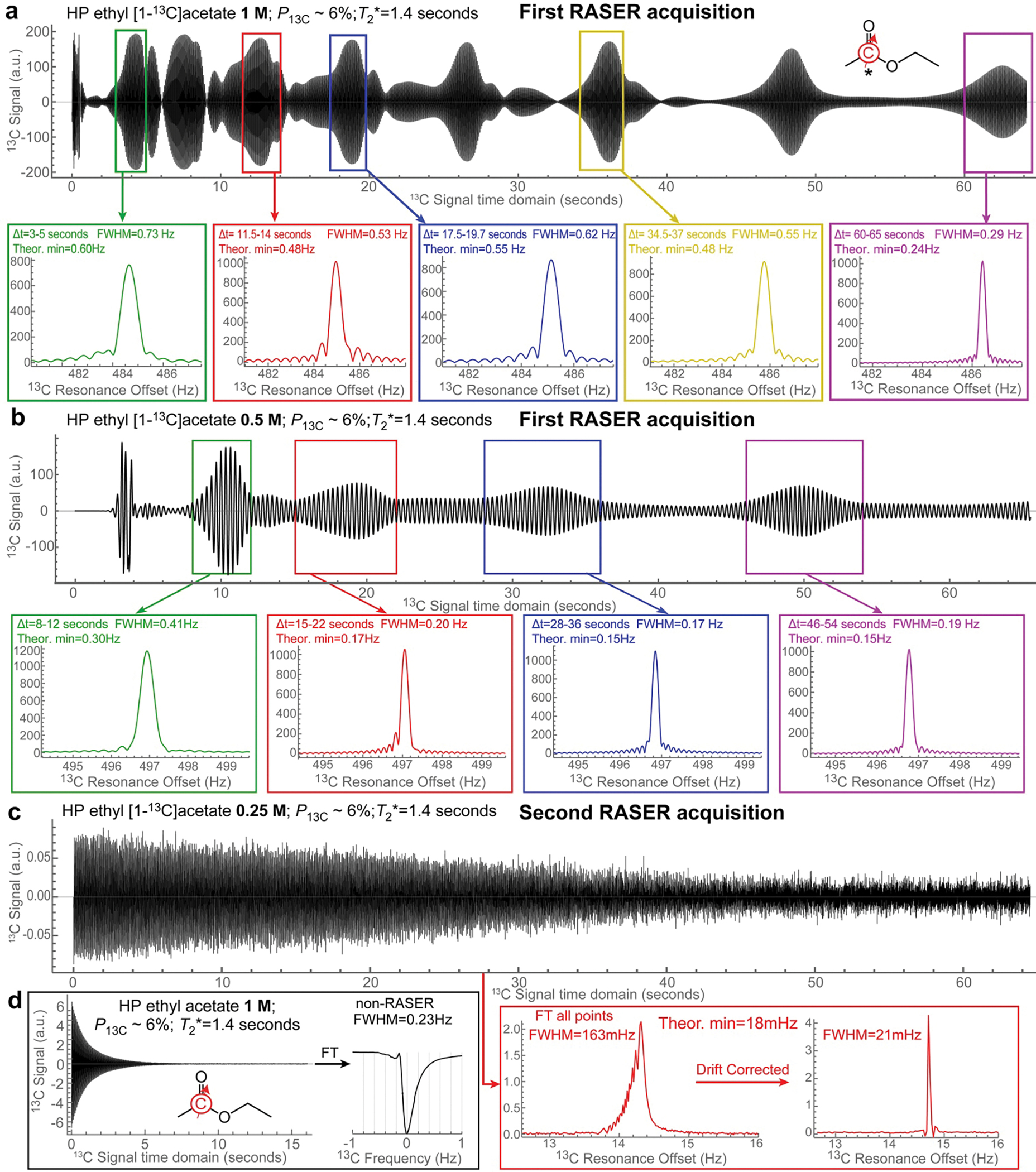
Proton-decoupled 13C NMR RASER spectroscopy of solution-phase PHIP of ethyl [1-13C]acetate (P13C~6%, 0.5 M in acetone-d6) detected at 1.4 T using 13C resonator with Q of 32. (a-c) Time-domain 13C RASER signals and FT spectra recorded without a RF pulse but with 1H decoupling for 1M, 0.5M, and 0.25M samples respectively (additional RASER acquisitions are shown in Figures S4–S7. (d) 13C spectrum of HP ethyl acetate with total magnetization well below the RASER threshold (recorded using a 10° RF pulse under otherwise similar detection conditions): FWHM = 0.23 Hz, and 13C T2* ~ 1.4 seconds, Figure S2.

References

    1. Ardenkjaer-Larsen JH, Fridlund B, Gram A, Hansson G, Hansson L, Lerche MH, Servin R, Thaning M, Golman K, Proc. Natl. Acad. Sci. U. S. A. 2003, 100, 10158–10163. - PMC - PubMed
    1. Nikolaou P, Goodson BM, Chekmenev EY, Chem. Eur. J. 2015, 21, 3156–3166. - PMC - PubMed
    1. Albert MS, Cates GD, Driehuys B, Happer W, Saam B, Springer CS, Wishnia A, Nature 1994, 370, 199–201. - PubMed
    1. Gloggler S, Colell J, Appelt S, J. Magn. Reson. 2013, 235, 130–142. - PubMed
    1. Kurhanewicz J, Vigneron DB, Brindle K, Chekmenev EY, Comment A, Cunningham CH, DeBerardinis RJ, Green GG, Leach MO, Rajan SS, Rizi RR, Ross BD, Warren WS, Malloy CR, Neoplasia 2011, 13, 81–97. - PMC - PubMed

Publication types

LinkOut - more resources