. 2023 Mar;475(3):309-322.
doi: 10.1007/s00424-022-02772-x. Epub 2022 Nov 28.

FGF-23 protects cell function and viability in murine pancreatic islets challenged by glucolipotoxicity

Affiliations

FGF-23 protects cell function and viability in murine pancreatic islets challenged by glucolipotoxicity

Betina Pajaziti et al. Pflugers Arch. 2023 Mar.

Abstract

The fibroblast growth factor FGF-23 is a member of the FGF-15/19 subfamily with hormonal functions. Besides its well-known role for bone mineralization, FGF-23 is discussed as a marker for cardiovascular disease. We investigated whether FGF-23 has any effects on the endocrine pancreas of mice by determining insulin secretion, electrical activity, intracellular Ca2+, and apoptosis. Acute application of FGF-23 (10 to 500 ng/ml, i.e., 0.4 to 20 nM) does not affect insulin release of murine islets, while prolonged exposure leads to a 21% decrease in glucose-stimulated secretion. The present study shows for the first time that FGF-23 (100 or 500 ng/ml) partially protects against impairment of insulin secretion and apoptotic cell death induced by glucolipotoxicity. The reduction of apoptosis by FGF-23 is approximately twofold higher compared to FGF-21 or FGF-15/19. In contrast to FGF-23 and FGF-21, FGF-15/19 is clearly pro-apoptotic under control conditions. The beneficial effect of FGF-23 against glucolipotoxicity involves interactions with the stimulus-secretion cascade of beta-cells. Electrical activity and the rise in the cytosolic Ca2+ concentration of islets in response to acute glucose stimulation increase after glucolipotoxic culture (48 h). Co-culture with FGF-23 further elevates the glucose-mediated effects on both parameters. Protection against apoptosis and glucolipotoxic impairment of insulin release by FGF-23 is prevented, when calcineurin is inhibited by tacrolimus or when c-Jun N-terminal kinase (JNK) is blocked by SP600125. In conclusion, our data suggest that FGF-23 can activate compensatory mechanisms to maintain beta-cell function and integrity of islets of Langerhans during excessive glucose and lipid supply.

Keywords: Beta-cell; Calcineurin; FGF-23; Glucolipotoxicity; Insulin; JNK.


Conflict of interest statement

The authors declare no competing interests.

Figures
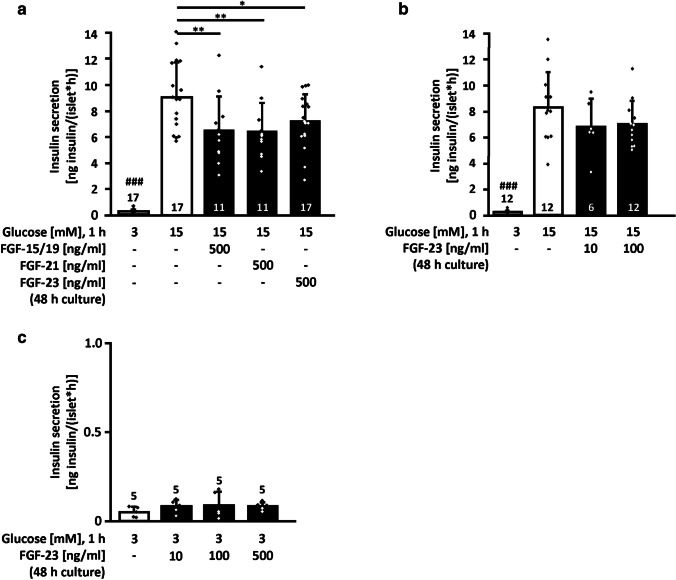
Fig. 1
Fig. 1
FGF-23 lowers glucose-stimulated insulin secretion under standard conditions. a Steady-state incubation (1 h) of murine islets was performed after culturing islets with or without 500 ng/ml FGF-15/19, FGF-21, or FGF-23 under standard conditions for 48 h. All three FGFs lowered glucose-stimulated insulin release. b Insulin secretion stimulated by 15 mM glucose also showed a tendency to decline when exposed to 10 or 100 ng/ml FGF-23 for 48 h, whereas c basal secretion (3 mM glucose) was unaffected by 10, 100, and 500 ng/ml FGF-23. In these experiments, FGF-23 was not present during the acute determination of glucose-stimulated insulin secretion. Numbers in bars indicate the number of independent islet preparations; *p < 0.05, **p < 0.01, ###p < 0.001 vs. all other conditions
Fig. 2
Fig. 2
FGF-23, FGF-21, and FGF-15/19 differently affect electrical activity and islet cell mass under standard conditions. a The time with electrical activity (fraction of plateau phase, FOPP) was determined by extracellular recordings of islets on MEA chips after culture (48 h) with or without FGF-15/19, FGF-21, or FGF-23. Electrical activity was induced by acute stimulation with 10 mM glucose. The FOPP was decreased to the same level by 100 ng/ml FGF-15/19 or 500 ng/ml FGF-23. Islets treated with 500 ng/ml FGF-21 revealed no changes in the FOPP compared to controls. b Apoptotic cell death was low (< 1%) under control conditions (standard medium, 10 mM glucose). Co-culture with 100 or 500 ng/ml FGF-23 (48 h) did not influence cell viability. (c) Islet cells cultured for 7 days in medium supplemented with 100 ng/ml FGF-21 or FGF-23 showed no significant increase in the amount of apoptotic cells, whereas co-culture with 100 ng/ml FGF-15/19 resulted in a significantly elevated fraction of apoptotic cells. Numbers in bars indicate the number of islets (a) or independent islet preparations (b, c); *p < 0.05, **p < 0.01, ***p < 0.001
Fig. 3
Fig. 3
FGF-23 partially protects against impairment of insulin release by glucolipotoxicity and reduces glucolipotoxicity-induced cell death. a The number of apoptotic islet cells increased after culture in glucolipotoxic medium for 7 days. FGF-15/19, FGF-21, and FGF-23 (100 ng/ml) prevented the impairment of islet cell viability caused by glucolipotoxicity with FGF-23 leading to the strongest decline. b Insulin release in the presence of 3 mM glucose (1 h) was not affected by glucolipotoxicity, but elevated vs. control by the combination of glucolipotoxicity and FGF-23 (500 ng/ml). c Glucolipotoxicity reduced glucose-stimulated (15 mM glucose, 1 h) insulin release. FGF-23 partially prevented this effect. d Addition of the FGFR inhibitor PD-161570 (100 nM) during glucolipotoxic culture abrogated the protective effect of FGF-23. e The protective effect of FGF-23 on glucolipotoxicity-induced apoptotic cell death was prevented by the FGFR inhibitors PD-161570 and PD-173074 (both 100 nM). Glucolipotoxicity: 33 mM glucose, 500 μM palmitate (a, e); 25 mM glucose, 100 μM palmitate (bd). Numbers in bars indicate the number of independent islet preparations; *p < 0.05, **p < 0.01, ***p < 0.001, ##p < 0.01, ###p < 0.001 vs. control (a, e) or vs. 3 mM glucose (c)
Fig. 4
Fig. 4
FGF-23 increases electrical activity under pathophysiological conditions. Electrical activity was determined by extracellular recordings of single islets placed on MEA chips. Electrical activity was induced by elevating glucose from 3 to 8 mM during the recording. After glucolipotoxic culture (25 mM glucose, 100 μM palmitate, 48 h), the fraction with electrical activity (fraction of plateau phase, FOPP) was elevated vs. control. Pre-treatment with FGF-23 potentiated this effect. Numbers in bars indicate the number of islets; *p < 0.05, ***p < 0.001
Fig. 5
Fig. 5
FGF-23 elevates [Ca2+]c in response to glucose stimulation under glucolipotoxic conditions. The cytosolic Ca2+ concentration was measured after a culture period of 48 h in control or glucolipotoxic medium (25 mM glucose, 100 μM palmitate) supplemented with or without 500 ng/ml FGF-23. a The upper trace shows a representative experiment of an islet regularly oscillating when acutely stimulated with 8 or 15 mM glucose. Reducing glucose to 3 mM decreases [Ca2+]c to a basal value. In the middle, the effect of glucolipotoxic culture (GLT) on [Ca2+]c is illustrated. On the bottom, an experiment with islets after culture in glucolipotoxic medium supplemented with FGF-23 is shown. b Mean [Ca2+]c and c AUC were increased by the application of 8 or 15 mM glucose. Co-culture with FGF-23 further enhanced mean [Ca2+]c and the AUC when glucose was acutely elevated to 15 mM. Numbers in bars indicate the number of islets; **p < 0.01, ***p < 0.001, ###p < 0.001 vs. 3 mM glucose + glucolipotoxicity, ‡‡‡p < 0.001 vs. 3 mM glucose + glucolipotoxicity + 500 ng/ml FGF-23
Fig. 6
Fig. 6
Calcineurin and JNK counteract the protection of FGF-23 against glucolipotoxic impairment. a Inhibition of calcineurin by tacrolimus (10 nM) during the 48-h culture period with glucolipotoxic medium and FGF-23 (500 ng/ml) abrogated the protective effect of FGF-23 on glucose-stimulated insulin release. b Inhibition of JNK by SP600125 (1 μM, 48 h) led to similar results. Of note, tacrolimus tends to augment the deleterious effect of glucolipotoxicity on glucose-stimulated insulin secretion. SP600125 did not alter the effect of glucolipotoxic culture per se. FGF-23 and inhibitors were not present during the steady-state incubation. c Inhibition of calcineurin by tacrolimus (10 nM) prevented the beneficial effect of FGF-23 (100 ng/ml) on glucolipotoxicity-mediated cell death (7 d). d Similar results were obtained for the inhibition of JNK by SP600125 (1 μM, 7 d). Glucolipotoxicity: 25 mM glucose, 100 μM palmitate (a, b); 33 mM glucose, 500 μM palmitate (c, d). Numbers in bars indicate the number of independent islet preparations; *p < 0.05, **p < 0.01, #p < 0.05, ##p < 0.01, ###p < 0.001 vs. 3 mM glucose (a, b) or vs. control (c, d)
Fig. 7
Fig. 7
Summary of the effects of glucolipotoxicity and the protective influence of FGF-23. High glucose and palmitate concentrations induce beta-cell stress leading to a rise in apoptosis and a decrease in insulin content. This reduces glucose-stimulated insulin secretion. Compensatory mechanisms include an elevation of electrical activity and [Ca2+]c influx. FGF-23 partly prevents beta-cell death and further augments membrane depolarization and Ca2+ influx. As a consequence, insulin secretion is enhanced in the presence of FGF-23 compared to glucolipotoxicity alone. Of note, the reduction in insulin content is slightly attenuated by FGF-23. Dotted lines indicate the proposed interaction partners of FGF-23 in beta-cells under glucolipotoxic conditions. [Ca2+]c, cytosolic Ca2+ concentration; FFA, free fatty acids; FGFR, fibroblast growth factor receptor; FOPP, fraction of plateau phase; JNK, c-Jun N-terminal kinase; SP, SP600125; Tac, tacrolimus.

References

    1. Ahlqvist E, Storm P, Käräjämäki A, et al. Novel subgroups of adult-onset diabetes and their association with outcomes: a data-driven cluster analysis of six variables. Lancet Diabetes Endocrinol. 2018;6:361–369. doi: 10.1016/S2213-8587(18)30051-2. - DOI - PubMed
    1. Andrukhova O, Zeitz U, Goetz R, et al. FGF23 acts directly on renal proximal tubules to induce phosphaturia through activation of the ERK1/2-SGK1 signaling pathway. Bone. 2012;51:621–628. doi: 10.1016/j.bone.2012.05.015. - DOI - PMC - PubMed
    1. Bär L, Großmann C, Gekle M, et al. Calcineurin inhibitors regulate fibroblast growth factor 23 (FGF23) synthesis. Naunyn Schmiedebergs Arch Pharmacol. 2017;390:1117–1123. doi: 10.1007/s00210-017-1411-2. - DOI - PubMed
    1. Bär L, Wächter K, Wege N, et al. Advanced glycation end products stimulate gene expression of fibroblast growth factor 23. Mol Nutr Food Res. 2017;61:1601019.1–1601019.6. doi: 10.1002/mnfr.201601019. - DOI - PubMed
    1. Barlow J, Jensen VH, Jastroch M, et al. Palmitate-induced impairment of glucose-stimulated insulin secretion precedes mitochondrial dysfunction in mouse pancreatic islets. Biochem J. 2016;473:487–496. doi: 10.1042/BJ20151080. - DOI - PubMed

Publication types
