


A systematic review of the purposes of Blockchain and fog computing integration: classification and open issues
- PMID: 36438442
- PMCID: PMC9676739
- DOI: 10.1186/s13677-022-00353-y
A systematic review of the purposes of Blockchain and fog computing integration: classification and open issues
Abstract
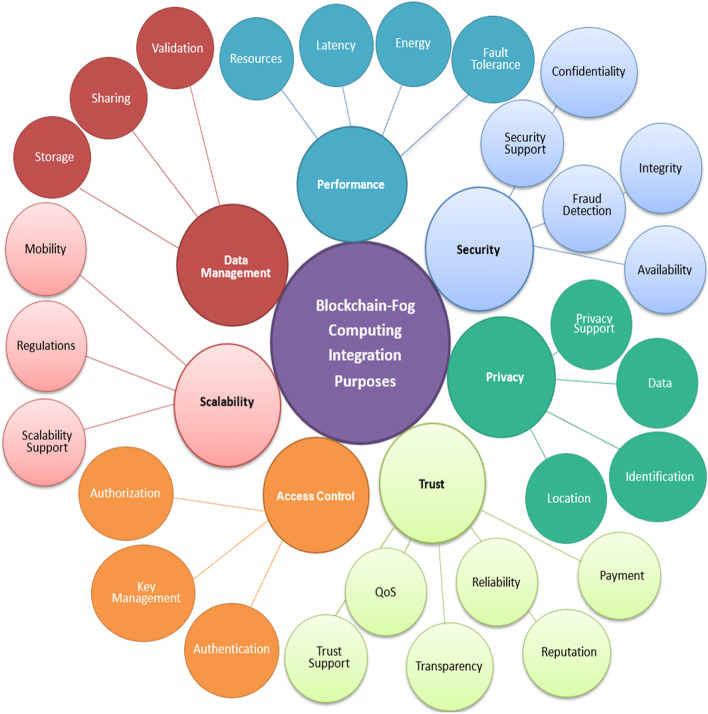
The fog computing concept was proposed to help cloud computing for the data processing of Internet of Things (IoT) applications. However, fog computing faces several challenges such as security, privacy, and storage. One way to address these challenges is to integrate blockchain with fog computing. There are several applications of blockchain-fog computing integration that have been proposed, recently, due to their lucrative benefits such as enhancing security and privacy. There is a need to systematically review and synthesize the literature on this topic of blockchain-fog computing integration. The purposes of integrating blockchain and fog computing were determined using a systematic literature review approach and tailored search criteria established from the research questions. In this research, 181 relevant papers were found and reviewed. The results showed that the authors proposed the combination of blockchain and fog computing for several purposes such as security, privacy, access control, and trust management. A lack of standards and laws may make it difficult for blockchain and fog computing to be integrated in the future, particularly in light of newly developed technologies like quantum computing and artificial intelligence. The findings of this paper serve as a resource for researchers and practitioners of blockchain-fog computing integration for future research and designs.
Keywords: Blockchain; Cloud computing; Fog computing; Integration; Internet of things (IoT); Security.
© The Author(s) 2022.
Conflict of interest statement
Competing interestsNot applicable.
Figures

References
-
- Mouradian C, Naboulsi D, Yangui S, Glitho RH, Morrow MJ, Polakos PA. A comprehensive survey on fog computing: state-of-the-art and research challenges. IEEE Commun Surv Tutor. 2017;20:416–464. doi: 10.1109/COMST.2017.2771153. - DOI
-
- Atlam HF, Walters RJ, Wills GB. Fog computing and the internet of things: a review. Big Data Cogn Comput. 2018;2:10. doi: 10.3390/bdcc2020010. - DOI
-
- Bellavista P, Berrocal J, Corradi A, Das SK, Foschini L, Zanni A. A survey on fog computing for the internet of things. Pervasive Mob Comput. 2019;52:71–99. doi: 10.1016/j.pmcj.2018.12.007. - DOI
-
- Dastjerdi AV, Gupta H, Calheiros RN, Ghosh SK, Buyya R (2016) Fog computing: Principles, architectures, and applications. In: Buyya R, Dastjerdi AV (eds) Internet of things: Principles and Paradigms. Elsevier, Morgan Kaufmann, Burlington, Massachusetts, ed, pp 61–75
Publication types
LinkOut - more resources
Full Text Sources