


Learning to discover medicines
- PMID: 36440369
- PMCID: PMC9676887
- DOI: 10.1007/s41060-022-00371-8
Learning to discover medicines
Abstract
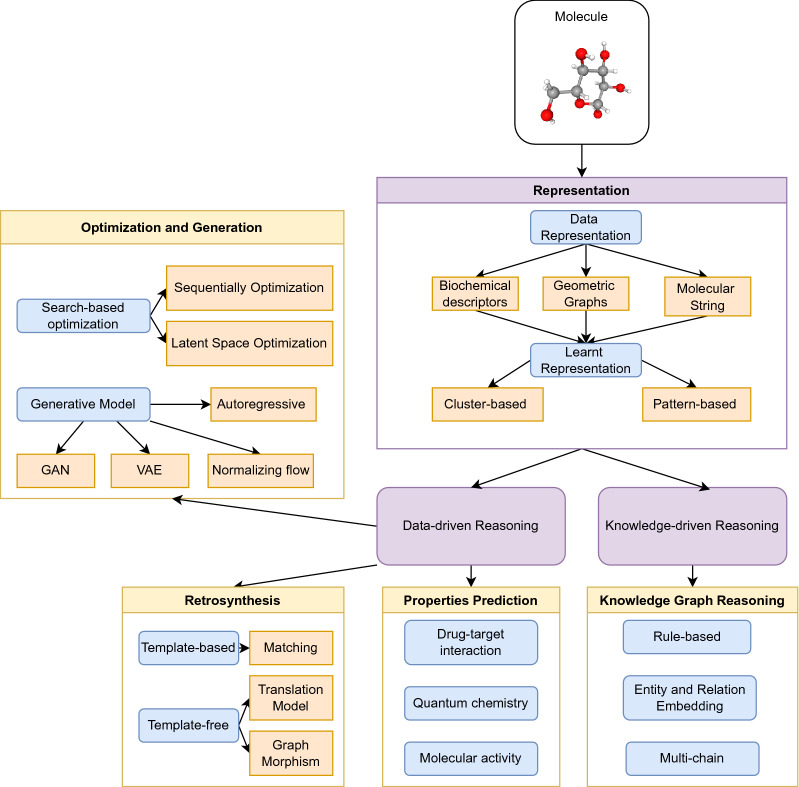
Discovering new medicines is the hallmark of the human endeavor to live a better and longer life. Yet the pace of discovery has slowed down as we need to venture into more wildly unexplored biomedical space to find one that matches today's high standard. Modern AI-enabled by powerful computing, large biomedical databases, and breakthroughs in deep learning offers a new hope to break this loop as AI is rapidly maturing, ready to make a huge impact in the area. In this paper, we review recent advances in AI methodologies that aim to crack this challenge. We organize the vast and rapidly growing literature on AI for drug discovery into three relatively stable sub-areas: (a) representation learning over molecular sequences and geometric graphs; (b) data-driven reasoning where we predict molecular properties and their binding, optimize existing compounds, generate de novo molecules, and plan the synthesis of target molecules; and (c) knowledge-based reasoning where we discuss the construction and reasoning over biomedical knowledge graphs. We will also identify open challenges and chart possible research directions for the years to come.
Keywords: Artificial intelligence; Biomedical representation learning; Drug discovery; Drug discovery reasoning; Machine learning.
© The Author(s), under exclusive licence to Springer Nature Switzerland AG 2022, Springer Nature or its licensor (e.g. a society or other partner) holds exclusive rights to this article under a publishing agreement with the author(s) or other rightsholder(s); author self-archiving of the accepted manuscript version of this article is solely governed by the terms of such publishing agreement and applicable law.
Conflict of interest statement
Conflict of interestAll authors have no conflict of interest to report.
Figures
References
-
- Zhang, D., Mishra, S., Brynjolfsson, E., Etchemendy, J., Ganguli, D., Grosz, B.: et al. The AI Index 2021 Annual Report. (2021) arxiv: 2103.06312
-
- The Drug Development Process. https://wwwfdagov/patients/learn-about-drug-and-device-approvals/drug-development-process;
Publication types
LinkOut - more resources
Full Text Sources