


Feasibility of a Reinforcement Learning-Enabled Digital Health Intervention to Promote Mammograms: Retrospective, Single-Arm, Observational Study
- PMID: 36441579
- PMCID: PMC9745647
- DOI: 10.2196/42343
Feasibility of a Reinforcement Learning-Enabled Digital Health Intervention to Promote Mammograms: Retrospective, Single-Arm, Observational Study
Abstract
Background: Preventive screenings such as mammograms promote health and detect disease. However, mammogram attendance lags clinical guidelines, with roughly one-quarter of women not completing their recommended mammograms. A scalable digital health intervention leveraging behavioral science and reinforcement learning and delivered via email was implemented in a US health system to promote uptake of recommended mammograms among patients who were 1 or more years overdue for the screening (ie, 2 or more years from last mammogram).
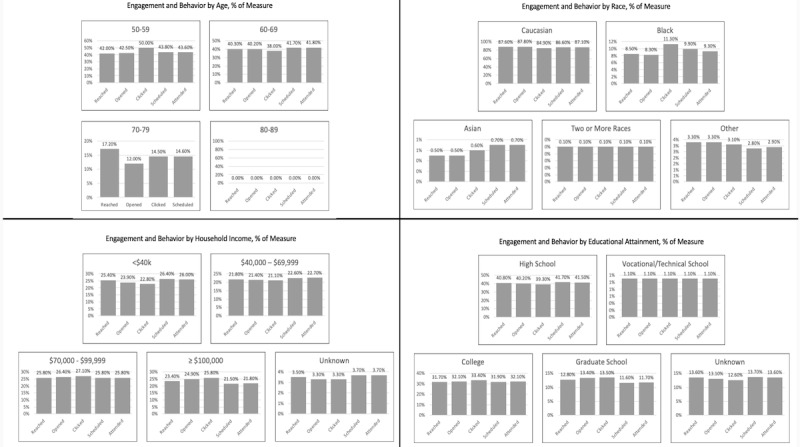
Objective: The aim of this study was to establish the feasibility of a reinforcement learning-enabled mammography digital health intervention delivered via email. The research aims included understanding the intervention's reach and ability to elicit behavioral outcomes of scheduling and attending mammograms, as well as understanding reach and behavioral outcomes for women of different ages, races, educational attainment levels, and household incomes.
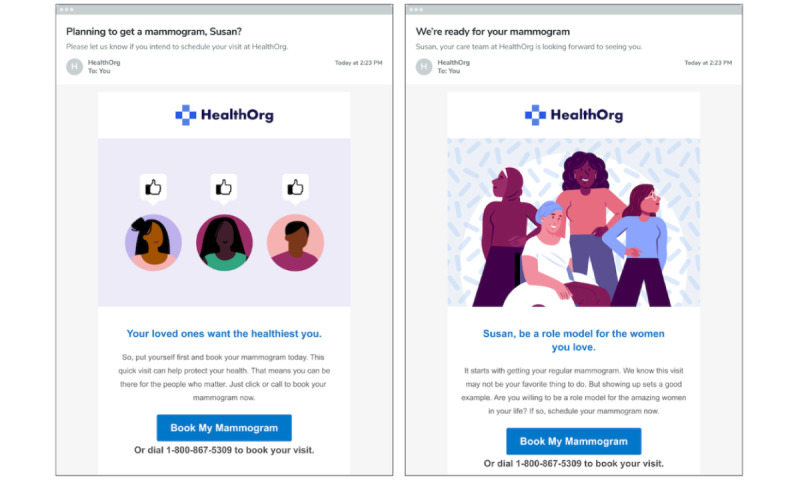
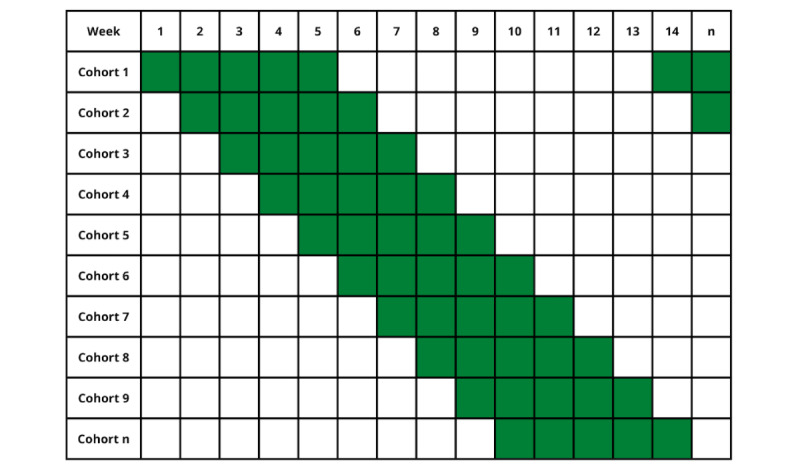
Methods: The digital health intervention was implemented in a large Catholic health system in the Midwestern United States and targeted the system's existing patients who had not received a recommended mammogram in 2 or more years. From August 2020 to July 2022, 139,164 eligible women received behavioral science-based email messages assembled and delivered by a reinforcement learning model to encourage clinically recommended mammograms. Target outcome behaviors included scheduling and ultimately attending the mammogram appointment.
Results: In total, 139,164 women received at least one intervention email during the study period, and 81.52% engaged with at least one email. Deliverability of emails exceeded 98%. Among message recipients, 24.99% scheduled mammograms and 22.02% attended mammograms (88.08% attendance rate among women who scheduled appointments). Results indicate no practical differences in the frequency at which people engage with the intervention or take action following a message based on their age, race, educational attainment, or household income, suggesting the intervention may equitably drive mammography across diverse populations.
Conclusions: The reinforcement learning-enabled email intervention is feasible to implement in a health system to engage patients who are overdue for their mammograms to schedule and attend a recommended screening. In this feasibility study, the intervention was associated with scheduling and attending mammograms for patients who were significantly overdue for recommended screening. Moreover, the intervention showed proportionate reach across demographic subpopulations. This suggests that the intervention may be effective at engaging patients of many different backgrounds who are overdue for screening. Future research will establish the effectiveness of this type of intervention compared to typical health system outreach to patients who have not had recommended screenings as well as identify ways to enhance its reach and impact.
Keywords: artificial intelligence; behavioral intervention; cancer screening; digital health; email; feasibility studies; health equity; mammograms; nudging; reinforcement learning.
©Amy Bucher, E Susanne Blazek, Ashley B West. Originally published in JMIR Formative Research (https://formative.jmir.org), 28.11.2022.
Conflict of interest statement
Conflicts of Interest: AB, ESB, and ABW are paid employees of Lirio, LLC, which developed the intervention studied.
Figures
References
-
- Breast cancer statistics. Centers for Disease Control and Prevention. 2022. [2022-06-30]. https://www.cdc.gov/cancer/breast/statistics/index.htm .
-
- Sung H, Ferlay J, Siegel RL, Laversanne M, Soerjomataram I, Jemal A, Bray F. Global cancer statistics 2020: GLOBOCAN estimates of incidence and mortality worldwide for 36 cancers in 185 countries. CA Cancer J Clin. 2021 May;71(3):209–249. doi: 10.3322/caac.21660. doi: 10.3322/caac.21660. - DOI - PubMed
-
- Treatment of breast cancer stages I-III. American Cancer Society. 2022. [2022-06-30]. https://www.cancer.org/cancer/breast-cancer/treatment/treatment-of-breas... .
-
- Blumen H, Fitch K, Polkus V. Comparison of treatment costs for breast cancer, by tumor stage and type of service. Am Health Drug Benefits. 2016 Feb;9(1):23–32. https://europepmc.org/abstract/MED/27066193 - PMC - PubMed
-
- Duffy SW, Tabár L, Yen AM, Dean PB, Smith RA, Jonsson H, Törnberg S, Chen SL, Chiu SY, Fann JC, Ku MM, Wu WY, Hsu C, Chen Y, Svane G, Azavedo E, Grundström H, Sundén P, Leifland K, Frodis E, Ramos J, Epstein B, Åkerlund A, Sundbom A, Bordás P, Wallin H, Starck L, Björkgren A, Carlson S, Fredriksson I, Ahlgren J, Öhman D, Holmberg L, Chen TH. Mammography screening reduces rates of advanced and fatal breast cancers: Results in 549,091 women. Cancer. 2020 Jul 01;126(13):2971–2979. doi: 10.1002/cncr.32859. doi: 10.1002/cncr.32859. - DOI - PMC - PubMed
LinkOut - more resources
Full Text Sources
