


A systematic review of the association of diet quality with the mental health of university students: implications in health education practice
- PMID: 36441584
- PMCID: PMC9853940
- DOI: 10.1093/her/cyac035
A systematic review of the association of diet quality with the mental health of university students: implications in health education practice
Abstract
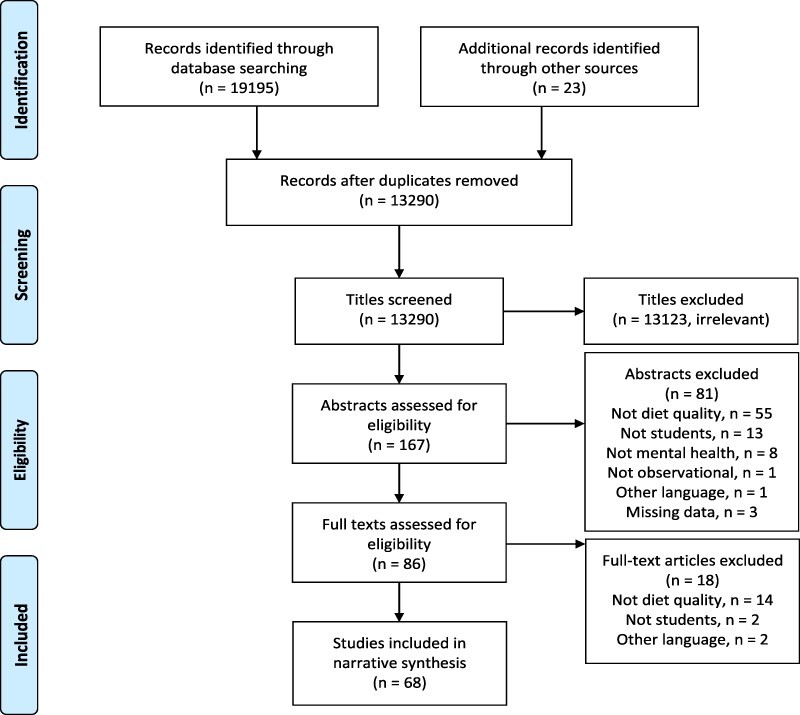
University students are at risk of experiencing mental health problems during the transition from home to university. This transition can also adversely affect their diet quality. This review aims to examine bidirectional associations from observational studies regarding the influence of diet quality on the mental health of university students, and vice versa. The databases PubMed, CINAHL, EMBASE, PsycINFO, The Cochrane Library and Web of Science were searched using relevant search terms. The searches were last updated on 15 July 2022. Majority of studies (36 out of 45) found that good diet quality of students was associated with better mental health in terms of depression, anxiety, stress and overall general mental well-being. Moreover, majority of studies (19 out of 23) found that stress and anxiety of students were associated with poorer diet quality. The effect sizes observed were generally small-moderate. Healthy diets of students have been associated with better mental health in terms of depression, anxiety, stress or other mental health issues. Stress experienced by university students has been associated with unhealthy diets. There are implications for health education research, as interventions to improve diet quality at the university level could reduce mental health issues; additionally, interventions to support students under stress may lead to healthier dietary habits when living on campuses. Randomized controlled trials and intervention studies are needed to further investigate these implications.
© The Author(s) 2022. Published by Oxford University Press.
Conflict of interest statement
There are no competing interests for any author. The authors declare no potential conflicts of interest with respect to the research, authorship and/or publication of this article. The authors received no financial support for the research, authorship and/or publication of this article.
References
-
- Jetten J, O’Brien A, Trindall N. Changing identity: predicting adjustment to organizational restructure as a function of subgroup and superordinate identification. Br J Soc Psychol 2002; 41: 281–97. - PubMed
-
- Baker RW, Siryk B. Measuring adjustment to college. J Couns Psychol 1984; 31: 179–89.
-
- Schweiger DM, Denisi AS. Communication with employees following a merger: a longitudinal field experiment. Acad Manage J 1991; 34: 110–35.
-
- Kessler RC, Berglund P, Demler O et al. Lifetime prevalence and age-of-onset distributions of DSM-IV disorders in the National Comorbidity Survey Replication. Arch Gen Psychiatry 2005; 62: 593–602. - PubMed
-
- Westefeld JS, Button C, Haley JT et al. College student suicide: a call to action. Death Stud 2006; 30: 931–56. - PubMed
