


Diencephalic versus Hippocampal Amnesia in Alzheimer's Disease: The Possible Confabulation-Misidentification Phenotype
- PMID: 36442200
- PMCID: PMC9881034
- DOI: 10.3233/JAD-220919
Diencephalic versus Hippocampal Amnesia in Alzheimer's Disease: The Possible Confabulation-Misidentification Phenotype
Abstract
Background: Alzheimer's disease (AD) is clinically heterogeneous, including the classical-amnesic (CA-) phenotype and some variants.
Objective: We aim to describe a further presentation we (re)named confabulation-misidentification (CM-) phenotype.
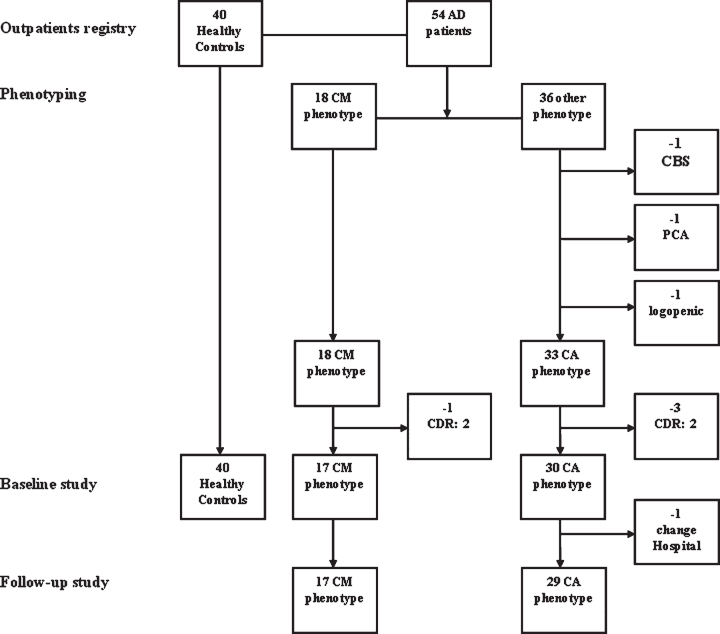
Methods: We performed a retrospective longitudinal case-series study of 17 AD outpatients with the possible CM-phenotype (CM-ADs). Then, in a cross-sectional study, we compared the CM-ADs to a sample of 30 AD patients with the CA-phenotype (CA-ADs). The primary outcome was the frequency of cognitive and behavioral features. Data were analyzed as differences in percentage by non-parametric Chi Square and mean differences by parametric T-test.
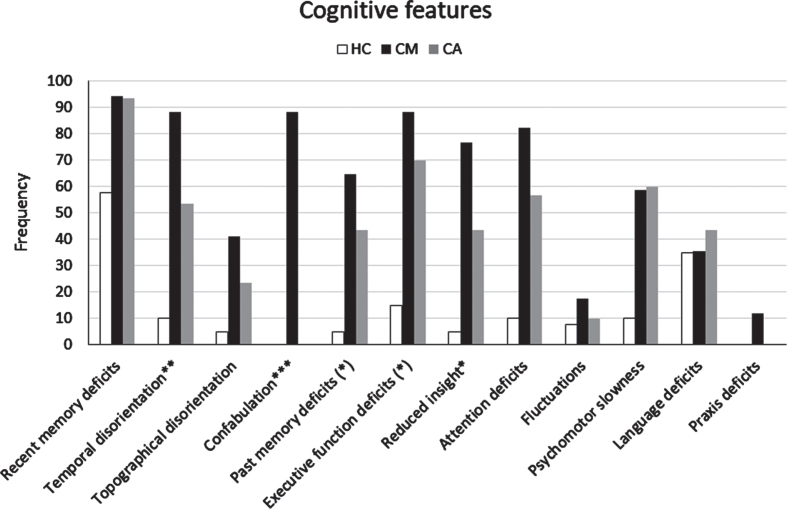
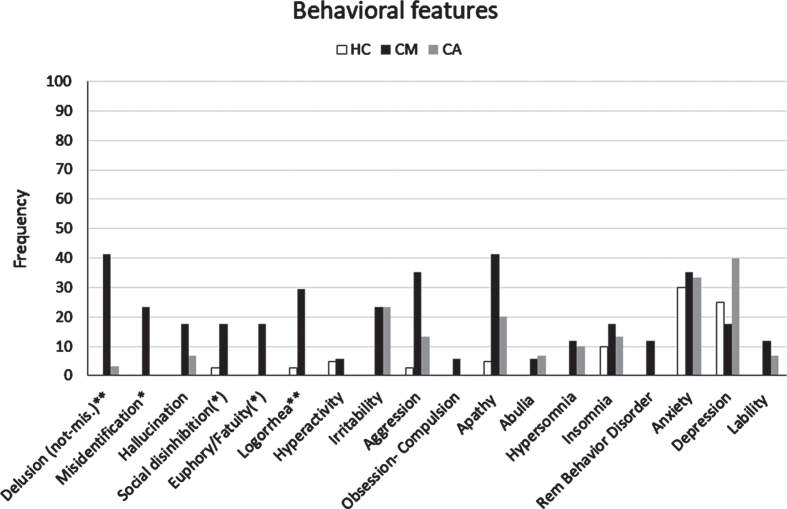
Results: Anterograde amnesia (100%) with early confabulation (88.2%), disorientation (88.2%) and non-infrequently retrograde amnesia (64.7%) associated with reduced insight (88.2%), moderate prefrontal executive impairment (94.1%) and attention deficits (82.3%) dominated the CM-phenotype. Neuropsychiatric features with striking misidentification (52.9%), other less-structured delusions (70.6%), and brief hallucinations (64.7%) were present. Marked behavioral disturbances were present early in some patients and very common at later stages. At the baseline, the CM-ADs showed more confabulation (p < 0.001), temporal disorientation (p < 0.02), misidentification (p = 0.013), other delusions (p = 0.002), and logorrhea (p = 0.004) than the CA-ADs. In addition, more social disinhibition (p = 0.018), reduction of insight (p = 0.029), and hallucination (p = 0.03) persisted at 12 months from baseline. Both the CA- and CM-ADs showed anterior and medial temporal atrophy. Compared to HCs, the CM-ADs showed more right fronto-insular atrophy, while the CA-ADs showed more dorsal parietal, precuneus, and right parietal atrophy.
Conclusion: We described an AD phenotype resembling diencephalic rather than hippocampal amnesia and overlapping the past-century description of presbyophrenia.
Keywords: Alzheimer’s disease; amnesia; confabulation; delusions; memory rehabilitation; misidentification; presbyophrenia.
Conflict of interest statement
Authors’ disclosures available online (
Figures
References
-
- Abbate C, Trimarchi PD, Rotondo E, Inglese S, Nicolini P, Rossi PD, Arosio B, Mari D (2016) Spontaneous confabulations in amnestic-mild cognitive impairment due to Alzheimer’s disease: A new (yet old) atypical variant? Neurocase 22, 451–460. - PubMed
-
- Berrios GE (1985) Presbyophrenia: Clinical aspects. BJPsych 147, 76–79. - PubMed
-
- Berrios GE (1986) Presbyophrenia: The rise and fall of a concept. Psychol Med 16, 267–275. - PubMed
-
- Nedjam Z, Dalla Barba G, Pillon B (2000) Confabulation in a patient with frontotemporal dementia and a patient with Alzheimer’s disease. Cortex 36, 561–577. - PubMed
-
- Moulin CJA (2013) Disordered recognition memory: Recollective confabulation. Cortex 49, 1541–1552. - PubMed
Publication types
MeSH terms
LinkOut - more resources
Full Text Sources
Medical
Miscellaneous
