


Improvement of angiographic and clinical outcomes of percutaneous coronary intervention for chronic total occlusion after implementation of a dedicated team: a single-centre experience
- PMID: 36445615
- PMCID: PMC9950300
- DOI: 10.1007/s12471-022-01732-5
Improvement of angiographic and clinical outcomes of percutaneous coronary intervention for chronic total occlusion after implementation of a dedicated team: a single-centre experience
Abstract
Introduction: In a Dutch heart centre, a dedicated chronic total occlusion (CTO) team was implemented in June 2017. The aim of this study was to the evaluate treatment success and clinical outcomes before and after this implementation.
Methods: A total of 662 patients who underwent percutaneous coronary intervention (PCI) for a CTO between January 2013 and June 2020 were included and divided into pre- and post-CTO team groups. The primary endpoint was the angiographic success rate of CTO-PCI. Secondary endpoints included angiographic success stratified by complexity using the J‑CTO score and the following clinical outcomes: in-hospital complications and myocardial infarction, target vessel revascularisation, all-cause mortality, quality of life (QoL) and major adverse cardiac events (MACE) at 30-day and 1‑year follow-up.
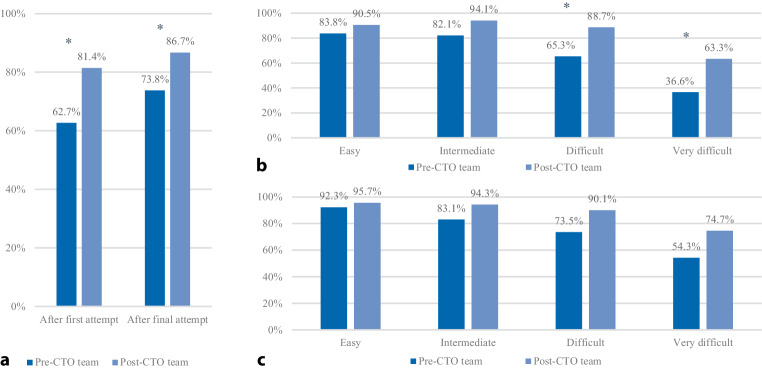
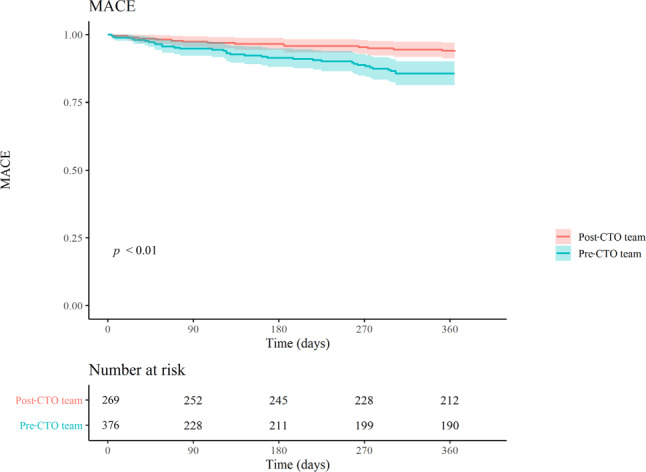
Results: Compared with the pre-CTO team group, the success rate in the post-CTO team group was higher after the first attempt (81.4% vs 62.7%; p < 0.001) and final attempt (86.7% vs 73.8%; p = 0.001). This was mainly driven by higher success rates for difficult and very difficult CTO lesions according to the J‑CTO score. The MACE rate at 1 year was lower in the post-CTO team group than in the pre-CTO team group (6.4% vs 16.0%; p < 0.01), while it was comparable at 30-day follow-up (0.1% vs 1.7%; p = 0.74). Angina symptoms were significantly reduced at 30-day and 1‑year follow-up, and QoL scores were higher after 1 year.
Conclusion: This study demonstrated higher success rates of CTO-PCI and improved clinical outcomes and QoL at 1‑year follow-up after implementation of a dedicated CTO team using the hybrid algorithm.
Keywords: Chronic total occlusion; Hybrid algorithm; Percutaneous coronary intervention.
© 2022. The Author(s).
Figures

References
-
- Christopoulos G, Kandzari DE, Yeh RW, et al. Development and validation of a novel scoring system for predicting technical success of chronic total occlusion percutaneous coronary interventions the PROGRESS CTO (prospective global registry for the study of chronic total occlusion intervention) score. JACC Cardiovasc Interv. 2016;9:1–9. doi: 10.1016/j.jcin.2015.09.022. - DOI - PubMed
LinkOut - more resources
Full Text Sources
Miscellaneous
