. 2023 Jan;43(1):3-13.
doi: 10.1002/pd.6276. Epub 2022 Dec 8.

Noninvasive prenatal screening for cystic fibrosis using circulating trophoblasts: Detection of the 50 most common disease-causing variants

Affiliations

Noninvasive prenatal screening for cystic fibrosis using circulating trophoblasts: Detection of the 50 most common disease-causing variants

Line Dahl Jeppesen et al. Prenat Diagn. 2023 Jan.

Abstract

Objectives: Cystic fibrosis (CF) is one of the most common severe autosomal recessive disorders. Prenatal or preconception CF screening is offered in some countries. A maternal blood sample in early pregnancy can provide circulating trophoblasts and offers a DNA source for genetic analysis of both the mother and the fetus. This study aimed to develop a cell-based noninvasive prenatal test (NIPT) to screen for the 50 most common CF variants.

Methods: Blood samples were collected from 30 pregnancies undergoing invasive diagnostics and circulating trophoblasts were harvested in 27. Cystic fibrosis testing was conducted using two different methods: by fragment length analysis and by our newly developed NGS-based CF analysis.

Results: In all 27 cases, cell-based NIPT provided a result using both methods in agreement with the invasive test result.

Conclusion: This study shows that cell-based NIPT for CF screening provides a reliable result without the need for partner- and proband samples.


Conflict of interest statement

Line Dahl Jeppesen, Lotte Hatt, Jakob Hedegaard, Ripudaman Singh, and PS are all employed by ARCEDI, a Danish biotech company that holds the patented technology for enrichment of circulating trophoblasts used in this study. Anders Sune Pedersen and Michael Knudsen are employed as consultants by ARCEDI. Dorte Launholt Lildballe, Christian Liebst Frisk Toft, and Ida Vogel have no conflicts of interest and do not receive any funding by ARCEDI.

Figures
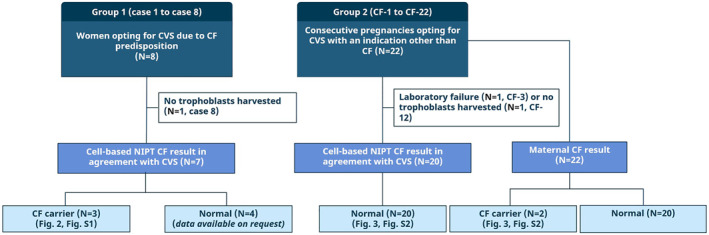
FIGURE 1
FIGURE 1
The flow of patients and samples. Blood was collected from two groups of pregnant women receiving invasive sampling. In group 1, the pregnancies were included when they opted for invasive sampling for Cystic fibrosis (CF) due to the couple's carrier status or family history. This group was the validation group. In group 2, N = 22 pregnant women were included consecutively when they opted for invasive sampling with an indication other than CF. This group simulated a prenatal screening program with a CF risk corresponding to the background population. The text describes the outcome for cell‐based noninvasive prenatal test (NIPT) for both groups as well as the maternal CF result in group 2. Abbreviations: CF, cystic fibrosis; CVS, chorionic villous sampling.
FIGURE 2
FIGURE 2
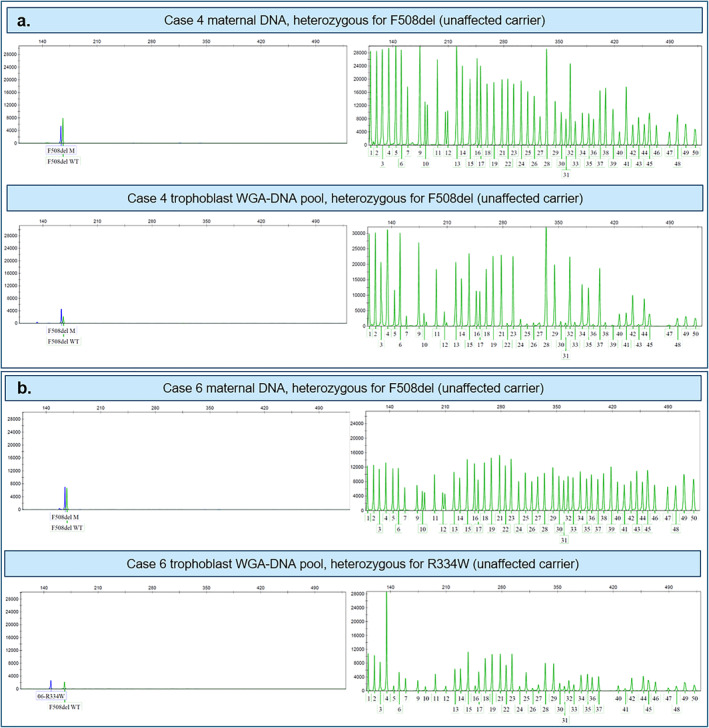
CF test results for maternal DNA and trophoblast WGA‐DNA pools for case 4 and case 6. The fragment length analysis results to the left show the variant (mutant, M) alleles represented by blue peaks and the normal (wildtype) F508del allele represented by a green peak. The fragment length analysis results to the right show the normal alleles and detection of a green peak indicates the heterozygote status of the individual, while the absence of the green peak indicates the homozygote status of the individual. Peaks 10 and 12 represent F508del, which present as split peaks separated by 3 bp if both a normal allele and a variant allele are present. (A) In case 4, both the pregnant woman and the fetus are heterozygote for F508del indicated by the F508del M and WT alleles, as well as 10 and 12 split peaks in the fragment length analysis result to the right. (B) In case 6, the pregnant woman is a heterozygote carrier of F508del. The fetus has inherited the paternal R334W variant allele and the normal F508del allele, indicating that the fetus is an unaffected carrier of Cystic fibrosis (CF). Abbreviations: CF, cystic fibrosis; M, mutant, WT, wildtype; WGA‐DNA, whole genome amplified DNA.
FIGURE 3
FIGURE 3
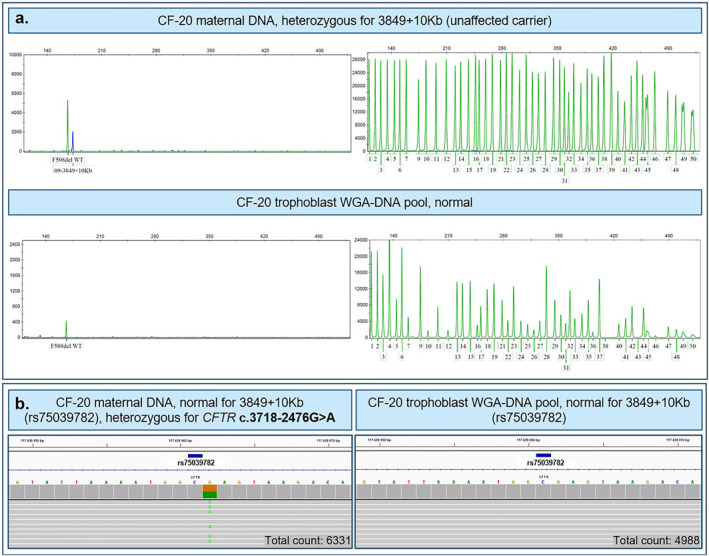
CF test result for maternal DNA and trophoblast WGA‐DNA pools for CF‐20 using (A) Amplification Refractory Mutation System polymerase chain reaction (ARMS‐PCR) and fragment length analysis and (B) next‐generation‐sequencing. (A) The maternal Cystic fibrosis (CF) test result presents with a blue variant peak 09–3849 + 10Kb indicating that the pregnant woman is a heterozygote carrier of Cystic Fibrosis Transmembrane Conductance Regulator (CFTR) 3849 + 10kbC > T (c.3718‐2477C > T, dbSNP: rs75039782). The trophoblast WGA‐DNA showed a normal CF test result, indicating that the fetus is unaffected. Panel (B) shows the sequencing analysis of the variant, rs75039782, and the base position is marked in dark blue bar. The grey bars represent sequences that do not vary from the hg38 reference genome, displayed by the colored base sequence. In the maternal test result, an single nucleotide variant (SNV), CFTR c.3718‐2476 G > A, was detected 1 bp downstream for the variant of interest. This SNV is a likely benign intron variant. Thus, the ARMS‐PCR result was due to an SNV in the primer binding site, resulting in a false‐positive result. The CF‐20 trophoblast WGA‐DNA sequencing result presented with a normal CF test result. Total counts for the specific amplicon are specified in the lower right corner. Abbreviations: ARMS‐PCR, Amplification Refractory Mutation System polymerase chain reaction; bp, base pair; CF, cystic fibrosis; SNV, single nucleotide variant; WGA‐DNA, whole genome amplified DNA.

References

    1. Scotet V, L’hostis C, Férec C. The Changing Epidemiology of Cystic Fibrosis: Incidence, Survival and Impact of the CFTRGene Discovery. Vol 11. Genes. MDPI AG; 2020. - PMC - PubMed
    1. Hospital of Sick Children . Cystic Fibrosis Mutation Database [Internet]. [cited 2022 Mar 10]. http://www.genet.sickkids.on.ca
    1. Nielsen OH, Thomsen BL, Green A, Andersen PK, Hauge M, Schiotz PO. Cystic fibrosis in Denmark 1945 to 1985. An analysis of incidence, mortality and influence of centralized treatment on survival. Acta Pædiatr Scand. 1988;77(6):836‐841. 10.1111/j.1651-2227.1988.tb10765.x - DOI - PubMed
    1. de Boeck K, Zolin A, Cuppens H, Olesen H, Viviani L. The relative frequency of CFTR mutation classes in European patients with cystic fibrosis. J Cyst Fibros. 2014;13(4):403‐409. 10.1016/j.jcf.2013.12.003 - DOI - PubMed
    1. Romero S, Biggio JR, Saller DN, Giardine R. Committee Opinion Number 432. Vol 486. Committee Opinion Number; 2005.