


Blood Pressure Variability and Cognitive Decline: A Post Hoc Analysis of the SPRINT MIND Trial
- PMID: 36448621
- PMCID: PMC10208742
- DOI: 10.1093/ajh/hpac128
Blood Pressure Variability and Cognitive Decline: A Post Hoc Analysis of the SPRINT MIND Trial
Abstract
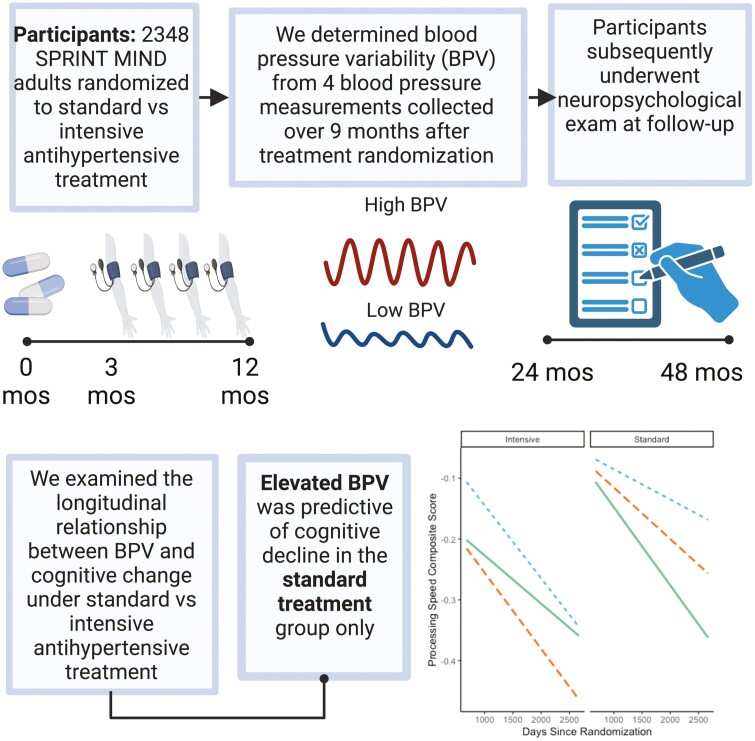
Background: Blood pressure (BP) variability (BPV) is an emerging risk factor for cognitive impairment and dementia, but relationships with cognition in the context of antihypertensive strategies remain unclear. We examined whether visit-to-visit BPV relates to cognitive change based on antihypertensive treatment type.
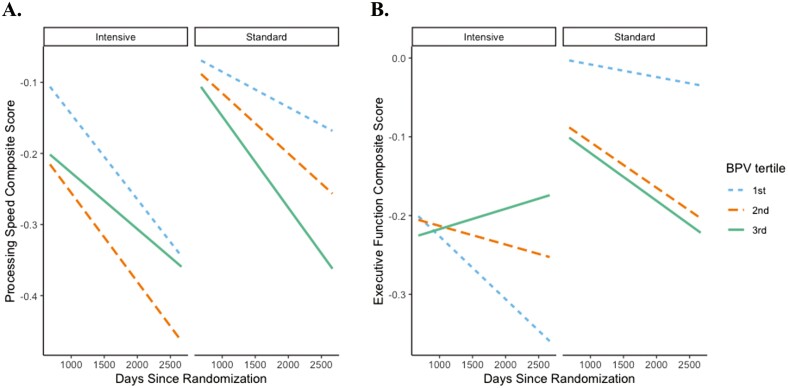
Methods: In this post hoc analysis of the SPRINT MIND trial, 2,348 participants underwent 4 BP measurements over a 9-month period after treatment randomization (standard vs. intensive BP lowering) and ≥ 1 neuropsychological evaluation thereafter. BPV was calculated as tertiles of BP SD. Participants underwent cognitive testing at baseline and every 2 years during the planned 4-year follow-up. Cognitive composite scores were calculated for global cognition, memory, language, executive function, and processing speed. Linear mixed models investigated relationships between BPV, antihypertensive treatment group, and time on cognitive composite scores.
Results: Elevated BPV was associated with the fastest decline in processing speed (ß = -.07 [95% CI -.12, -.01]; P = 0.02) and executive function (ß = -.08 [95% CI -.16, -.006]; P = 0.03) in the standard treatment group only. BPV was not related to cognitive change in the intensive treatment group. Mean/minimum/maximum BP was not associated with cognitive composite scores over time in either antihypertensive treatment group.
Conclusions: Elevated BPV remains a risk for cognitive decline despite strictly controlled BP levels, in the standard treatment group. Specific declines were observed in processing speed and executive function, domains often impacted by cerebrovascular disease and may underpin risk for dementia and cerebrovascular disease associated with BPV. Clinical trial information: ClinicalTrials.gov; NCT01206062.
Keywords: antihypertensives; blood pressure variability; cognition; executive functioning; processing speed.
© The Author(s) 2022. Published by Oxford University Press on behalf of American Journal of Hypertension, Ltd. All rights reserved. For permissions, please e-mail: journals.permissions@oup.com.
Figures
References
-
- Yaffe K. Prevention of cognitive impairment with intensive systolic blood pressure control. JAMA 2019; 321:548–549. - PubMed
-
- Williamson JD, Pajewski NM, Auchus AP, Bryan RN, Chelune G, Cheung AK, Cleveland ML, Coker LH, Crowe MG, Cushman WC, Cutler JA, Davatzikos C, Desiderio L, Erus G, Fine LJ, Gaussoin SA, Harris D, Hsieh M-K, Johnson KC, Kimmel PL, Tamura MK, Launer LJ, Lerner AJ, Lewis CE, Martindale-Adams J, Moy CS, Nasrallah IM, Nichols LO, Oparil S, Ogrocki PK, Rahman M, Rapp SR, Reboussin DM, Rocco MV, Sachs BC, Sink KM, Still CH, Supiano MA, Snyder JK, Wadley VG, Walker J, Weiner DE, Whelton PK, Wilson VM, Woolard N, Wright JTJ, Wright CB; SPRINT MIND Investigators for the SPRINT Research Group. Effect of intensive vs standard blood pressure control on probable dementia: a randomized clinical trial. JAMA 2019; 321:553–561. doi:10.1001/jama.2018.21442. - DOI - PMC - PubMed
-
- de Heus RAA, Tzourio C, Lee EJL, Opozda M, Vincent AD, Anstey KJ, Hofman A, Kario K, Lattanzi S, Launer LJ, Ma Y, Mahajan R, Mooijaart SP, Nagai M, Peters R, Turnbull D, Yano Y, Claassen JAHR, Tully PJ; VARIABLE BRAIN Consortium. Association between blood pressure variability with dementia and cognitive impairment: a systematic review and meta-analysis. Hypertension 2021; 78:1478–1489. doi:10.1161/HYPERTENSIONAHA.121.17797. - DOI - PMC - PubMed
