


Insulin/IGF-dependent Wnt signaling promotes formation of germline tumors and other developmental abnormalities following early-life starvation in Caenorhabditis elegans
- PMID: 36449574
- PMCID: PMC9910406
- DOI: 10.1093/genetics/iyac173
Insulin/IGF-dependent Wnt signaling promotes formation of germline tumors and other developmental abnormalities following early-life starvation in Caenorhabditis elegans
Abstract
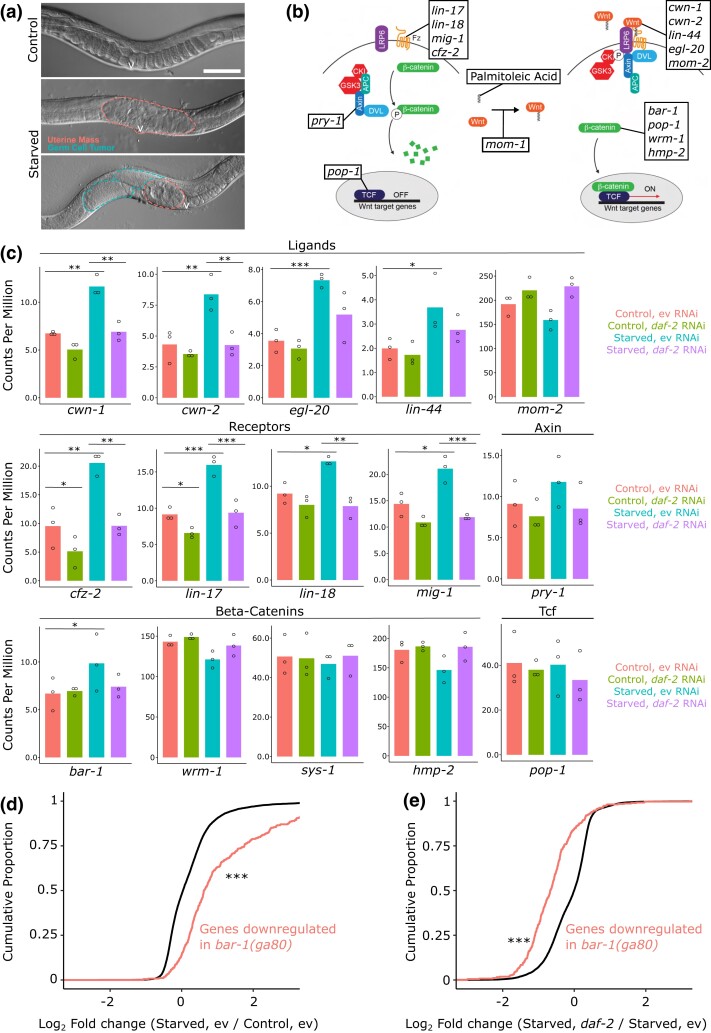
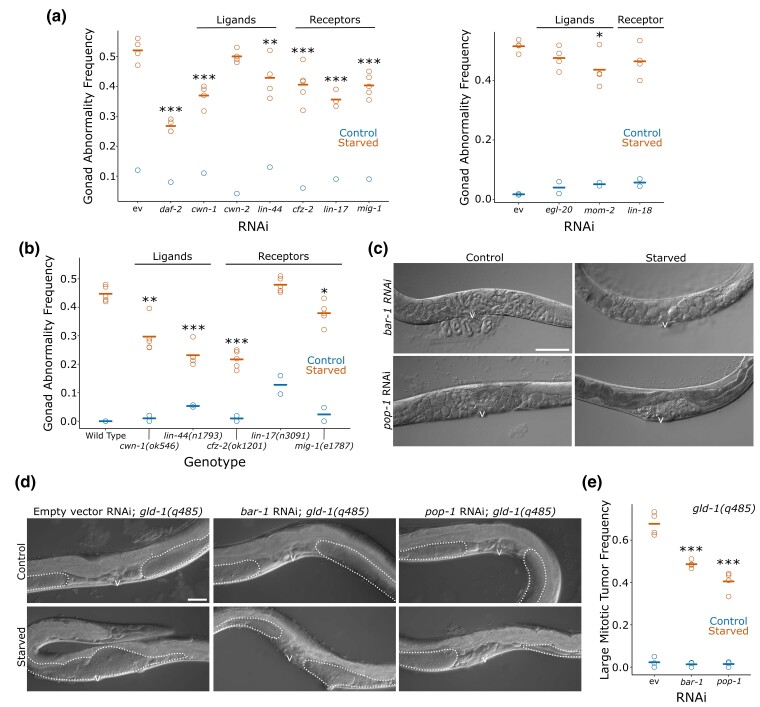
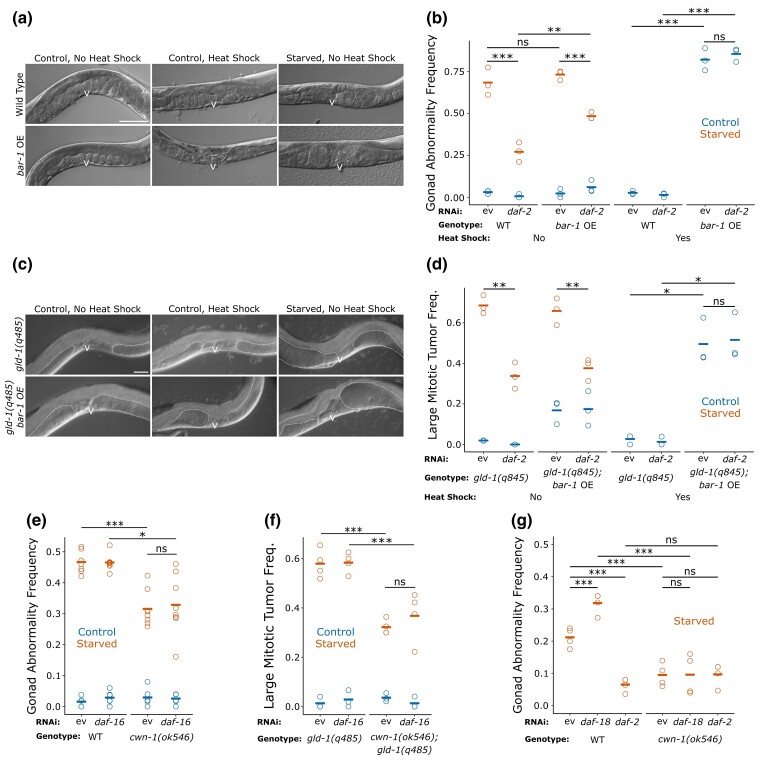
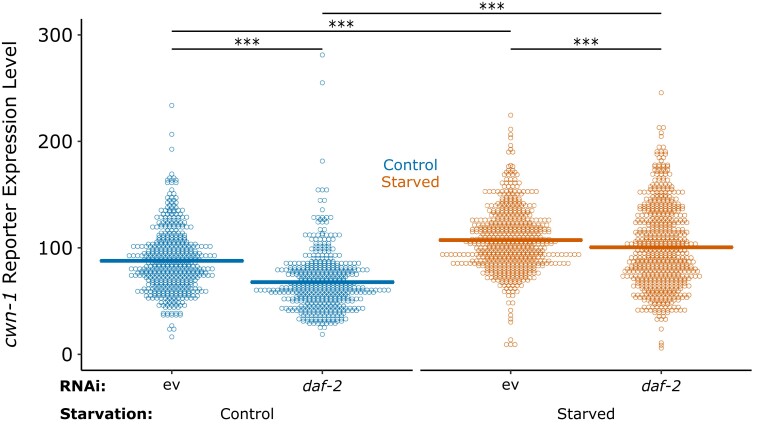
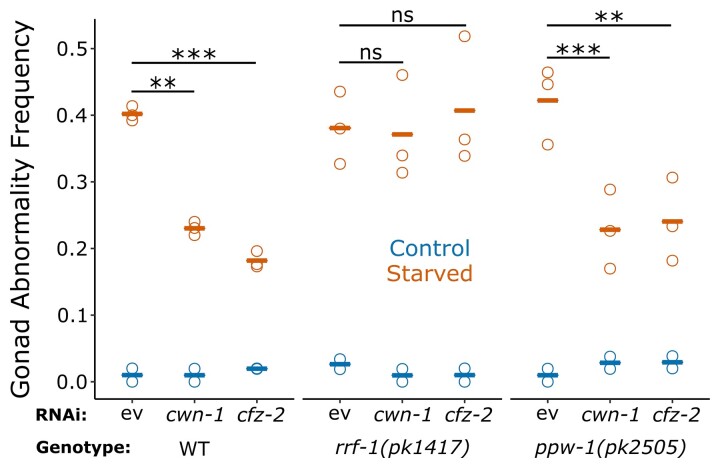
The Developmental Origins of Health and Disease hypothesis postulates that early-life stressors can predispose people to disease later in life. In the roundworm Caenorhabditis elegans, prolonged early-life starvation causes germline tumors, uterine masses, and other gonad abnormalities to develop in well-fed adults. Reduction of insulin/insulin-like growth factor (IGF) signaling (IIS) during larval development suppresses these starvation-induced abnormalities. However, molecular mechanisms at play in formation and suppression of starvation-induced abnormalities are unclear. Here we describe mechanisms through which early-life starvation and reduced IIS affect starvation-induced abnormalities. Transcriptome sequencing revealed that expression of genes in the Wnt signaling pathway is upregulated in adults starved as young larvae, and that knockdown of the insulin/IGF receptor daf-2/InsR decreases their expression. Reduction of Wnt signaling through RNAi or mutation reduced starvation-induced abnormalities, and hyperactivation of Wnt signaling produced gonad abnormalities in worms that had not been starved. Genetic and reporter-gene analyses suggest that Wnt signaling acts downstream of IIS in the soma to cell-nonautonomously promote germline hyperproliferation. In summary, this work reveals that IIS-dependent transcriptional regulation of Wnt signaling promotes starvation-induced gonad abnormalities, illuminating signaling mechanisms that contribute to adult pathology following early-life starvation.
Keywords: DOHaD; L1 arrest; Wnt; diapause; early-life stress; insulin; starvation.
© The Author(s) 2022. Published by Oxford University Press on behalf of the Genetics Society of America. All rights reserved. For permissions, please e-mail: journals.permissions@oup.com.
Conflict of interest statement
Conflicts of interest: The authors declare no conflict of interest.
Figures
References
-
- Abiola M, Favier M, Christodoulou-Vafeiadou E, Pichard AL, Martelly I, Guillet-Deniau I. Activation of Wnt/β-catenin signaling increases insulin sensitivity through a reciprocal regulation of Wnt10b and SREBP-1c in skeletal muscle cells. PLoS One. 2009;4:e8509. doi: 10.1371/journal.pone.0008509 - DOI - PMC - PubMed
Publication types
MeSH terms
Substances
Grants and funding
LinkOut - more resources
Full Text Sources
Medical
Miscellaneous
