. 2022 Nov 30;13(1):7365.
doi: 10.1038/s41467-022-35136-1.

A Shigella sonnei clone with extensive drug resistance associated with waterborne outbreaks in China

Affiliations

A Shigella sonnei clone with extensive drug resistance associated with waterborne outbreaks in China

Shaofu Qiu et al. Nat Commun. .

Abstract

Antimicrobial resistance of Shigella sonnei has become a global concern. Here, we report a phylogenetic group of S. sonnei with extensive drug resistance, including a combination of multidrug resistance, coresistance to ceftriaxone and azithromycin (cefRaziR), reduced susceptibility to fluoroquinolones, and even colistin resistance (colR). This distinct clone caused six waterborne shigellosis outbreaks in China from 2015 to 2020. We collect 155 outbreak isolates and 152 sporadic isolates. The cefRaziR isolates, including outbreak strains, are mainly distributed in a distinct clade located in global Lineage III. The outbreak strains form a recently derived monophyletic group that may have emerged circa 2010. The cefRaziR and colR phenotypes are attributed to the acquisition of different plasmids, particularly the IncB/O/K/Z plasmid coharboring the blaCTX-M-14, mphA, aac(3)-IId, dfrA17, aadA5, and sul1 genes and the IncI2 plasmid with an mcr-1 gene. Genetic analyses identify 92 accessory genes and 60 single-nucleotide polymorphisms associated with the cefRaziR phenotype. Surveillance of this clone is required to determine its dissemination and threat to global public health.


Conflict of interest statement

The authors declare no competing interests.

Figures
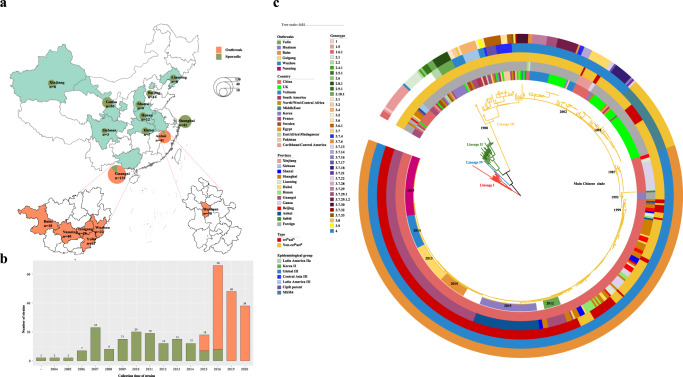
Fig. 1
Fig. 1. Distribution and phylogenetic analysis of Chinese S. sonnei strains, including the outbreak strains.
a shows the regional distribution of Chinese S. sonnei isolates, including sporadic and outbreak strains. There were 307 Chinese strains, including 155 outbreak strains and 152 sporadic strains from different regions of China. b shows the temporal distribution of Chinese S. sonnei isolates, including sporadic and outbreak strains. The outbreak strains were collected in 2015, 2016, 2019, and 2020. c shows a phylogenetic tree of global S. sonnei strains, displaying the position of Chinese S. sonnei strains, including the cefRaziR isolates as well as the six outbreak strains. The rings, from outer to inner, labeled with different colors indicate the cefRaziR and non-cefRaziR phenotypes, the isolation regions, geographical origin, and outbreak locations, respectively. Divergence dates are given on the major nodes in the tree. The map was created using publicly available data (https://www.webmap.cn/main.do?method=index). Source data are provided as a Source Data file. cefRaziR coresistance to ceftriaxone and azithromycin.
Fig. 2
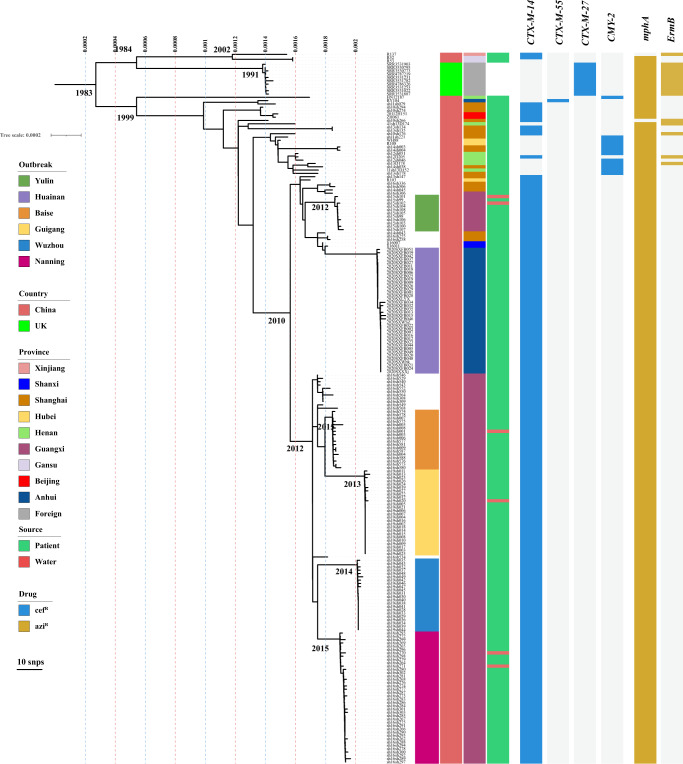
Fig. 2. Microevolution of the cefRaziRS. sonnei strains including the outbreak strains.
The phylogenetic tree was constructed based on 215 cefRaziR S. sonnei isolates, including 205 Chinese strains and 10 UK strains. The outbreak locations, isolation regions, geographical origin, and isolation sources (patient or water) are labeled in different colors. The AMR genes conferring cefRaziR coresistance are shown with a heatmap. Source data are provided as a Source Data file. cefR resistance to ceftriaxone, aziR resistance to azithromycin, SNP single-nucleotide polymorphism, cefRaziR coresistance to ceftriaxone and azithromycin, AMR antimicrobial resistance.
Fig. 3
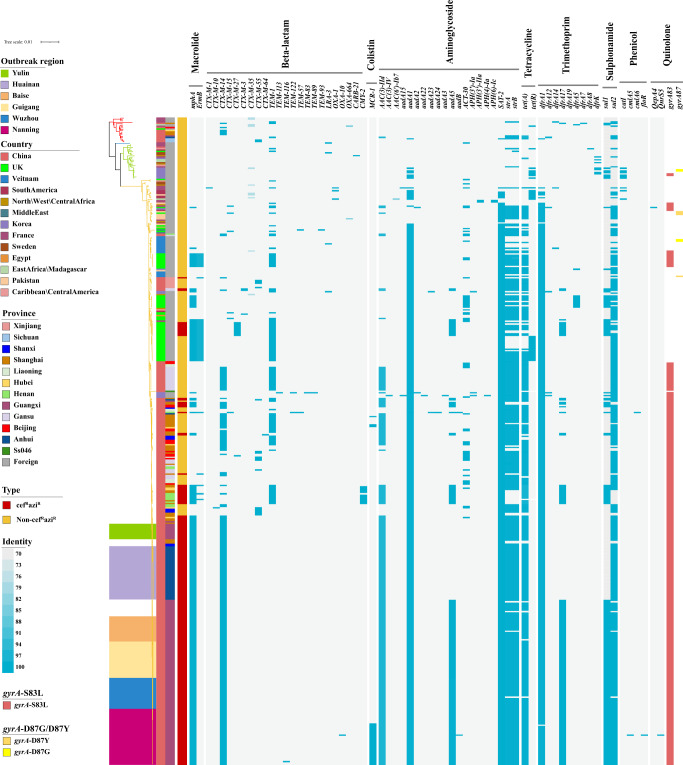
Fig. 3. Phylogeny of the global S. sonnei isolates with a heatmap showing the distribution of AMR determinants.
The region covered by color patches on the evolutionary tree represents the outbreak strains in different regions, and the two bands at the left of the heatmap indicate the information of the country and province of the strains, respectively. Blue stripes represent the identity of different types of AMR genes, showing genes with only more than 90% coverage and 70% identity. GyrA mutations, including S83L, D87Y, and D87G, are separately indicated by the colors red, gamboge, and yellow. Source data are provided as a Source Data file. cefRaziR coresistance to ceftriaxone and azithromycin, AMR antimicrobial resistance.
Fig. 4
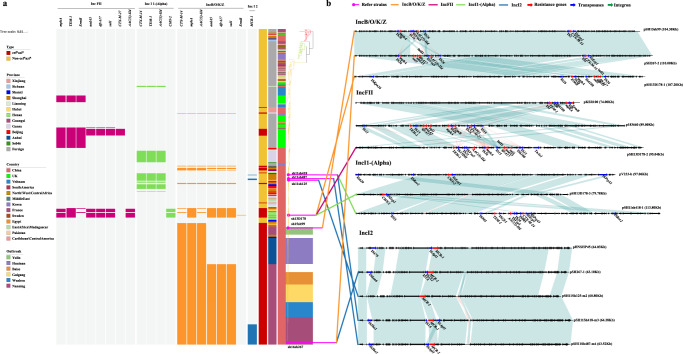
Fig. 4. Plasmid profiles and pairwise comparisons of plasmids associated with the cefRaziR and colR phenotypes.
a Plasmids and plasmid-mediated resistance genes are represented in the heatmap by red, green, yellow, and blue bands, respectively. b Pairwise comparisons of the plasmids harboring the blaCTX-M, blaCMY-2, blaTEM-1, mphA/ermB, and mcr-1 genes. Four replicons of plasmids, including pSH15sh99, pH267-2, and pSH13D178-1 of IncB/O/K/Z; pKSR100, p183660, and pSH13D178-2 of IncFII; pV233-b, pSH13D178-3, and pSH11sh418-1 of IncI1-(Alpha); and pHNSHP45 and pSH267-1 of IncI2, were selected for pairwise comparisons. Source data are provided as a Source Data file. cefRaziR coresistance to ceftriaxone and azithromycin, colR resistance to colistin.
Fig. 5
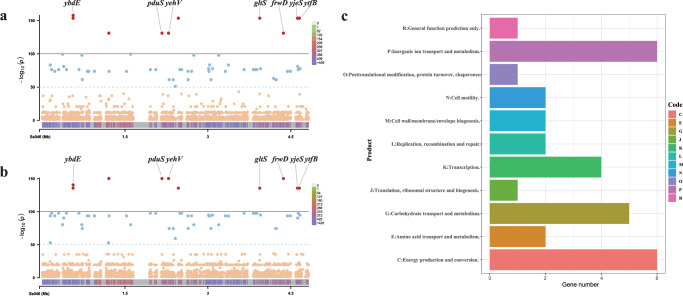
Fig. 5. The SNPs identified by a GWAS are associated with cefRaziR isolates and the outbreak strains.
a and b separately show SNPs identified by a GWAS associated with outbreak strains and cefRaziR strains. The red dots represent significantly associated (P < 1e-100) SNPs, while the blue dots represent SNPs with a P value <1e-50. The thresholds P = 1e-100 and P = 1e-50 are indicated by a red line and a blue line, respectively. The bottom band shows the density of SNP distribution. c shows COG function classifications of SNPs with P < 1e-50. These SNPs are mainly associated with transport, energy production, and transcription. Source data are provided as a Source Data file. SNP single-nucleotide polymorphism, GWAS genome-wide association study, cefRaziR coresistance to ceftriaxone and azithromycin, COG Cluster of Orthologous Groups.
Fig. 6
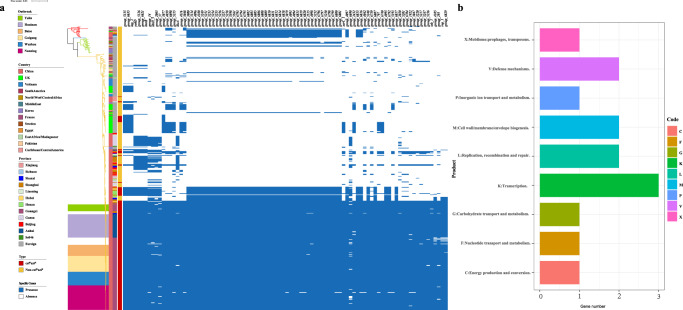
Fig. 6. Accessory genes identified by pangenome analysis that might be associated with cefRaziR isolates and the outbreak strains.
a shows the accessory genes significantly associated with the cefRaziR phenotype. There were 92 genes screened by the chi-square test whose P values were lower than 1e-30 and defined as genes if their proportion was more than 80% in the cefRaziR group but less than 20% in non-cefRaziR isolates. b COG function classifications of significant accessory clusters of orthologous genes. Source data are provided as a Source Data file. cefRaziR coresistance to ceftriaxone and azithromycin, COG Cluster of Orthologous Groups.

References

    1. Kotloff KL, et al. Global burden of Shigella infections: implications for vaccine development and implementation of control strategies. Bull. World Health Organ. 1999;77:651–666. - PMC - PubMed
    1. Bardhan P, Faruque AS, Naheed A, Sack DA. Decrease in shigellosis-related deaths without Shigella spp.-specific interventions, Asia. Emerg. Infect. Dis. 2010;16:1718–1723. doi: 10.3201/eid1611.090934. - DOI - PMC - PubMed
    1. Holt KE, et al. Shigella sonnei genome sequencing and phylogenetic analysis indicate recent global dissemination from Europe. Nat. Genet. 2012;44:1056–1059. doi: 10.1038/ng.2369. - DOI - PMC - PubMed
    1. Wang, X. Y. et al. Trend and disease burden of bacillary dysentery in China (1991-2000). Bull. World Health Organ.84, 561–568 (2006). - PMC - PubMed
    1. Qiu S, et al. Shift in serotype distribution of Shigella species in China, 2003-2013. Clin. Microbiol. Infect. 2015;21:252 e255–252 e258. doi: 10.1016/j.cmi.2014.10.019. - DOI - PubMed

Publication types

Substances