


Identification of three new 'Candidatus Liberibacter solanacearum' haplotypes in four psyllid species (Hemiptera: Psylloidea)
- PMID: 36450781
- PMCID: PMC9712394
- DOI: 10.1038/s41598-022-24032-9
Identification of three new 'Candidatus Liberibacter solanacearum' haplotypes in four psyllid species (Hemiptera: Psylloidea)
Abstract
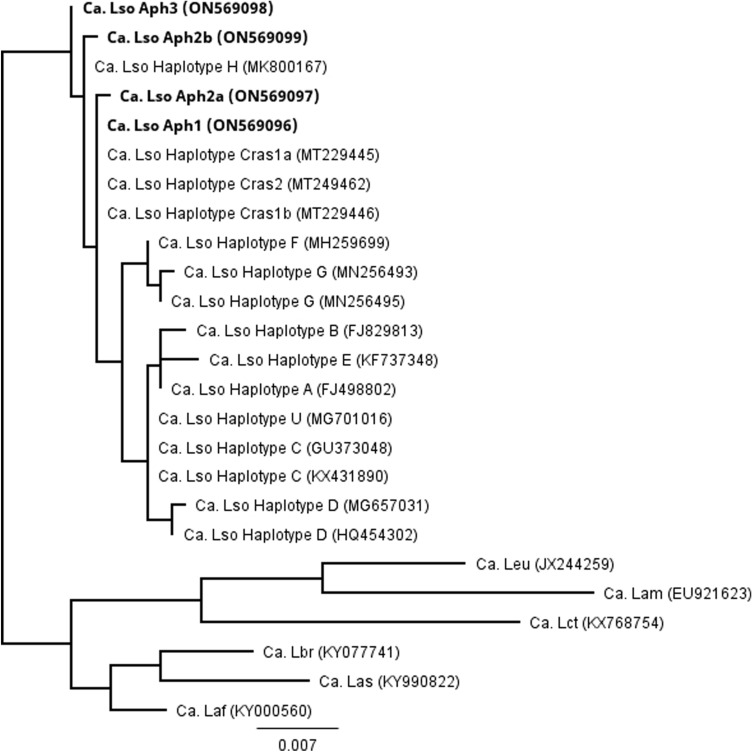
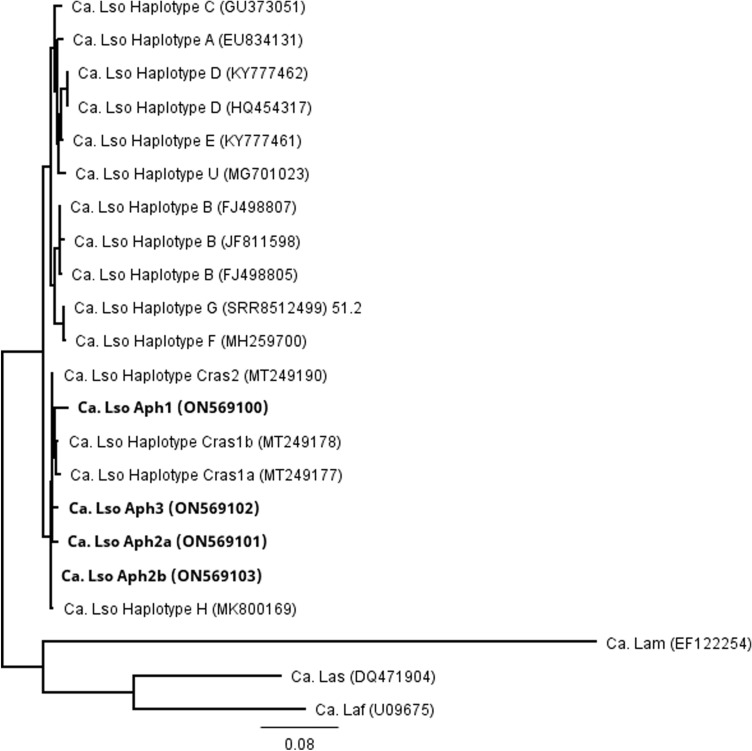
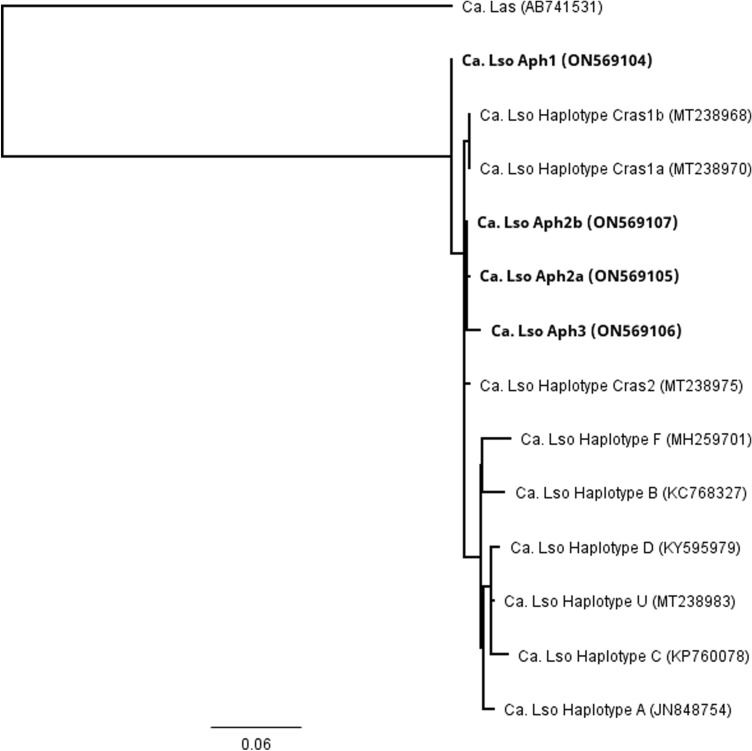
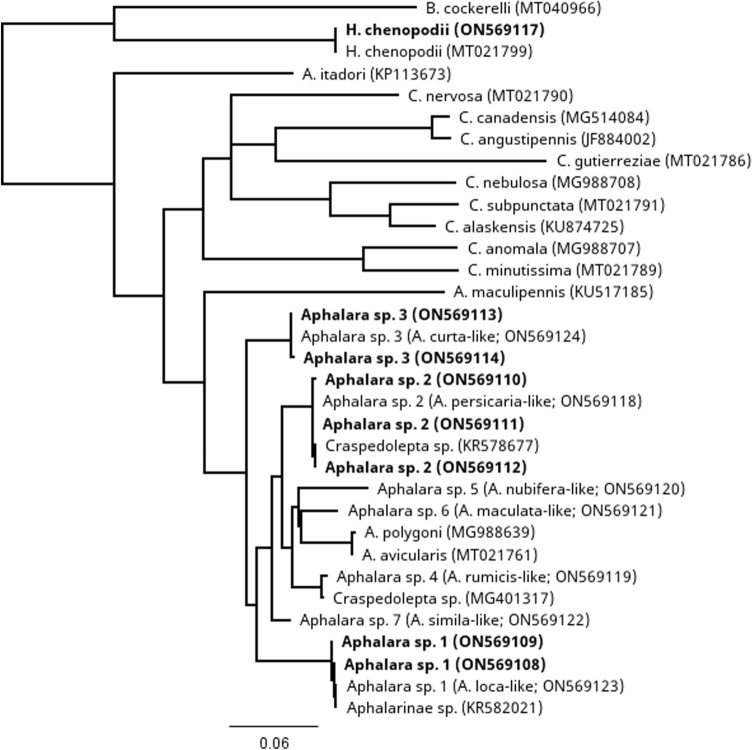
Eleven haplotypes of the bacterium, 'Candidatus Liberibacter solanacearum', have been identified worldwide, several of which infect important agricultural crops. In the United States, haplotypes A and B are associated with yield and quality losses in potato, tomato, and other crops of the Solanaceae. Both haplotypes are vectored by potato psyllid, Bactericera cockerelli. Recently, a third haplotype, designated F, was identified in southern Oregon potato fields. To identify the vector of this haplotype, psyllids of multiple species were collected from yellow sticky cards placed near potato fields during two growing seasons. Over 2700 specimens were tested for 'Ca. L. solanacearum' by polymerase chain reaction. Forty-seven psyllids harbored the bacterium. The infected specimens comprised four psyllid species in two families, Aphalaridae and Triozidae (Hemiptera: Psylloidea). Nucleic acid and/or amino acid sequence analysis of the 'Ca. L. solanacearum' 16S ribosomal RNA, 50S ribosomal proteins L10/L12, and outer membrane protein identified three new haplotypes of the bacterium, designated as Aph1, Aph2 and Aph3, including two variants of Aph2 (Aph2a and Aph2b). The impact of these new haplotypes on solanaceous or other crops is not known. The vector of 'Ca. L. solanacearum' haplotype F was not detected in this study.
© 2022. This is a U.S. Government work and not under copyright protection in the US; foreign copyright protection may apply.
Conflict of interest statement
The authors declare no competing interests.
Figures
References
-
- Munyaneza JE. Zebra chip disease, Candidatus Liberibacter, and potato psyllid: A global threat to the potato industry. Am. J. Potato Res. 2015;92:230–235. doi: 10.1007/s12230-015-9448-6. - DOI
-
- Swisher Grimm, K. D. & Garczynski, S. F. Identification of a new haplotype of ‘Candidatus Liberibacter solanacearum’ in Solanum tuberosum. Plant Dis. 103, 468–474 (2019). - PubMed
-
- Swisher Grimm, K. D., Mustafa, T., Cooper, W. R. & Munyaneza, J. E. Growth and yield performance of Solanum tuberosum grown from seed potatoes infected with ‘Candidatus Liberibacter solanacearum’ haplotypes A and B. Plant Dis. 104, 688–693 (2020). - PubMed
-
- Caicedo JD, Simbaña LL, Calderón DA, Lalangui KP, Rivera-Vargas LI. First report of ‘Candidatus Liberibacter solanacearum’ in Ecuador and in South America. Australasian Plant Dis. Notes. 2020;15:1–3. doi: 10.1007/s13314-020-0375-0. - DOI
-
- Borges KM, et al. “Candidatus Liberibacter solanacearum” associated with the psyllid, Bactericera maculipennis (Hemiptera: Triozidae) Environ. Entomol. 2017;46:210–216. - PubMed
Publication types
MeSH terms
LinkOut - more resources
Full Text Sources
