. 2023 May;30(5):443-454.
doi: 10.1038/s41434-022-00375-w. Epub 2022 Dec 1.

In vivo genome editing using novel AAV-PHP variants rescues motor function deficits and extends survival in a SOD1-ALS mouse model

Affiliations

In vivo genome editing using novel AAV-PHP variants rescues motor function deficits and extends survival in a SOD1-ALS mouse model

Yi A Chen et al. Gene Ther. 2023 May.

Abstract

CRISPR-based gene editing technology represents a promising approach to deliver therapies for inherited disorders, including amyotrophic lateral sclerosis (ALS). Toxic gain-of-function superoxide dismutase 1 (SOD1) mutations are responsible for ~20% of familial ALS cases. Thus, current clinical strategies to treat SOD1-ALS are designed to lower SOD1 levels. Here, we utilized AAV-PHP.B variants to deliver CRISPR-Cas9 guide RNAs designed to disrupt the human SOD1 (huSOD1) transgene in SOD1G93A mice. A one-time intracerebroventricular injection of AAV.PHP.B-huSOD1-sgRNA into neonatal H11Cas9 SOD1G93A mice caused robust and sustained mutant huSOD1 protein reduction in the cortex and spinal cord, and restored motor function. Neonatal treatment also reduced spinal motor neuron loss, denervation at neuromuscular junction (NMJ) and muscle atrophy, diminished axonal damage and preserved compound muscle action potential throughout the lifespan of treated mice. SOD1G93A treated mice achieved significant disease-free survival, extending lifespan by more than 110 days. Importantly, a one-time intrathecal or intravenous injection of AAV.PHP.eB-huSOD1-sgRNA in adult H11Cas9 SOD1G93A mice, immediately before symptom onset, also extended lifespan by at least 170 days. We observed substantial protection against disease progression, demonstrating the utility of our CRISPR editing preclinical approach for target evaluation. Our approach uncovered key parameters (e.g., AAV capsid, Cas9 expression) that resulted in improved efficacy compared to similar approaches and can also serve to accelerate drug target validation.


Conflict of interest statement

The authors would like to declare they are/were employees of Biogen Inc.

Figures
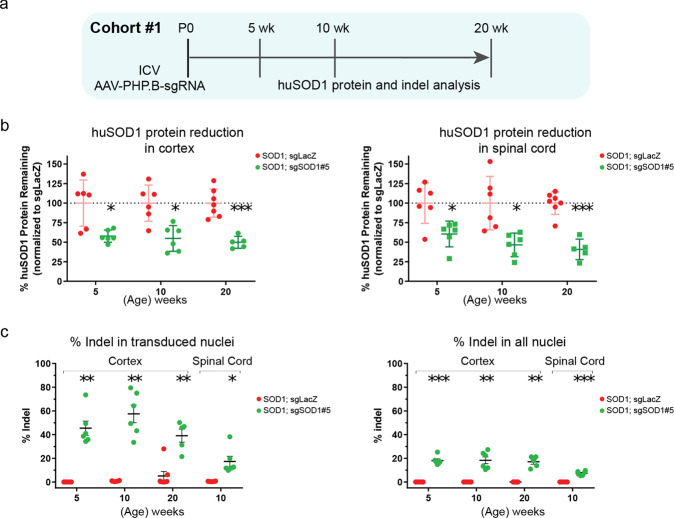
Fig. 1
Fig. 1. Neonatal ICV injection of AAV-sgSOD1 effectively reduces huSOD1 protein in the CNS and generates high indel rates in the huSOD1 gene.
a Study design of histological and biochemical analysis on H11Cas9 SOD1G93A mice treated with AAV-sgSOD1 (Cohort #1). b Percentage of remaining huSOD1 protein in cortex (left) and spinal cord (right) of H11Cas9 SOD1G93A mice treated with AAV-sgSOD1 (Cohort #1) as determined by ELISA. c Indel percentage in cortex and spinal cord of H11Cas9 SOD1G93A mice treated with AAV-sgSOD1 (Cohort #1) as determined by amplicon-Seq of transduced nuclei (left) and all nuclei (right). Data are presented as mean with standard deviation (SD) unless otherwise stated. Welch’s t-test with Bonferroni correction is performed unless otherwise stated. *p < 0.05, **p < 0.01, and ***p < 0.001, n.s. not significant. See also Fig. S3.
Fig. 2
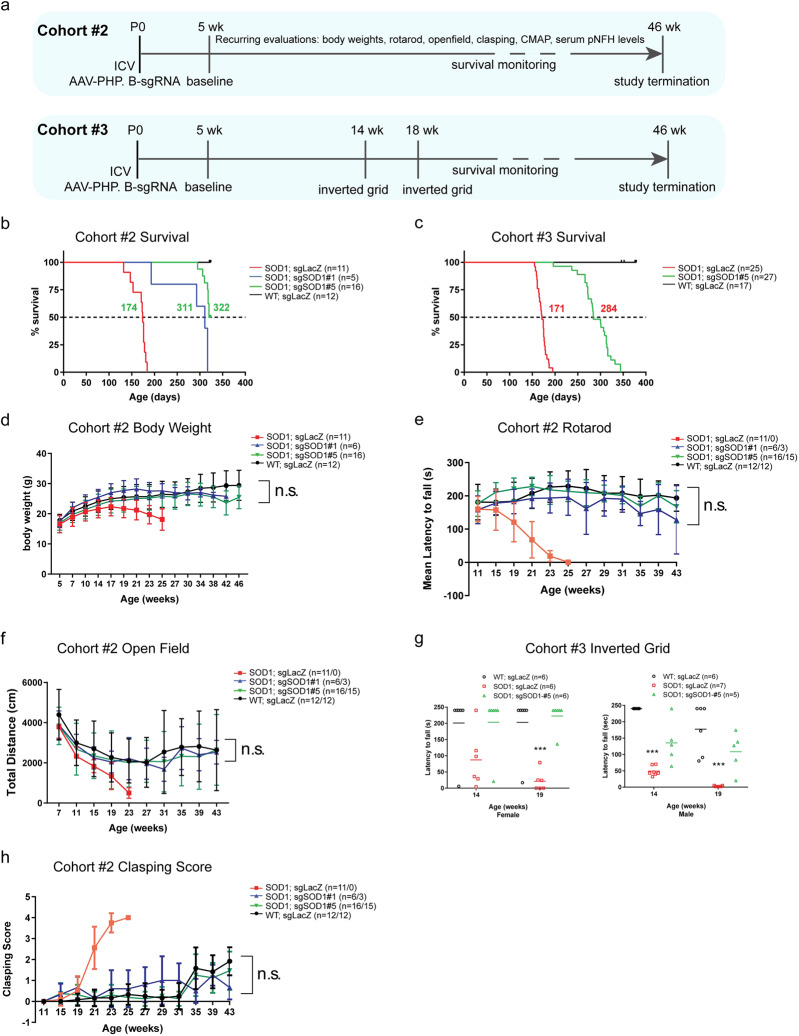
Fig. 2. Neonatal ICV injection of AAV-sgSOD1 prevents motor function decline and significantly extends survival in H11Cas9 SOD1G93A mice.
a Study design of two independent cohorts (Cohorts #1 and #2) of H11Cas9 SOD1G93A mice treated with AAV-sgSOD1. b, c Kaplan-Meier survival curves of Cohorts #1 and #2. Log-Rank test, P < 0.0001. d Body weight of mice over time (Cohort #1). Behavioral assessments of SOD1G93A mice treated with AAV-sgSOD1: rotarod performance measured as latency to fall over age (e), total distance travelled in open field over time (f), performance in inverted grid test measured as latency to fall at week 14 and 19 (g), and clasping score over age (h). Data are presented as mean with standard deviation (SD) unless otherwise stated. Two-way ANOVA was performed with all groups compared to WT group in df. One-way ANOVA Dunnett’s multiple comparisons test was performed with all groups compared to WT group in g (n.s. is not labeled). *p < 0.05, **p < 0.01, and ***p < 0.001, and n.s. not significant (p > 0.05).
Fig. 3
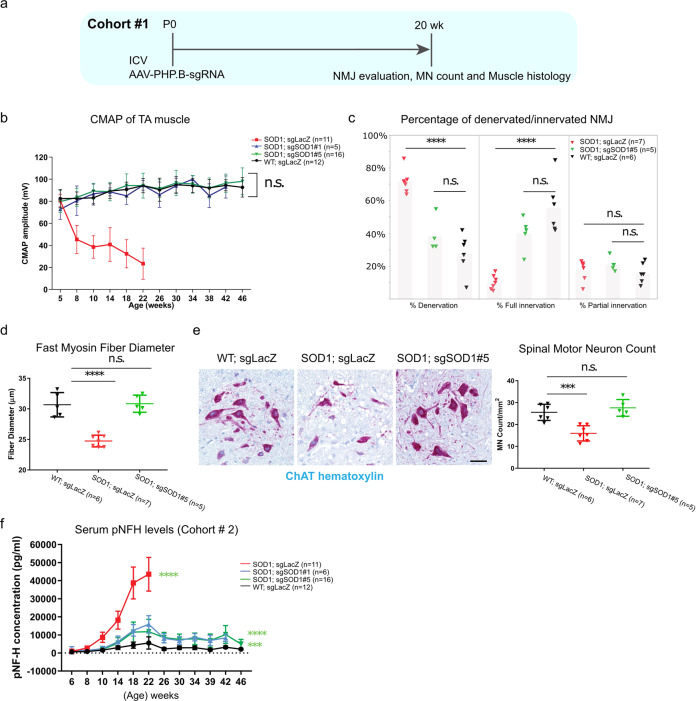
Fig. 3. Neonatal ICV injection of AAV-sgSOD1 prevents NMJ loss, muscle atrophy and neurodegeneration in H11Cas9 SOD1G93A mice.
a Study design of histological and biochemical analysis on H11Cas9 SOD1G93A mice treated with AAV-sgSOD1 (Cohort #1). b CMAP amplitude over disease progression (time). Two-way ANOVA is performed with all groups compared to WT group. c Percentage of fully innervated, denervated and partially innervated NMJs in male mice at 20 weeks of age. d Diameter of fast myosin muscle fiber of tibialis muscles at 20 weeks of age. e Left, representative images of spinal motor neurons stained by ChAT at 20 weeks of age. (scale bar, 50 µm); Right, spinal motor neuron numbers at 20 weeks of age. ce One-way ANOVA Dunnett’s multiple comparisons test was performed with all groups compared to WT group. f Serum pNFH levels over disease progression (time). Two-way ANOVA was performed, all groups compared to WT group. bf Data are presented as mean with standard deviation (SD) unless otherwise stated. *p < 0.05, **p < 0.01, ***p < 0.001, ****p < 0.0001, and n.s. not significant. Data was from collected from Cohort #3 in B-E and from Cohort #1 in F.
Fig. 4
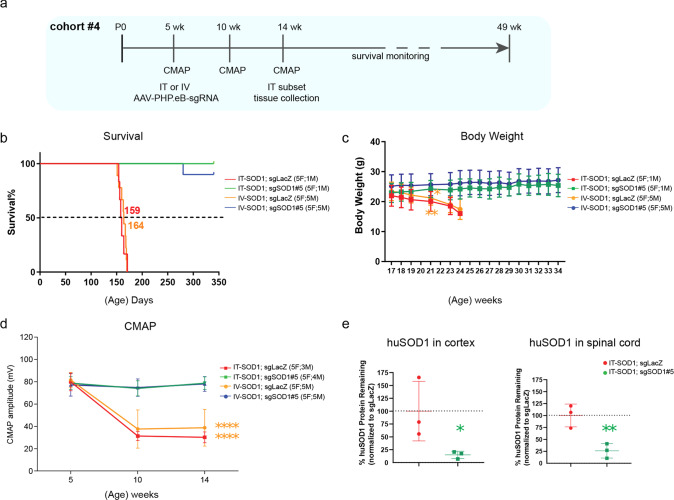
Fig. 4. IT and IV injection of AAV-sgSOD1 in adult H11Cas9 SOD1G93A mice preserves neuromuscular function and significantly extends survival.
a Study design of IT and IV injection of AAV-sgSOD1 in adult H11Cas9 SOD1G93A mice (Cohort #4). b Kaplan-Meier survival curves of Cohorts #1 and #2. Log-Rank test, P < 0.0001. c Body weight of mice over age (Cohort #4). t-test was performed at week 21 before any mock-treated mice reach euthanasia endpoint: IT-sgLacZ vs. IT-sgSOD1; IV-sgLacZ vs. IV-sgSOD1. d CMAP amplitude of TA muscle at week 5, 10 and 14. Two-way ANOVA with Dunnett’s multiple comparisons test was performed. e Percentage of remaining huSOD1 protein at week 14 in cortex (left) and spinal cord (right) of H11Cas9 SOD1G93A mice IT injected with AAV-sgSOD1 (Cohort #4) as determined by ELISA. Unpaired t-test. ce Data are presented as mean with standard deviation (SD). *p < 0.05, **p < 0.01, and ***p < 0.001, ****p < 0.0001, n.s, not significant. Color of * indicates the group on which statistics was performed.

References

    1. Brown RH, Al-Chalabi A. Amyotrophic lateral Sclerosis. N Engl J Med. 2017;377:162–72. doi: 10.1056/NEJMra1603471. - DOI - PubMed
    1. Rosen DR. Mutations in Cu/Zn superoxide dismutase gene are associated with familial amyotrophic lateral sclerosis. Nature. 1993;364:362. doi: 10.1038/364362c0. - DOI - PubMed
    1. Andersen PM, Nilsson P, Keranen ML, Forsgren L, Hagglund J, Karlsborg M, et al. Phenotypic heterogeneity in motor neuron disease patients with CuZn-superoxide dismutase mutations in Scandinavia. Brain. 1997;120:1723–37. doi: 10.1093/brain/120.10.1723. - DOI - PubMed
    1. Bruijn LI, Cleveland DW. Mechanisms of selective motor neuron death in ALS: insights from transgenic mouse models of motor neuron disease. Neuropathol Appl Neurobiol. 1996;22:373–87. doi: 10.1111/j.1365-2990.1996.tb00907.x. - DOI - PubMed
    1. Fischer LR, Glass JD. Oxidative stress induced by loss of Cu,Zn-superoxide dismutase (SOD1) or superoxide-generating herbicides causes axonal degeneration in mouse DRG cultures. Acta Neuropathol. 2010;119:249–59. doi: 10.1007/s00401-009-0631-z. - DOI - PMC - PubMed

Publication types