Review
. 2023 Jan 28;33(1):15-27.
doi: 10.4014/jmb.2207.07032. Epub 2022 Oct 17.

Biofilm Signaling, Composition and Regulation in Burkholderia pseudomallei

Affiliations
Review

Biofilm Signaling, Composition and Regulation in Burkholderia pseudomallei

Pravin Kumran Nyanasegran et al. J Microbiol Biotechnol. .

Abstract

The incidence of melioidosis cases caused by the gram-negative pathogen Burkholderia pseudomallei (BP) is seeing an increasing trend that has spread beyond its previously known endemic regions. Biofilms produced by BP have been associated with antimicrobial therapy limitation and relapse melioidosis, thus making it urgently necessary to understand the mechanisms of biofilm formation and their role in BP biology. Microbial cells aggregate and enclose within a self-produced matrix of extracellular polymeric substances (EPSs) to form biofilm. The transition mechanism of bacterial cells from planktonic state to initiate biofilm formation, which involves the formation of surface attachment microcolonies and the maturation of the biofilm matrix, is a dynamic and complex process. Despite the emerging findings on the biofilm formation process, systemic knowledge on the molecular mechanisms of biofilm formation in BP remains fractured. This review provides insights into the signaling systems, matrix composition, and the biosynthesis regulation of EPSs (exopolysaccharide, eDNA and proteins) that facilitate the formation of biofilms in order to present an overview of our current knowledge and the questions that remain regarding BP biofilms.

Keywords: Burkholderia pseudomallei; biofilm; cyclic-di-GMP; eDNA; exopolysaccharide; quorum sensing.


Conflict of interest statement

Conflict of Interest

The authors have no financial conflicts of interest to declare.

Figures
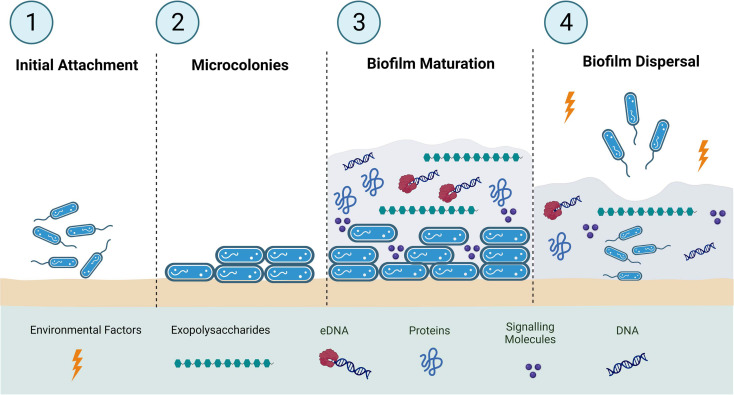
Fig. 1
Fig. 1. Schematic diagram representing four stages of biofilm formation (1) surface bacterial attachment, (2) microcolony formation, (3) maturation of biofilm architecture, and (4) dispersion of cells into the planktonic state (adapted from [15-17]).
Fig. 2
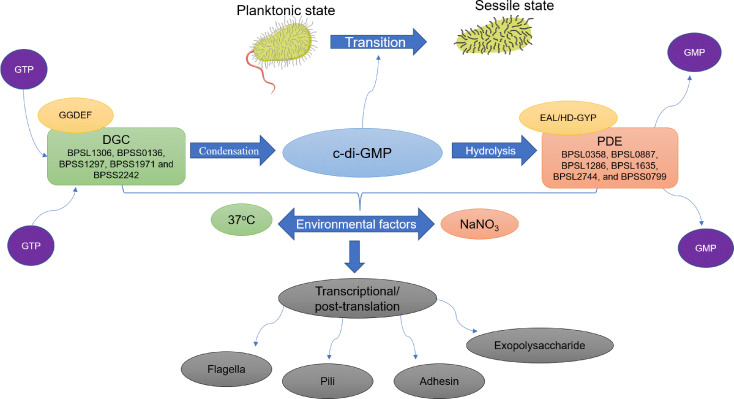
Fig. 2. C-di-GMP synthesis mechanism and functional properties during BP biofilm formation.
The synthesis and breakdown of cyclic-di-GMP (c-di-GMP) are regulated by two enzymes, diguanylate cyclase (DGC) and phosphodiesterase (PDE), each containing a conserved GGDEF or EAL/HD-GYP domain respectively. Two guanosine-5’-triphosphate (GTP) molecules are utilized by DGC during the condensation reaction that results in the formation of c-di-GMP, which favors biofilm formation by enhancing the transition from free-living planktonic cells to sessile cells. PDE catalyzes the hydrolysis of c-di-GMP into two guanosine monophosphate (GMP) molecules. Both enzymes are influenced by environmental signals such as temperature and concentration of sodium nitrate (NaNO3) that ultimately determine the level of c-di-GMP. The phenotypic characteristics of the cells such as the presence of flagella, pili, adhesin, and exopolysaccharide may be regulated by these enzymes at the transcriptional and post-translation levels through determining the level of c-di-GMP [41].
Fig. 3
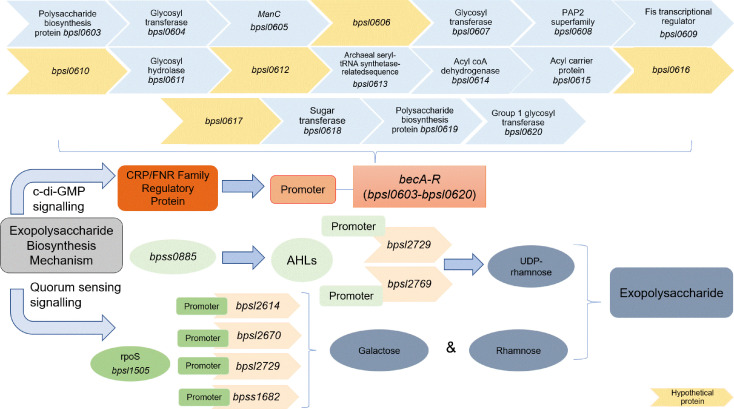
Fig. 3. Proposed BP exopolysaccharide biosynthesis regulation mechanism via c-di-GMP and QS signaling.
Signaling molecules, e.g. c-di-GMP, and QS molecules, e.g., RpoS and AHLs, regulate the development of the EPS components, particularly exopolysaccharides. c-di-GMP is reported to improve the binding between the regulatory protein and the promoter region of the becA-R gene cluster thereby triggering gene expression of the cluster to produce the enzymes that facilitate the synthesis of exopolysaccharides in the EPS.

References

    1. Mariappan V, Vellasamy KM, Barathan M, Girija ASS, Shankar EM, Vadivelu J. Hijacking of the Host's Immune Surveillance Radars by Burkholderia pseudomallei. Front. Immunol. 2021;12:718719. doi: 10.3389/fimmu.2021.718719. - DOI - PMC - PubMed
    1. Wiersinga WJ, Virk HS, Torres AG, et al. Melioidosis. Nat. Rev. Dis. Primers. 2018;4:17108. doi: 10.1038/nrdp.2017.107. - DOI - PMC - PubMed
    1. Yip C-H, Ghazali A-K, Nathan S. Burkholderia pseudomallei pathogenesis and survival in different niches. Biochem. Soc. Trans. 2020;48:569–579. doi: 10.1042/BST20190836. - DOI - PubMed
    1. Panomket P, Wongsana P, Wanram S, Wongratanacheewin S. Burkholderia pseudomallei biofilm plays a key role in chronic inflammation in C57BL/6 mice. Southeast Asian J. Trop. Med. Public Health. 2017;48:73–82. - PubMed

    1. Duangurai T, Indrawattana N, Pumirat P. Burkholderia pseudomallei adaptation for survival in stressful conditions. Biomed Res. Int. 2018;2018:3039106. doi: 10.1155/2018/3039106. - DOI - PMC - PubMed