


Negative effects of heat stress on ovarian tissue in female rabbit
- PMID: 36452142
- PMCID: PMC9704112
- DOI: 10.3389/fvets.2022.1009182
Negative effects of heat stress on ovarian tissue in female rabbit
Abstract
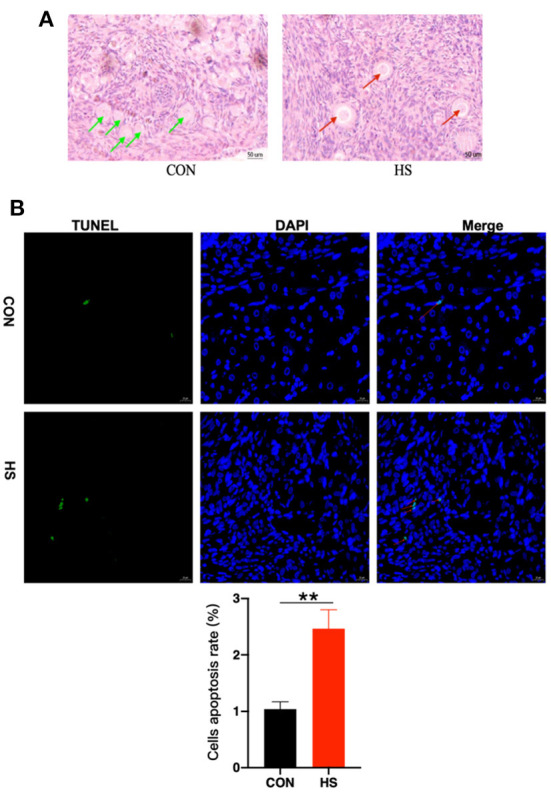
Numerous studies have highlighted the role of miRNA in the deformation and necrosis of cells of ovarian tissue caused by heat stress (HS), which ultimately affects ovarian function. Although the role of small RNAs has been investigated in alterations in ovarian tissue functioning in response to HS, the expression profile of ovarian miRNA has been explored to a lesser extent. In this study, female rabbits were subject to HS treatment by using electrical heater. The current work demonstrated that HS could significantly change physiological performance of female rabbits including body weight, rectal temperature and relative ovary weight, and significantly reduce serum IL-2, IL-8, CAT, and GSH-Px concentrations by enzyme-linked immunosorbent assay (ELISA) technique. As a result, an increase in apoptosis in ovarian cells, as well as unhealthy follicles, were observed by Hematoxylin-eosin (HE) and TUNEL staining. Additionally, small RNA-seq revealed changes in the miRNA expression profile of rabbit ovaries under HS. Five hundred fourteen miRNAs were obtained including known miRNAs 442 and novel miRNAs 72. Among these miRNAs, 23 miRNAs were significantly expressed under HS. Eleven differentially expressed miRNAs (DE miRNAs) and 9 their predicted targets were confirmed by qPCR, which were expected miRNA-mRNA negative regulation pattern. Among the DE miRNAs and targets, miR-141-39 may target COQ6, miR-449a-5p and miR-34c-5p may control RFC5 and RTN2 together, miR-449a-5p may target ACADVL, miR-34c-5p potentially targets Bcl-2 and miR-196b-5p potentially regulates CASK and HOXB6. Thus, the current work suggested the negative effects of HS on the ovarian tissue of female rabbits, and in conclusion these changes could be caused by decreased serum IL-2, IL-8, CAT and GSH-Px levels, increased ovarian apoptosis, and changed the expression of miRNAs.
Keywords: gene expression; heat stress; microRNA; ovary; rabbit.
Copyright © 2022 Tang, Bai, Xie, Chen, Jia, Lei, Li and Lai.
Conflict of interest statement
The authors declare that the research was conducted in the absence of any commercial or financial relationships that could be construed as a potential conflict of interest.
Figures




References
-
- Abbas MA, Alqaisi KM, Disi A, Hameed NA. Chrysin increased progesterone and LH levels, estrous phase duration and altered uterine histology without affecting aromatase expression in rat ovary. J Funct Foods. (2022) 89:104964. 10.1016/j.jff.2022.104964 - DOI
-
- Yasoob TB, Yu D, Khalid AR, Zhang Z, Zhu X, Saad HM, et al. . Oral administration of Moringa oleifera leaf powder relieves oxidative stress, modulates mucosal immune response and cecal microbiota after exposure to heat stress in New Zealand White rabbits. J Anim Sci Biotechnol. (2021) 12:1–15. 10.1186/s40104-021-00586-y - DOI - PMC - PubMed
LinkOut - more resources
Full Text Sources
Research Materials
Miscellaneous
