Review
. 2022 Oct 31;2(11):100325.
doi: 10.1016/j.crmeth.2022.100325. eCollection 2022 Nov 21.

Challenges and considerations for single-cell and spatially resolved transcriptomics sample collection during spaceflight

Affiliations
Review

Challenges and considerations for single-cell and spatially resolved transcriptomics sample collection during spaceflight

Eliah G Overbey et al. Cell Rep Methods. .

Abstract

Single-cell RNA sequencing (scRNA-seq) and spatially resolved transcriptomics (SRT) have experienced rapid development in recent years. The findings of spaceflight-based scRNA-seq and SRT investigations are likely to improve our understanding of life in space and our comprehension of gene expression in various cell systems and tissue dynamics. However, compared to their Earth-based counterparts, gene expression experiments conducted in spaceflight have not experienced the same pace of development. Out of the hundreds of spaceflight gene expression datasets available, only a few used scRNA-seq and SRT. In this perspective piece, we explore the growing importance of scRNA-seq and SRT in space biology and discuss the challenges and considerations relevant to robust experimental design to enable growth of these methods in the field.

Keywords: RNA-sequencing; single-cell; spaceflight; spatial; spatially resolved transcriptomics; transcriptomics.


Figures

Figure 1
Figure 1
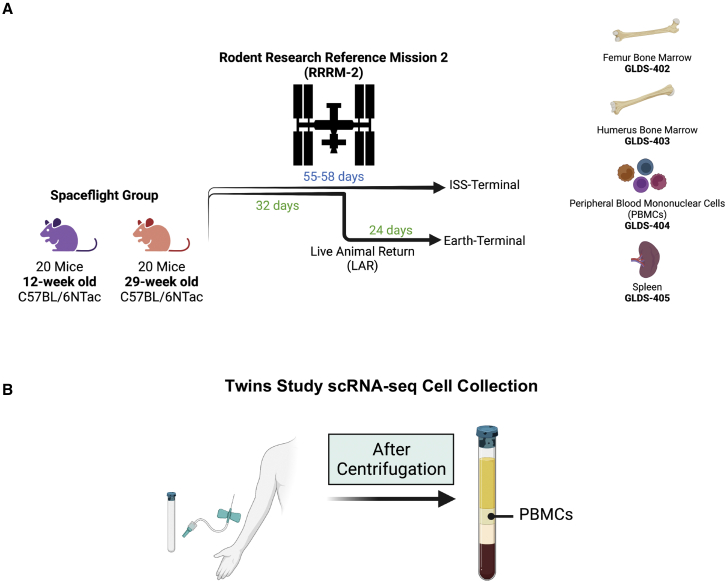
scRNA-seq datasets from spaceflight samples (A) Design for the rodent research reference mission 2 (RRRM-2) experiment. In RRRM-2, two age groups of mice were launched to the ISS. After 32 days, half of the mice from each age group returned to Earth, where they lived 24 additional days before dissection. This was time-matched with the remaining groups of mice in orbit, which were euthanized and frozen in-flight. Sixteen mice total were selected for scRNA-seq using the 10X Genomics platform. Four cell/tissue types were selected for scRNA-seq, and they each have an associated GeneLab Dataset (GLDS) publicly available: femur bone marrow (GLDS-402), humerus bone marrow (GLDS-403), PBMCs (GLDS-404), and spleen tissue (GLDS-405). (B) PBMCs from human blood were obtained before and after spaceflight on the ISS as part of the NASA Twins Study. Whole blood was obtained using venipuncture into a sodium citrate cell processing tube (CPT) and PBMCs were obtained from the buffy coat after centrifugation of the CPT.
Figure 2
Figure 2
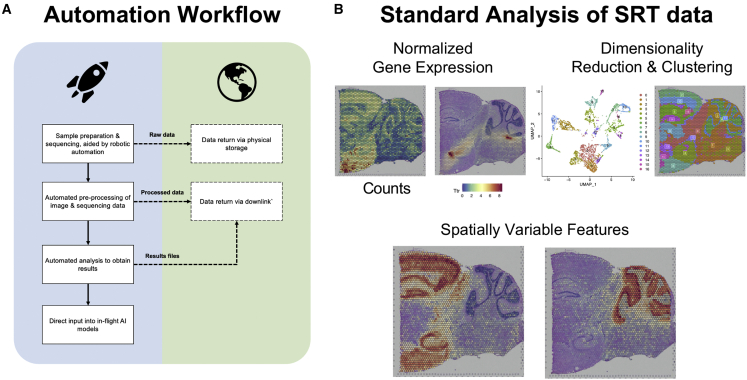
Computational analysis of spatial transcriptomics data (A) Shows the flow of data that could be unlocked with increased computational automation. The right column shows sequential steps of proposed computational automation onboard spacecraft, with the dotted lines to boxes on the left showing opportunities to transfer data back to Earth. (B) Example of data analysis workflow from the 10X Genomics Visium on the “Mouse Brain Serial Section 2 (Sagittal-Posterior)” dataset available through the 10X Genomics Dataset portal (https://www.10xgenomics.com/resources/datasets). Dataset analyzed with Seurat.

References

    1. Hasin Y., Seldin M., Lusis A. Multi-omics approaches to disease. Genome Biol. 2017;18:83. doi: 10.1186/s13059-017-1215-1. - DOI - PMC - PubMed
    1. Manzoni C., Kia D.A., Vandrovcova J., Hardy J., Wood N.W., Lewis P.A., Ferrari R. Genome, transcriptome and proteome: the rise of omics data and their integration in biomedical sciences. Brief. Bioinform. 2018;19:286–302. doi: 10.1093/bib/bbw114. - DOI - PMC - PubMed
    1. Mathé E., Hays J., Stover D., Chen J. The omics revolution continues: the Maturation of high-throughput biological data sources. Yearb. Med. Inform. 2018;27:211–222. doi: 10.1055/s-0038-1667085. - DOI - PMC - PubMed
    1. Lu M., Zhan X. The crucial role of multiomic approach in cancer research and clinically relevant outcomes. EPMA J. 2018;9:77–102. doi: 10.1007/s13167-018-0128-8. - DOI - PMC - PubMed
    1. Vlaanderen J., Moore L.E., Smith M.T., Lan Q., Zhang L., Skibola C.F., Rothman N., Vermeulen R. Application of OMICS technologies in occupational and environmental health research; current status and projections. Occup. Environ. Med. 2010;67:136–143. doi: 10.1136/oem.2008.042788. - DOI - PMC - PubMed

Publication types

MeSH terms

LinkOut - more resources