


The prognostic impact of lymph node dissection for clinically node-negative upper urinary tract urothelial carcinoma in patients who are treated with radical nephroureterectomy
- PMID: 36454803
- PMCID: PMC9714942
- DOI: 10.1371/journal.pone.0278038
The prognostic impact of lymph node dissection for clinically node-negative upper urinary tract urothelial carcinoma in patients who are treated with radical nephroureterectomy
Abstract
Background: To evaluate the prognostic impact of lymph node dissection (LND) in patients who underwent radical nephroureterectomy (RNU) with bladder cuff excision (BCE) for clinically node-negative (cN0) upper urinary tract urothelial carcinoma (UTUC).
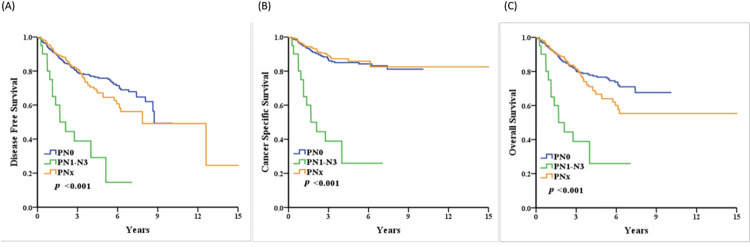
Methods: We retrospectively enrolled 520 patients with cN0 UTUC in a single tertiary referral center from 2000 to 2015. The patients were divided into three groups: patients with and without pathologically proved lymph node metastasis (pN1-3 and pN0, respectively) and patients without LND (pNx). We analyzed associations between overall survival (OS)/ disease-free survival (DFS)/ cancer-specific survival (CSS) and clinical characteristics.
Results: The patients were divided into three groups (pN1-3, pN0 and pNx with 20, 303, and 197 patients, respectively). OS/DFS/CSS in the pN1-3 group were significantly worse (all p<0.001) compared with the pN0 group. However, there were no significant differences between the pNx and pN0 groups. In the multivariate analyses, CSS was only affected by age [(hazard ratio (HR) = 1.03, p = 0.008]), positive surgical margin (HR = 3.38, p<0.001) and pathological T3-4 stages (HR = 4.07, p<0.001). In the subgroup analyses for patients with LND, locally advanced disease (pT3 and pT4) had significantly more metastases [T3-4: 13.91% (16/115) vs. T0-2: 1.92% (4/208), p<0.001].
Conclusions: In the pN0 group, LND for cN0 UTUC did not show therapeutic benefits in terms of DFS, CSS, and OS. However, LND with RNU allowed optimal tumor staging, through patients still had a poor prognosis. Clinically occult LN metastases were found in 6.2% of our patients.
Copyright: © 2022 Hsieh et al. This is an open access article distributed under the terms of the Creative Commons Attribution License, which permits unrestricted use, distribution, and reproduction in any medium, provided the original author and source are credited.
Conflict of interest statement
The authors have declared that no competing interests exist.
Figures
References
-
- Cosentino M, Palou J, Gaya JM, Breda A, Rodriguez-Faba O, Villavicencio-Mavrich H. Upper urinary tract urothelial cell carcinoma: location as a predictive factor for concomitant bladder carcinoma. World journal of urology. 2013;31(1):141–5. Epub 2012/05/04. doi: 10.1007/s00345-012-0877-2 . - DOI - PubMed
MeSH terms
LinkOut - more resources
Full Text Sources
Medical
Miscellaneous
