


Mediation of the association between stigma and HIV status and fertility intention by fertility desire among heterosexual couples living with HIV in Kunming, China
- PMID: 36454983
- PMCID: PMC9714893
- DOI: 10.1371/journal.pone.0278244
Mediation of the association between stigma and HIV status and fertility intention by fertility desire among heterosexual couples living with HIV in Kunming, China
Abstract
Objectives: This study aimed to assess the influences of stigma and HIV status on reproductive intention among heterosexual couples living with HIV in China.
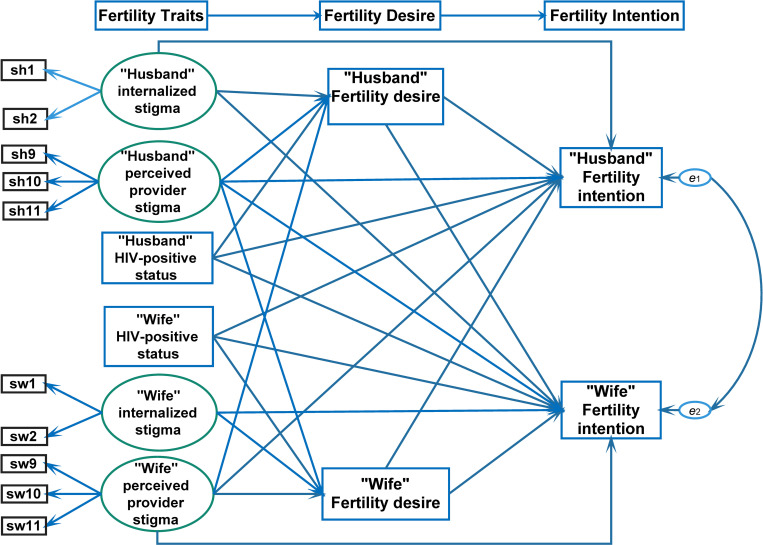
Methods: A cross-sectional study was conducted in Kunming, China among 315 HIV-positive individuals and their spouses (n = 315 couples). An interview questionnaire was used to collect data on intention, desire, HIV Stigma Scale items, and HIV status. Dyadic fertility intention was examined using the actor-partner interdependence mediation model, based on the Traits-Desires-Intentions-Behavior framework.
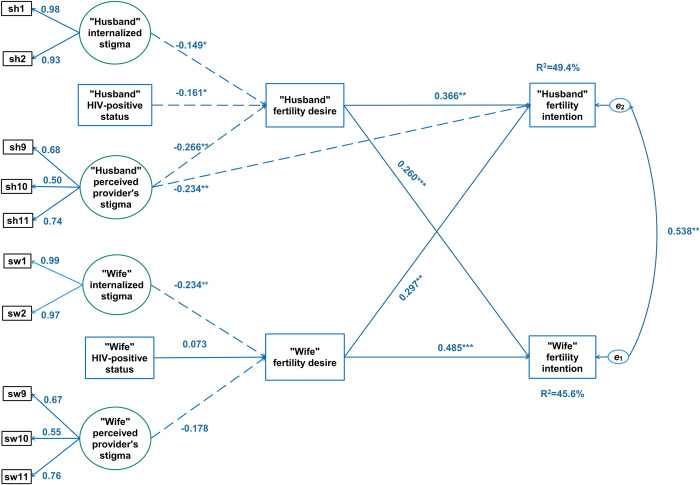
Results: The husbands' or wives' internalized stigma had significant negative effects on their own fertility desire (β = -0.149, p<0.05 and β = -0.238, p<0.01, respectively). HIV-positive status of the husbands was weakly linked to their own fertility intention (β = -0.181, p<0.05). Husbands' perceived provider stigma was associated with their own and their wives' fertility intention via the mediating effect of their fertility desire (β = -0.374, p<0.001 and β = -0.203, p<0.01, respectively). The cumulative influence of their reproductive desire mediated the husband's perceived provider stigma and the wife's internalized stigma on their fertility intention.
Conclusions: Stigma and HIV status were associated with fertility intention among couples living with HIV, mediated by fertility desire. The high intra-couple correlation suggested that counseling should be conducted when both spouses are present together with extensive discussions on concerns regarding HIV-related stigma, potential discrepancies between each partner's fertility desire and intention, and the influence of one partner on the other.
Copyright: © 2022 Guo et al. This is an open access article distributed under the terms of the Creative Commons Attribution License, which permits unrestricted use, distribution, and reproduction in any medium, provided the original author and source are credited.
Conflict of interest statement
The authors declare no conflict of interest.
Figures
References
-
- Reed RG, Butler EA. Dyadic Models for the Study of Health. Soc Personal Psychol Compass. 2013;7: 228–245. doi: 10.1111/spc3.12022 - DOI
-
- Cook WL, Kenny DA. The Actor–Partner Interdependence Model: A model of bidirectional effects in developmental studies. Int J Behav Dev. 2005;29: 101–109. doi: 10.1080/01650250444000405 - DOI
-
- Chen Z, Hou L. An Actor-Partner Interdependence Model of Work Challenge Stressors and Work-Family Outcomes: the Moderating Roles of Dual-Career Couples’ Stress Mindsets. J Bus Psychol. 2021;36: 1109–1123. doi: 10.1007/s10869-020-09724-1 - DOI
Publication types
MeSH terms
LinkOut - more resources
Full Text Sources
Medical
