


Adherence to the Atrial Fibrillation Better Care (ABC) pathway and the risk of major outcomes in patients with atrial fibrillation: A post-hoc analysis from the prospective GLORIA-AF Registry
- PMID: 36457650
- PMCID: PMC9706520
- DOI: 10.1016/j.eclinm.2022.101757
Adherence to the Atrial Fibrillation Better Care (ABC) pathway and the risk of major outcomes in patients with atrial fibrillation: A post-hoc analysis from the prospective GLORIA-AF Registry
Abstract
Background: The 'Atrial fibrillation Better Care' (ABC) pathway has been proposed to streamline a more holistic or integrated care approach to atrial fibrillation (AF) management. We aimed to analyse the impact of adherence to the ABC pathway on the risk of major adverse outcomes in a contemporary prospective global cohort of patients with AF.
Methods: Patients enrolled Phase II and III of the GLORIA-AF Registry with complete data on ABC pathway adherence and follow-up were included in this post-hoc analysis between November 2011 and December 2014 for Phase II, and between January 2014 and December 2016 for Phase III. The primary outcome was the composite of all-cause death and major adverse cardiovascular events (MACEs). Multivariable Cox-regression and delay of event (DoE) analyses were used to evaluate the association between adherence to the ABC pathway and the risk of outcomes.
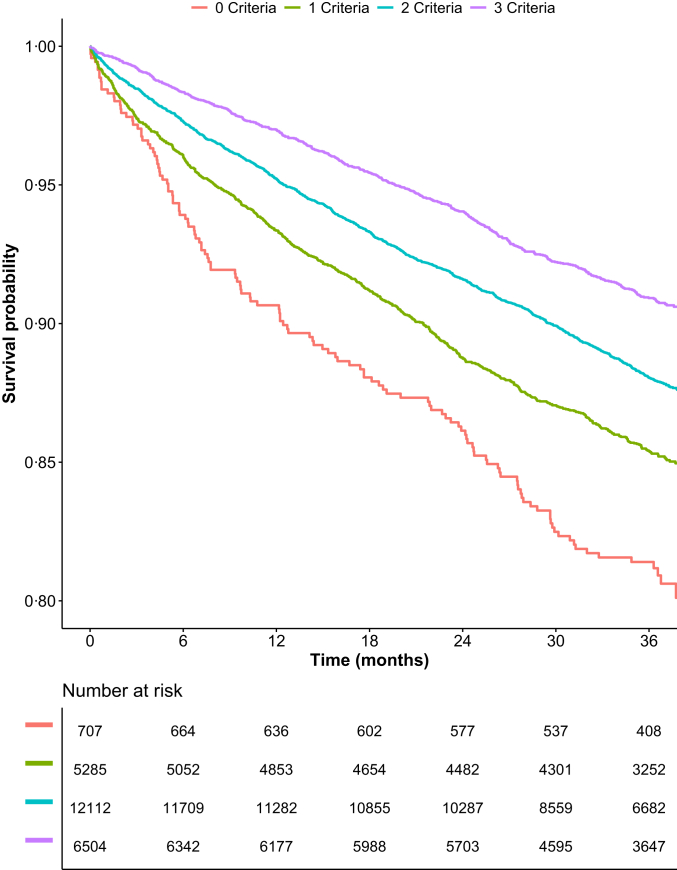
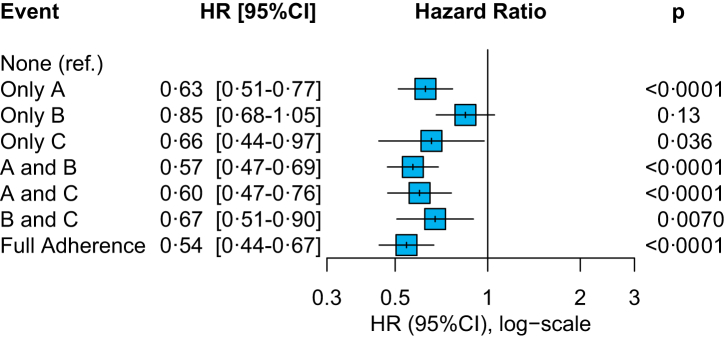
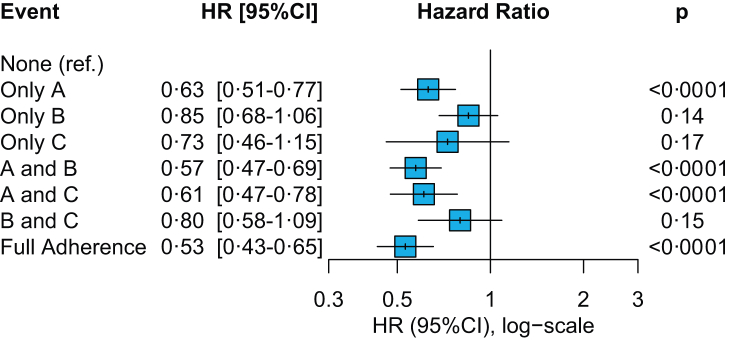
Findings: We included 24,608 patients in this analysis (mean age: 70.2 (10.3) years, 10,938 (44.4%) females). Adherence to the ABC pathway was associated with a significant risk reduction for the primary outcome, with greatest magnitude observed for full ABC pathway adherence (adjusted Hazard Ratio [aHR] 0.54, 95% Confidence Interval [CI]: 0.44-0.67, p < 0.0001). ABC pathway adherence was also associated with reduced risk of mortality (aHR: 0.89, 95% CI: 0.79-1.00, p = 0.048), thromboembolism (aHR: 0.78, 95% CI: 0.65-0.94, p = 0.0078), and MACE (aHR: 0.82, 95% CI: 0.71-0.95, p = 0.0071). An increasing number of ABC criteria attained was associated with longer event-free survival in the DoE analysis.
Interpretation: Adherence to the ABC pathway in patients with AF was associated with a reduced risk of major adverse events, including mortality, thromboembolism and MACE. This underlines the importance of using the ABC pathway in the clinical care of patients with AF.
Funding: This study was funded by Boehringer Ingelheim.
Keywords: Atrial fibrillation; Integrated care; Outcomes.
© 2022 The Author(s).
Conflict of interest statement
G.Y.H.L. has been consultant and speaker for BMS/Pfizer, Boehringer Ingelheim and Daiichi-Sankyo. No fees are directly received personally. All the disclosures happened outside the submitted work. G.B. received small speaker's fees from Medtronic, Boston, Boehringer Ingelheim and Bayer. M.V.H. has been receiving research grants from the Dutch Healthcare Fund, Dutch Heart Foundation, BMS-Pfizer, Bayer Healthcare and Boehringer Ingelheim and consulting fees from BMS-Pfizer, Bayer Healthcare and Boehringer Ingelheim. All other authors have nothing to declare.
Figures
References
-
- Chiang C.E., Wang K.L., Lip G.Y.H. Stroke prevention in atrial fibrillation: an Asian perspective. Thromb Haemost. 2014;111:789–797. - PubMed
-
- Burdett P., Lip G.Y.H. Atrial fibrillation in the UK: predicting costs of an emerging epidemic recognizing and forecasting the cost drivers of atrial fibrillation-related costs. Eur Heart J Qual Care Clin Outcomes. 2020;8:187–194. - PubMed
