


The regulatory role of endoplasmic reticulum chaperone proteins in neurodevelopment
- PMID: 36458041
- PMCID: PMC9705995
- DOI: 10.3389/fnins.2022.1032607
The regulatory role of endoplasmic reticulum chaperone proteins in neurodevelopment
Abstract
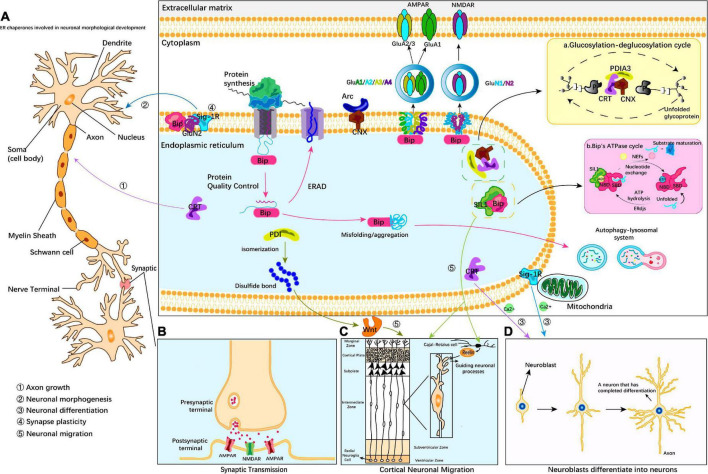
The endoplasmic reticulum (ER) is the largest tubular reticular organelle spanning the cell. As the main site of protein synthesis, Ca2+ homeostasis maintenance and lipid metabolism, the ER plays a variety of essential roles in eukaryotic cells, with ER molecular chaperones participate in all these processes. In recent years, it has been reported that the abnormal expression of ER chaperones often leads to a variety of neurodevelopmental disorders (NDDs), including abnormal neuronal migration, neuronal morphogenesis, and synaptic function. Neuronal development is a complex and precisely regulated process. Currently, the mechanism by which neural development is regulated at the ER level remains under investigation. Therefore, in this work, we reviewed the recent advances in the roles of ER chaperones in neural development and developmental disorders caused by the deficiency of these molecular chaperones.
Keywords: endoplasmic reticulum; molecular chaperone; neurodevelopment; neuronal migration; neuronal morphogenesis; synaptic function.
Copyright © 2022 Sun, Wu, Wang, Zhang and Zhu.
Conflict of interest statement
The authors declare that the research was conducted in the absence of any commercial or financial relationships that could be construed as a potential conflict of interest.
Figures
References
Publication types
LinkOut - more resources
Full Text Sources
Research Materials
Miscellaneous
