


Neutrophil-albumin ratio as a biomarker for postoperative complications and long-term prognosis in patients with colorectal cancer undergoing surgical treatment
- PMID: 36458178
- PMCID: PMC9705583
- DOI: 10.3389/fnut.2022.976216
Neutrophil-albumin ratio as a biomarker for postoperative complications and long-term prognosis in patients with colorectal cancer undergoing surgical treatment
Abstract
Background: To explore the prognostic value of the preoperative neutrophil-albumin ratio (NAR) in patients with colorectal cancer (CRC) undergoing surgical treatment.
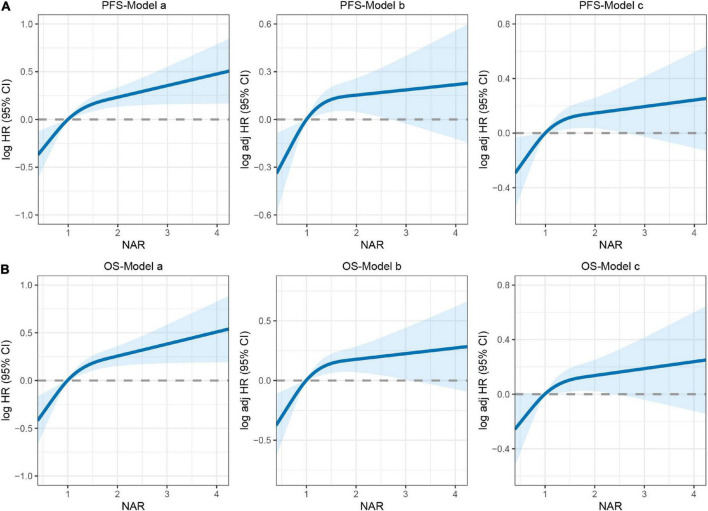
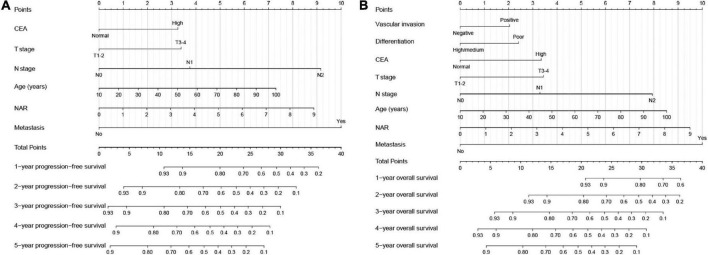
Materials and methods: The standardized log-rank statistic was used to determine the optimal cut-off value for NAR. A logistic regression model was used to evaluate the value of NAR in predicting postoperative complications. Cox proportional hazards models were used to assess the independent association of NAR with progression-free survival (PFS) and overall survival (OS) in CRC patients. Restricted cubic splines were used to assess the relationship between continuous NAR and survival in CRC patients. The Kaplan-Meier method and log-rank test were used to compare survival differences between low and high NAR groups. NAR-based prognostic nomograms were constructed to predict the 1-5-year PFS and OS of CRC patients. The concordance index (C-index) and calibration curve were used to evaluate the prognostic accuracy of the nomograms.
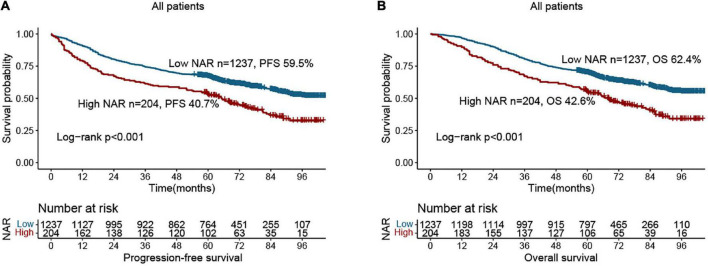
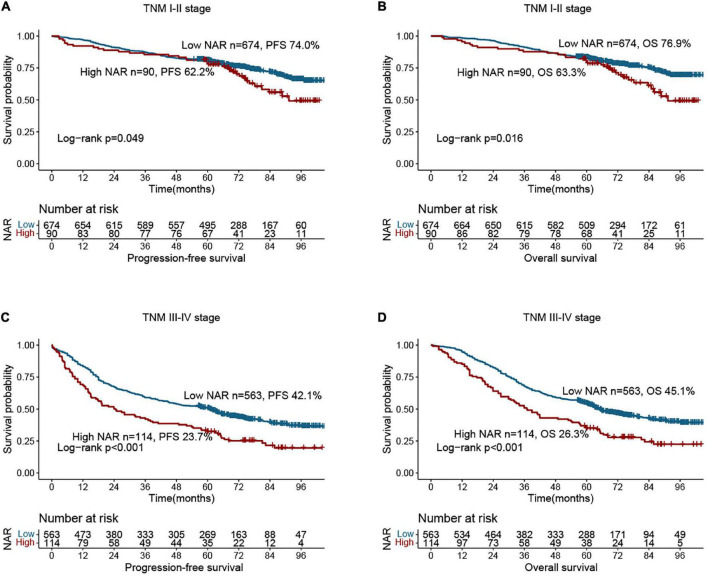
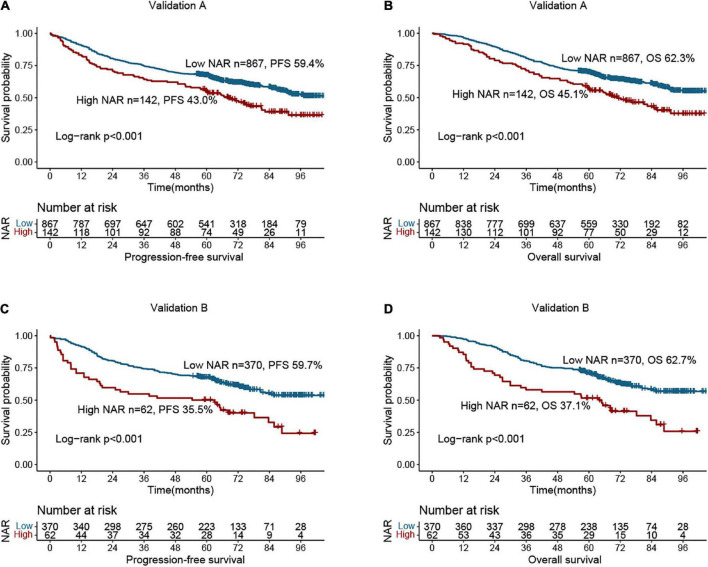
Results: A total of 1,441 CRC patients were enrolled from January 2012 to December 2016. There were 904 men (62.7%) and 537 women (37.3%), with an average age of 58.12 ± 13.15 years. High NAR was closely associated with low BMI, advanced pathological stage, colon cancer, large tumors, vascular invasion, poor differentiation, high CEA levels, long hospital stay, and recurrence and metastasis. A high NAR was an independent risk factor for postoperative complications in CRC patients (OR: 2.298, 95% CI: 1.642-3.216, p < 0.001). Patients with a high NAR had worse PFS (40.7 vs. 59.5%, p < 0.001) and OS (42.6 vs. 62.4%, p < 0.001). After adjusting for confounders, high NAR was independently associated with PFS (HR: 1.280, 95% CI: 1.031-1.589, p = 0.025) and OS (HR: 1.280; 95% CI: 1.026-1.596, p = 0.029) in CRC patients. The C-index and calibration curves showed that the NAR-based prognostic nomograms had good predictive accuracy.
Conclusion: High NAR was an independent risk factor for postoperative complications and long-term prognosis of CRC patients. NAR-based research could provide references for prognostic judgment and clinical decision-making of CRC patients.
Keywords: colorectal cancer; complication; neutrophil-albumin ratio; nutrition; prognosis; systemic inflammation.
Copyright © 2022 Xie, Wei, Liu, Liang, Yuan, Gao, Wang, Lin, Tang and Gan.
Conflict of interest statement
The authors declare that the research was conducted in the absence of any commercial or financial relationships that could be construed as a potential conflict of interest.
Figures
References
-
- Sung H, Ferlay J, Siegel RL, Laversanne M, Soerjomataram I, Jemal A, et al. Global cancer statistics 2020: GLOBOCAN estimates of incidence and mortality worldwide for 36 cancers in 185 countries. CA Cancer J Clin. (2021) 71:209–49. - PubMed
-
- Jia W, Yuan L, Ni H, Xu B, Zhao P. Prognostic value of platelet-to-lymphocyte ratio, neutrophil-to-lymphocyte ratio, and lymphocyte-to-white blood cell ratio in colorectal cancer patients who received neoadjuvant chemotherapy. Technol Cancer Res Treat. (2021) 20:15330338211034291. 10.1177/15330338211034291 - DOI - PMC - PubMed
LinkOut - more resources
Full Text Sources
